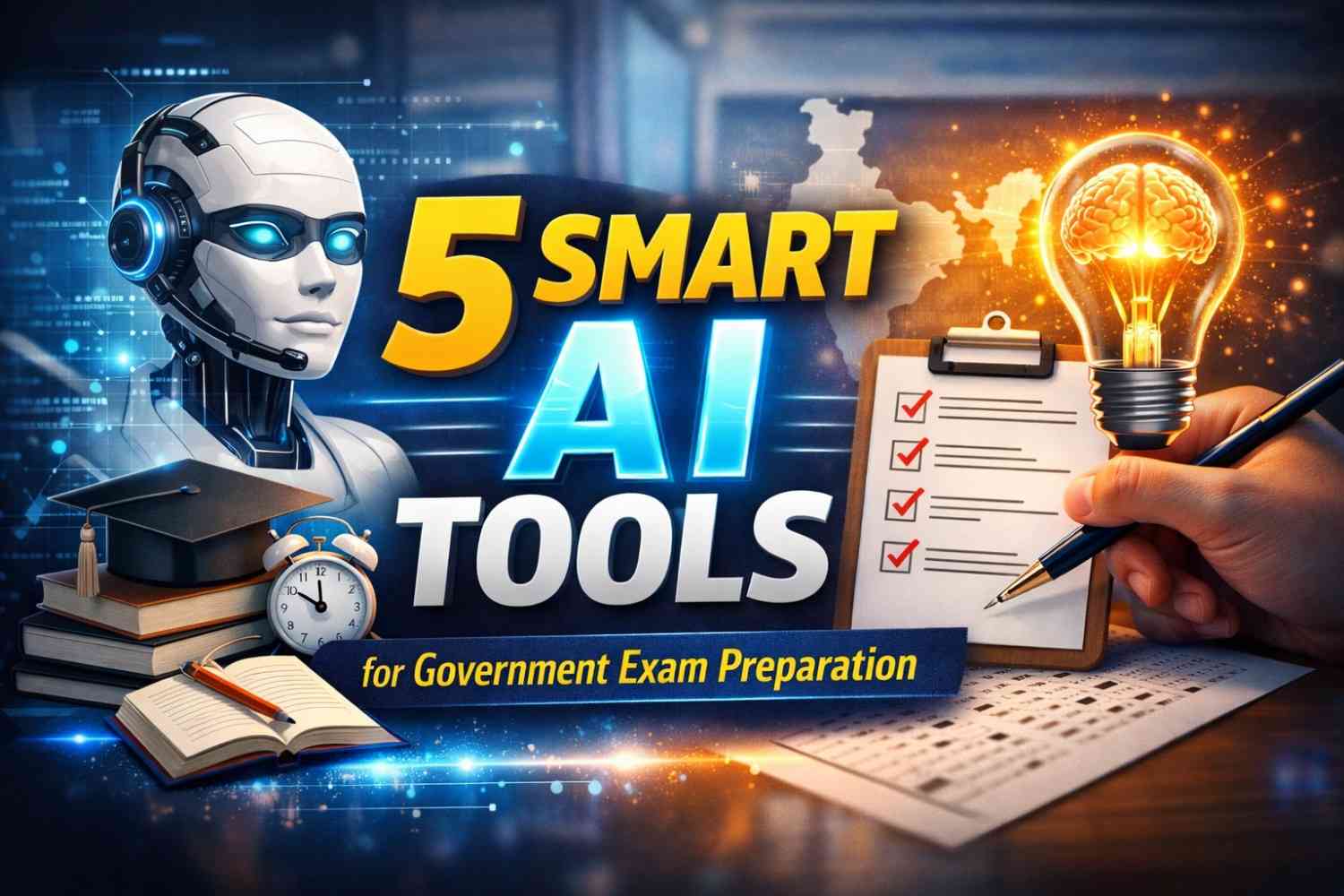
Preparing for competitive public service tests is tough, but the arrival of AI has opened new pathways to study smarter. In this post I will outline five smart solutions and approaches that leverage AI tools for government exam preparation to streamline revision, generate practice questions, simulate interviews and personalize weak-area focus. Whether you are starting months ahead or polishing last-minute topics, these AI tools for government exam preparation can help you prioritize time and improve recall.
Table of Contents
5 Smart AI Tools for Government Exam Preparation — an overview
Not all learning tools labeled “AI” are equally helpful for state and national level tests. The five smart AI tools for government exam preparation listed below are chosen for their ability to: create targeted practice items, summarize large syllabi, adapt to a learner’s pace, and give actionable feedback. Use them together to cover content review, question practice, time management and answer writing.
ChatGPT — an adaptable conversational tutor
ChatGPT is a large language model you can use as a study partner to explain concepts, generate practice questions, and draft concise answers for essay-style government exam questions. When you ask targeted prompts, ChatGPT can produce past-paper style questions, suggest step-by-step solutions for quantitative problems, and provide model answers for general studies papers.
How to use it effectively:
– Ask for multiple-choice mocks on a specific topic with difficulty tags.
– Request stepwise explanations, not just final answers, to strengthen conceptual clarity.
– Use ChatGPT to simulate an interview or personality test by roleplaying a panel.
Remember to verify factual content and current affairs facts from official sources when using ChatGPT for government exam preparation.
Quizlet Learn & Quizlet AI — fast flashcards and test modes
Quizlet’s Learn mode combines spaced repetition with algorithmic prioritization. For factual-heavy government exam sections, well-crafted flashcard sets accelerate memorization. Quizlet’s AI features can suggest new cards from uploaded notes and test you in a variety of modes, improving retention of dates, terms, and definitions.
Best practices:
– Build subject-specific decks (History, Polity, Economy) and separate static facts from conceptual cards.
– Use the “test” and “write” modes to train recall under time pressure.
Anki with AI-generated cards — spaced repetition that adapts
Anki remains one of the most powerful spaced repetition systems for long-term retention. Pair it with AI tools that convert lecture notes and PDFs into high-quality question/answer cards. This combination eases the heavy lifting of card creation while preserving Anki’s scientifically backed review schedule for government exam preparation.
Tips:
– Keep cards simple: one fact per card, clear questions and answers.
– Use AI to generate initial cards, then edit to match the exact exam focus.
Perplexity.ai / Elicit — fast summarization and targeted research
For current affairs and complex policy topics, tools like Perplexity.ai or Elicit help you find concise summaries, sources, and comparisons. When preparing for papers that require analysis of government schemes, public policy, or technology in governance, use these tools to distill long reports into exam-ready notes.
How to incorporate them:
– Summarize government reports into bullet points for quick revision.
– Cross-check claims with official documents and reputable news sources.
Khanmigo and adaptive learning platforms — guided practice and feedback
Khanmigo and other adaptive platforms offer personalized hints, scaffolded explanations, and practice sequences that respond to learner performance. These platforms are particularly useful for candidates who need structured daily routines or want to build conceptual mastery in mathematics and reasoning sections for government exams.
To get the most from adaptive platforms:
– Follow the recommended study path but revisit weak topics more frequently.
– Use platform analytics to identify and close knowledge gaps.
How AI tools for government exam preparation improve study efficiency
AI tools for government exam preparation accelerate learning in several measurable ways. They automate repetitive tasks like flashcard creation and mock test generation, freeing candidates to focus on understanding. They also surface patterns: common mistakes, recurring question formats, and timing issues in practice tests. When combined, these insights reduce wasted study hours and increase focused practice.
Practical gains include:
– Faster syllabus coverage through AI-assisted summarization.
– Higher retention via spaced repetition reinforced by AI-created flashcards.
– More realistic practice under timed conditions using AI-generated mocks.
Government aspirants can also adopt AI agents that craft personalized study schedules. If you’d like to explore AI agents in more depth, check out this guide on AI agents for personalized exam learning which explains how automated tutors can replace ad-hoc study plans with consistent, measurable routines.
How to combine these AI tools into a practical study plan
A balanced plan mixes content creation, repetitive practice, and review. Here’s a recommended weekly routine that makes the most of the AI tools for government exam preparation described above.
Weekly routine
Day 1 — Content mapping and summarization:
– Use Perplexity.ai or Elicit to summarize syllabus topics and current affairs.
– Convert summaries into crisp notes and import key facts into Quizlet or Anki.
Day 2 — Question generation and practice:
– Use ChatGPT to generate a 30-question mock focusing on the week’s topics.
– Time the mock and review mistakes immediately, adding missed facts to flashcards.
Day 3 — Spaced repetition:
– Rely on Anki or Quizlet Learn to revisit high-priority cards identified by the AI.
Day 4 — Deeper understanding:
– Use Khanmigo or similar platforms for guided problem-solving in weak areas.
Day 5 — Timed full-length mock:
– Combine AI-generated MCQs and past-paper questions, simulate exam timing, and analyze results.
Day 6 — Interview and answer-writing practice:
– Roleplay with ChatGPT for personality and interview rounds, and draft essays using AI to refine structure.
Day 7 — Rest, light revision and planning:
– Review analytics from platforms to refine next week’s focus.
Safety, accuracy and verification when using AI tools for government exam preparation
AI tools are powerful, but they can make errors or produce dated information. For high-stakes government exam preparation, always cross-verify facts and policy dates with primary sources. When using AI to summarize government schemes, consult official portals and documents directly. For India-focused policy and initiatives, you can review the Ministry of Electronics & IT resources such as AI in Indian education initiatives to validate claims and stay aligned with official language.
Additionally, it helps to monitor global trends in how AI is used in education; resources that track adoption and ethical guidelines, like the World Economic Forum coverage on AI, can be informative for designing responsible study strategies: global AI adoption in education.
Choosing the right combination of AI tools for government exam preparation
Not every candidate needs every AI tool. Choose based on your weakest links:
If factual recall is weak
Lean on Anki and Quizlet with AI-assisted card generation. The repetition systems in these platforms are tailored for long-term memorization, ideal for static syllabus material in government exams.
If conceptual clarity is weak
Use ChatGPT and adaptive tutors to break down complex topics into manageable steps. Ask for analogies, step-by-step solutions, and multiple examples until the idea clicks.
If current affairs and policy analysis are needed
Summarization tools like Perplexity.ai and curated research on platforms that aggregate reports will save you hours. Always back up summaries with official releases and authoritative analysis.
If time management and exam simulation are priorities
Use AI to generate timed mock tests and track pacing across sections. Simulate the exam environment regularly to reduce anxiety and improve speed.
For a beginner-friendly walkthrough on how AI can be integrated into a study plan, you may find the practical tips on AI tools for exam preparation helpful; they outline step-by-step implementation for learners new to AI-assisted study.
Final tips and common pitfalls to avoid
Common mistakes include over-reliance on AI for facts without verification, using poorly designed flashcards that confuse rather than clarify, and ignoring exam-specific formats. Use AI to augment disciplined study habits, not replace them. Track progress with measurable metrics — accuracy on mocks, topic-wise error rates, and time per question — and let the data guide which AI tools receive most of your attention.
Finally, remember that these AI tools for government exam preparation are most effective when used consistently and critically. Treat AI output as a starting point: refine, verify, and practice until the answers become second nature.
Conclusion: Combining a conversational tutor like ChatGPT, spaced repetition tools like Anki and Quizlet, summarization assistants such as Perplexity.ai, and adaptive platforms can create a highly efficient, personalized prep ecosystem. When you deliberately integrate these AI tools for government exam preparation with verification from official sources and focused practice, your study time becomes more productive and outcome-oriented. Good luck with your preparation.



Leave a Reply