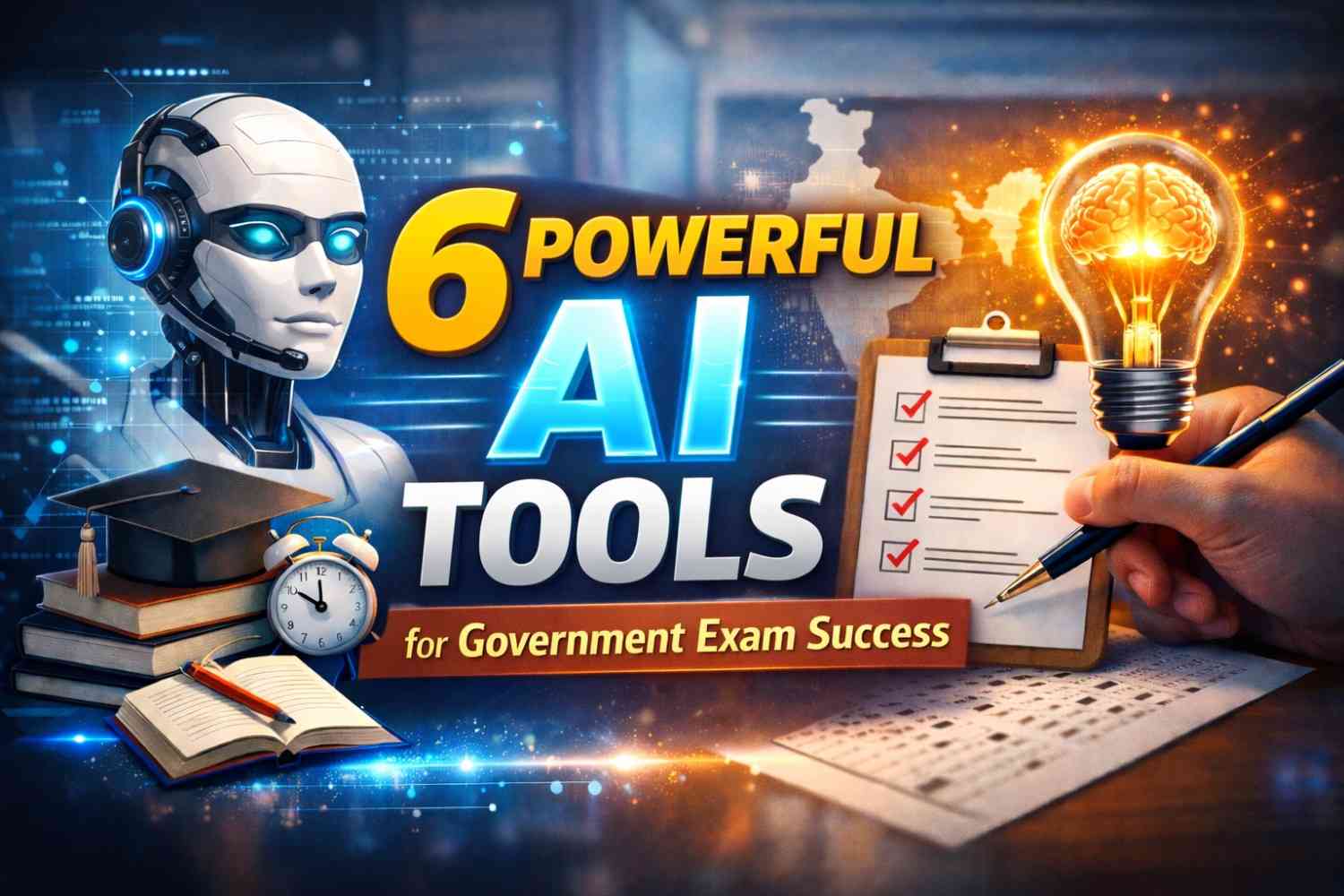
Preparing for competitive government exams is a marathon of content, practice, and strategy, and modern aspirants increasingly rely on AI tools for government exam success to gain an edge. These smart assistants speed up revision, personalize practice, and help manage time — all crucial for high-stakes exams. In this post I’ll walk you through six powerful AI tools for government exam success, how to use them effectively, and practical tips to build a reproducible study plan that fits any syllabus.
Table of Contents
6 Powerful AI tools for government exam success
Below are six AI-driven platforms and utilities that consistently help candidates improve accuracy, retention, and exam readiness. Each tool is paired with a short guide on how to integrate it into daily study routines and common use cases for aspirants preparing for government roles.
1. ChatGPT (OpenAI) — flexible tutor and question generator
ChatGPT is widely used by candidates because it can explain concepts, generate custom quizzes, and simulate interview or viva questions. Use ChatGPT to break complex topics into step-by-step explanations, generate practice questions in specific formats (MCQs, short answer, essay prompts), and create mnemonics for rapid recall. When you ask ChatGPT to produce past-paper style questions and timed mock tests, you’re leveraging one of the most accessible AI tools for government exam success.
2. Google Bard — quick fact-checks and context-aware summaries
Google Bard excels at summarizing long documents and verifying factual timelines, which is useful for current affairs and general studies sections. Ask Bard to condense government reports, explain policy changes, or create short revision notes. Integrating Bard into your weekly review ensures you capture the latest developments succinctly — a practical way to use AI tools for government exam success when time is limited.
3. Notion AI — organize notes and build adaptive study systems
Notion AI helps students build structured revision databases: concept pages, spaced-repetition schedules, and integrated calendars. Use Notion AI to turn raw notes into flashcards, set reminders for weak topics, and produce compact cheat-sheets for last-minute review. When combined with other practice platforms, Notion AI becomes a central hub for AI tools for government exam success that keeps everything in one searchable place.
4. Quizlet + AI-powered study modes — active recall and spaced repetition
Quizlet’s AI enhancements create smarter practice sets and estimate retention probabilities, helping you focus on items most likely to be forgotten. Use Quizlet’s Learn and Test modes to simulate exam conditions and track error patterns. As a part of a broader toolkit, Quizlet represents a category of AI tools for government exam success centered on memory science and adaptive practice.
5. Otter.ai / ELSA Speak — listening, dictation, and verbal practice
For interviews, language sections, or oral tests, tools like Otter.ai and ELSA Speak refine pronunciation and produce accurate transcripts of mock interviews. Record practice answers, transcribe them with Otter.ai, and analyze filler words or unclear phrasing. Combined with AI feedback, these platforms are practical AI tools for government exam success that target speaking and listening skills often overlooked in self-study.
6. Adaptive learning platforms (example: AI-driven coaching apps)
Several adaptive learning apps combine analytics, syllabus mapping, and personalized test series to pinpoint weak areas and suggest targeted practice. These platforms automatically adjust difficulty and frequency of topics based on performance, making them among the most efficient AI tools for government exam success for long-term progress tracking and smart scheduling.
How AI tools for government exam success transform study planning
AI tools for government exam success are not just flashy aides — they change how study plans are constructed and executed. Here’s how to translate that transformation into a practical, time-bound routine:
- Personalized syllabus mapping: Use AI to analyze your syllabus and create topic-by-topic timelines, prioritizing high-weight areas.
- Smart revision cycles: Configure AI-generated spaced-repetition schedules so difficult items recur more often.
- Performance analytics: Regularly review AI dashboards to identify trends (error types, time per question, topic-wise accuracy).
- Adaptive mocks: Let AI adjust mock difficulty based on your current level to avoid plateauing and to build confidence gradually.
Integrating these capabilities is a hallmark of modern preparation; candidates who combine human judgment with AI insights find steady improvements faster than those who rely solely on static timetables. For more context on how artificial intelligence is shaping education strategy, see AI-driven education India and global discussions about AI impact on exam preparation.
Choosing the right AI tool for your exam needs
Select tools that match the exam format and your personal weaknesses. Consider the following approach:
- Begin with a diagnostic test (human-scored or AI-generated) to identify top three weak areas.
- Pick a primary daily tool for content creation and explanation (e.g., ChatGPT or Bard) and a secondary tool for practice (e.g., Quizlet or adaptive platforms).
- Use an organizational AI (Notion AI) to maintain a single source of truth: notes, test history, and error logs.
For detailed tutorials and step-by-step learning workflows using AI, check resources like AI agents for exam performance, which outline how to set up automated study workflows. If you need a quick reference on exam-focused AI tool collections, the guide on AI tools for competitive exam success is useful for mapping tools to study phases.
Implementing AI tools responsibly
While AI tools for government exam success bring many benefits, ethical and practical considerations matter:
- Verify facts: AI can hallucinate. Cross-check factual answers, especially in current affairs and policy topics.
- Maintain exam integrity: Use AI for learning and practice, not to gain unfair access to paid exam content or distribute copyrighted materials.
- Limit over-reliance: Use AI to augment practice, not replace active problem-solving and peer discussion.
- Protect privacy: Be careful with personal data and recordings when using transcription or coaching tools.
Applying these safeguards keeps AI tools for government exam success in a constructive role: improving study quality without compromising learning fundamentals.
Practical study plan using AI tools for government exam success
Here’s a simple four-week template that leverages these tools to build momentum rapidly. Replace content specifics with your syllabus topics and exam dates:
- Week 1 — Diagnostic and foundation:
- Take a full-length AI-generated diagnostic test (ChatGPT or adaptive platform).
- Use Notion AI to create a prioritized syllabus map and initial flashcards.
- Week 2 — Focused practice:
- Daily timed practice sets via Quizlet or adaptive app.
- Summarize weak topics using Bard and convert to quick revision sheets.
- Week 3 — Consolidation and simulated exams:
- Take two full-length AI-adjusted mocks; analyze errors with analytics dashboards.
- Refine answers with ChatGPT for structured responses and model essays.
- Week 4 — Final polish:
- Use spaced repetition flashcards produced by Notion AI and Quizlet for high-yield topics.
- Record oral answers and refine with Otter.ai or ELSA for interview readiness.
Following a plan like this converts AI insights into measurable gains and keeps your preparation focused and adaptive.
Final tips and common pitfalls
To make the most of AI tools for government exam success, remember:
- Be explicit in prompts: precise prompts yield better AI outputs.
- Schedule AI review sessions, not just ad-hoc queries, to maintain structure.
- Combine AI feedback with peer review or mentor checks for nuanced topics.
- Track progress numerically: record time per question, accuracy rates, and topic-wise improvement.
Used well, AI tools for government exam success shorten the feedback loop between practice and improvement, letting you iterate faster and study smarter.
In conclusion, integrating the right mix of AI tools for government exam success — from conversational tutors and summarizers to adaptive practice platforms and transcription tools — will improve retention, reduce wasted study time, and increase confidence on test day. Embrace these technologies responsibly, verify critical facts, and use analytics to keep your preparation on track for measurable results.



Leave a Reply