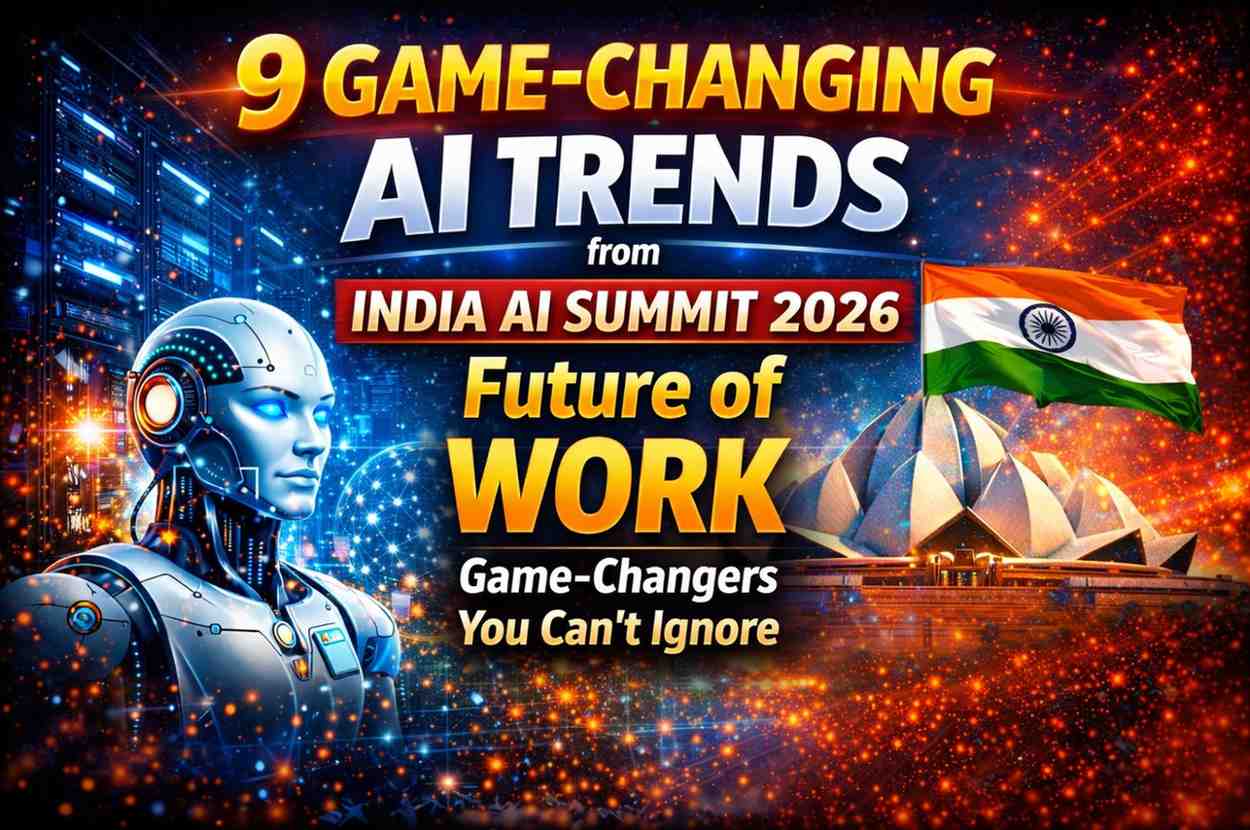
The conversations at AI Summit 2026 signaled a turning point: technologies once confined to research labs are now being woven into everyday work across industries. At the India AI Summit 2026, government leaders, start-up founders, enterprise CTOs and frontline workers shared concrete demonstrations, deployment roadmaps and human-centered design approaches that will reshape jobs, teams and the skills organizations prioritize. This post distills nine game-changing trends from AI Summit 2026 that will redefine the future of work and offers practical guidance for leaders who need to act fast and thoughtfully.
Highlights from AI Summit 2026
The AI Summit 2026 in India put collaboration between public policy, academic research and industry innovation at center stage. Sessions blended live demos, ethics panels and workforce transition case studies, and several announcements emphasized national strategy. For background on the broader policy moves discussed at the conference, see India AI policy and initiatives. Delegates also referenced global labor data and automation trends to benchmark India’s approach against international shifts in talent and regulation, which you can read about through Global AI workforce trends.
Table of Contents
Nine game-changing trends showcased at AI Summit 2026
1. AI agents move from research demos to everyday assistants
One clear message at AI Summit 2026 was that autonomous AI agents are now practical tools for knowledge work. These agents automate routine decision steps, handle triage tasks and let workers focus on judgment-driven activities. Organizations piloting agents reported faster turnaround and fewer repetitive mistakes, changing job descriptions rather than eliminating roles outright.
2. Industry-specific foundation models
Rather than one-size-fits-all models, the Summit highlighted vertical-specific foundation models tuned for healthcare, agriculture, manufacturing and finance. These models increase accuracy on domain tasks and lower the risk of dangerous hallucinations, enabling safer, industry-ready deployments that integrate with existing systems and compliance frameworks.
3. Workflows built around human-AI collaboration
Speakers at AI Summit 2026 stressed design patterns where AI augments human decision-making through real-time suggestions, explainable alternatives and confidence indicators. This trend reframes AI as a collaborator—improving job satisfaction when implemented with clear role boundaries and feedback loops.
4. Democratisation of AI tools for non-specialists
Low-code and no-code platforms were a dominant theme. Enabling domain experts to create and customize AI workflows reduces reliance on centralized data science teams and speeds innovation. For marketing and operational use cases, many teams are already using prebuilt agent templates and best practices, which you can explore in resources like Ai marketing Tricks and tips .
5. Responsible and certified AI deployments
Regulators, researchers and vendors discussed certification pathways and audit-ready development practices. At AI Summit 2026, several pilot frameworks for explainability metrics and simulation-based safety checks were presented—tools companies can adopt to reduce compliance friction and build trust with customers and employees.
6. Skills-first upskilling and modular credentials
Rather than long degree programs, the Summit emphasized modular credentials, project-based micro-credentials and employer-recognized badging to reskill workers rapidly. Employers are designing learning pathways that map to new hybrid roles—blending domain expertise with AI oversight capabilities.
7. Edge and on-device inference for real-time work
For latency-sensitive tasks—manufacturing inspection, telemedicine consultations, remote sensing—edge AI deployments were featured prominently. The practical outcome discussed at AI Summit 2026 is faster decision loops and reduced cloud costs, enabling teams to embed intelligent assistance where work actually happens.
8. Data collaboratives and secure multiparty computation
Privacy-preserving techniques gained traction as companies seek to train models without exposing raw data. The Summit showcased projects using federated learning and secure MPC to build models across institutions—opening new collaborative business models while protecting sensitive information.
9. New job archetypes: AI stewards, prompt engineers and model auditors
Rather than a single “AI job,” the Summit identified specialized roles focused on stewardship: people who curate model behavior, craft high-value prompts, conduct audits and manage governance. These roles bridge technical, ethical and operational responsibilities and are central to sustainable AI adoption.
How AI Summit 2026 Will Change Work
Collectively, the nine trends from AI Summit 2026 publish a blueprint for organizational transformation. Employers will redesign workflows to pair human judgment with algorithmic speed, invest in modular training programs to close gaps, and implement governance that matches their risk profile. The Summit repeatedly demonstrated that when organizations couple practical tooling with clear decision rights and measurement, AI becomes an enabler of productivity and better work-life balance rather than a source of disruption.
Policy, education and business responses highlighted at AI Summit 2026
Policy played a visible role in the Summit’s agenda: regulators and policymakers presented incentives for responsible adoption and funding for public data infrastructure. For ongoing reference to national initiatives and frameworks discussed at the conference, consult India AI policy and initiatives. Education leaders laid out rapid credentialing models, and businesses showcased how procurement and vendor evaluation now require traceability and audit logs. This shift elevates governance from an afterthought to a procurement criterion.
Action steps for leaders after AI Summit 2026
Leaders returning from AI Summit 2026 should act on three parallel tracks: strategy, people and operations. Practically, that means forming cross-functional AI councils, launching targeted pilots with measurable outcomes, and updating job profiles to incorporate AI stewardship. Adopt tools and templates that enable citizen developers safely—many platforms and thought partners outlined at the Summit can help, and a helpful collection of solutions for marketing and operations is available through AI tools shaping the future of work.
Short-term (0–6 months)
Run a capability audit to identify high-impact pilot projects, set guardrails for data use and appoint an AI steward for each pilot. Use rapid prototyping to test human-AI workflows and measure outcomes such as time saved, error reduction and employee satisfaction.
Medium-term (6–18 months)
Scale pilots that deliver value, roll out modular training for affected teams, and implement continuous monitoring for model drift and compliance. Integrate explainability and logging standards into procurement contracts so vendors provide audit artifacts.
Long-term (18+ months)
Institutionalize AI governance, refresh workforce plans to include new archetypes, and participate in cross-industry data collaboratives where appropriate to improve model quality without sacrificing privacy.
Preparing the workforce described at AI Summit 2026
Reskilling is not optional—AI Summit 2026 made clear that companies who invest in continuous learning will outperform peers. Practical measures include project-based micro-credentials, mentorship programs pairing technologists with domain experts, and rotational roles that expose employees to model stewardship. Public-private partnerships showcased at the Summit can accelerate talent pipelines, and employers should explore collaborations with academic institutions and certification providers mentioned during sessions.
Leaders should also watch global labor signals as they plan: analysis from international organizations and forums can help calibrate talent projections, particularly in sectors undergoing rapid automation. For a global perspective that complements the India-focused programs discussed at the Summit, consult Global AI workforce trends.
At the organizational level, championing a culture of experimentation—backed by clear risk thresholds, measurement frameworks and employee supports—turns the promise of AI into operational advantage. The practical guidance and case studies shared at AI Summit 2026 illustrate that thoughtful, incremental adoption yields resilient, innovative workplaces.
The India AI Summit 2026 left attendees with an actionable roadmap: pair technological agility with human-centered governance, prioritize modular learning, and design AI that amplifies human skills. Those who implement these nine trends thoughtfully will redefine roles and unlock new value while maintaining trust and accountability.
In short, AI Summit 2026 was less a single event than a launching pad for sustained change—one that will influence hiring, training, procurement and policy for years to come.



Leave a Reply