
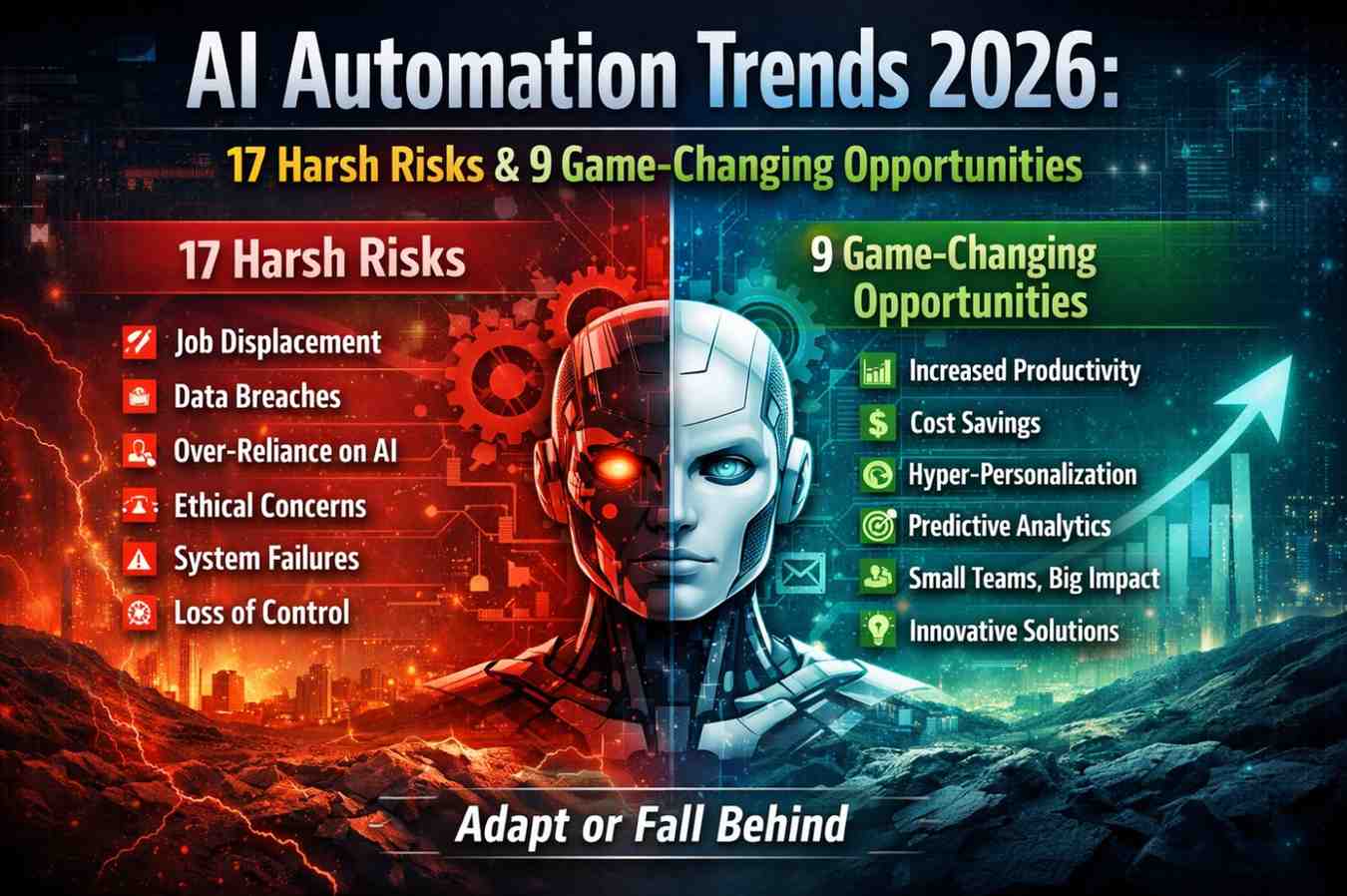
AI automation in 2026 is no longer experimental or optional. It has become a foundational layer that quietly replaces inefficiency, delays, and repetitive decision-making. While AI automation is creating massive productivity gains and new opportunities, it is also introducing serious risks that many businesses and professionals are not prepared for. Understanding AI Automation Trends is essential to avoid disruption and build long-term advantage.
Table of Contents
Introduction: Why AI Automation Trends Feel Uncomfortable
Every major technology shift follows a familiar emotional cycle.
First, it feels optional.
Then, it feels overwhelming.
Finally, it becomes unavoidable.
AI Automation Trends have now entered the final stage.
Unlike earlier technologies that added new tools, AI automation removes steps entirely. Processes that once required meetings, approvals, manual reviews, and time now happen automatically in the background. This is why AI automation feels unsettling — it exposes how much work existed only because systems were inefficient.
AI automation does not announce disruption loudly.
It simply makes certain roles, workflows, and habits unnecessary.
That quiet efficiency is what separates AI Automation Trends from previous digital shifts. The impact is not visible at first, but once noticed, it is impossible to ignore.
What Is AI Automation? (Simple Explanation)
AI automation is the use of artificial intelligence to perform tasks, make decisions, and continuously improve workflows with minimal human involvement.
Traditional automation works on fixed rules:
- If X happens, do Y.
AI automation works on probability and context:
- Given this situation, what is the best possible next action?
This ability to work under uncertainty is what makes AI automation fundamentally different — and why AI Automation Trends are reshaping entire industries rather than just speeding up tasks.
Traditional systems break when conditions change.
AI systems adapt.
Why AI Automation Trends Accelerated So Fast (2023–2026)
AI automation did not evolve slowly. It advanced rapidly because several forces aligned at the same time.
1. Advanced AI Models Became Widely Accessible
Powerful AI models, previously limited to research labs and large enterprises, became available to the public. Reasoning, summarization, prediction, and language understanding were no longer rare capabilities.
This removed the largest historical barrier to automation: technical expertise.
AI moved from infrastructure to utility.
2. No-Code and Low-Code Tools Removed Skill Barriers
AI automation no longer requires deep programming knowledge. Visual workflow builders and pre-trained models allow non-technical users to create complex automation systems.
This pushed AI Automation Trends beyond corporations into startups, agencies, and even solo professionals.
3. Economic Pressure Forced Efficiency
Rising costs, global competition, and tighter margins forced organizations to rethink productivity. Hiring more people became less viable than building smarter systems.
AI automation shifted from experimentation to necessity.
McKinsey – The economic potential of generative AI
A deep analysis of how AI, including automation, impacts productivity, industries, and economic growth.
The First 5 Game-Changing Opportunities in AI Automation Trends
1. AI Agents Are Replacing Entire Workflows
Modern AI agents can:
- Collect information
- Analyze options
- Execute actions
- Generate reports
What once required multiple roles and handoffs can now be handled by a single coordinated system. The real opportunity is not using agents, but designing how they interact and make decisions together.
2. Hyper-Personalization at Scale
One of the most visible AI Automation Trends is real-time personalization. Content, marketing messages, and user experiences now adapt automatically based on behavior, intent, and context.
Generic messaging is losing effectiveness because AI makes personalization scalable by default.
3. AI-Driven Marketing Execution
Marketing platforms increasingly automate:
- Creative testing
- Budget allocation
- Audience optimization
Humans define strategy and constraints. AI executes decisions continuously and without emotional bias.

4. Decision Automation Becomes Core Infrastructure
A defining shift within AI Automation Trends is the move from task automation to decision automation.
AI systems now determine:
- What should be prioritized
- When action should occur
- Whether action is needed at all
This fundamentally changes how organizations operate internally.
5. Predictive Operations Reduce Uncertainty
AI automation predicts customer churn, demand changes, and operational risks before they happen. Instead of reacting to problems, businesses can act early.
Early action compounds advantage.
Why AI Automation Trends Are Not Just a Technology Shift
AI automation is not simply another software upgrade. It changes how organizations think about work itself.
Work is no longer defined by:
- Time spent
- Tasks completed
- Headcount
It is defined by:
- Outcomes achieved
- Decisions made
- Systems designed
This is why AI Automation Trends affect leadership, careers, and strategy — not just technology teams.
The Psychological Impact of AI Automation
One overlooked aspect of AI automation is how it changes human behavior.
When systems:
- Decide faster
- Act consistently
- Learn continuously
Humans are forced to shift from doing work to designing work.
This transition is uncomfortable, but unavoidable.
Where Most People Misunderstand AI Automation Trends
Many assume AI automation is about replacing humans. In reality, it replaces manual decision-making at scale.
Humans remain essential for:
- Judgment
- Ethics
- Creativity
- Accountability
AI handles speed and repetition. Humans handle meaning and responsibility.
6. Content Automation With Human Oversight
AI automation has significantly changed how content is produced, updated, and optimized. Drafting, summarization, topic discovery, and performance-based updates are now automated.
However, the most successful implementations keep humans in control of meaning.
AI handles:
- Speed
- Scale
- Pattern recognition
Humans control:
- Accuracy
- Voice
- Ethics
This balance is one of the most practical AI Automation Trends shaping publishing, marketing, and education platforms.
7. Autonomous Customer Support at Scale
AI-powered support systems now resolve a majority of routine customer issues without human intervention. Common queries, account actions, and troubleshooting steps are handled instantly.
The result is not fewer humans, but better human focus. Support teams spend time on complex, high-value cases instead of repetitive tickets.
8. Small Teams Competing With Large Organizations
One of the most disruptive AI Automation Trends is power redistribution. Small teams equipped with intelligent systems can now outperform larger organizations burdened by slow processes.
Scale is no longer defined by headcount.
It is defined by systems efficiency.
9. AI Automation as a Core Career Skill
The most valuable professionals in 2026 are not those who use the most tools. They are those who understand:
- How workflows connect
- Where decisions should happen
- What outcomes matter
AI Automation Trends are reshaping careers toward system thinking, not execution-heavy roles.
The 17 Harsh Risks Hidden Inside AI Automation Trends
1. Most AI Tools Will Fail
A large percentage of AI tools disappear because they solve surface-level problems without sustainable differentiation.
2. Automation Without Strategy Accelerates Failure
When broken processes are automated, failure happens faster and at greater scale.
3. Job Displacement Is Uneven and Painful
AI automation removes certain roles faster than people can reskill, creating short-term disruption even when long-term productivity improves.
4. Prompt Engineering Is a Short-Term Skill
Prompts are inputs. Durable value comes from system and workflow design.
5. Poor Data Creates Confident Errors
AI automation magnifies data quality problems rather than fixing them.
6. Over-Automation Damages Brand Identity
Without human review, automated outputs become generic and emotionally flat.
7. Privacy and Security Risks Are Rising
Many AI systems store prompts, logs, and metadata, increasing regulatory and compliance exposure.
8. Vendor Lock-In Creates Fragility
Organizations dependent on a single AI provider risk sudden disruption when pricing, access, or policies change.
9. AI Still Makes Mistakes
Automation increases speed, not certainty. Errors scale faster.
10. Accountability Remains Human
AI does not accept responsibility. Humans do.
11. Ethical Oversight Is Lagging
Bias, misinformation, and misuse evolve faster than regulation.
12. GEO Is Reducing Traditional Website Traffic
AI-generated answers increasingly replace direct clicks, changing how visibility works.
13. SEO Alone Is No Longer Enough
Content must be optimized for search engines, answer engines, and AI summaries.
14. AI Lacks Deep Domain Judgment
AI recombines information but lacks lived experience and contextual understanding.
15. Automation Without Measurement Fails Quietly
Systems that are not measured degrade without obvious warning signs.
16. Creativity Remains Human
AI accelerates ideas, but meaning, originality, and emotional resonance remain human strengths.
17. The AI Adoption Gap Is Widening
Those who understand AI Automation Trends early compound advantages rapidly, while others fall behind.
AI Automation Trends, AEO, and GEO: The New Visibility Reality
Search behavior has shifted toward direct answers rather than lists of links. Platforms like Google increasingly surface AI-generated summaries.
To remain visible in this environment, content must:
- Answer questions clearly
- Be well-structured
- Demonstrate authority and reliability
This is why AI Automation Trends are tightly linked to AEO (Answer Engine Optimization) and GEO (Generative Engine Optimization) strategies.
Real-World Use Cases Driving AI Automation Trends
Marketing
Automated experimentation, budget optimization, and performance forecasting.
Sales
Predictive lead scoring, intelligent follow-ups, and deal probability analysis.
Operations
Workflow routing, capacity planning, and early risk detection.
Content
Topic discovery, automated updates, and performance-based optimization.
How to Adopt AI Automation Without Breaking Your Business
Step 1: Automate Decisions Before Actions
Focus on why something should happen before automating execution.
Step 2: Keep Humans in the Loop
Critical outcomes must remain reviewable and accountable.
Step 3: Measure Everything
Track efficiency gains, error rates, and real-world impact.
Step 4: Design for Change
AI systems evolve rapidly. Your workflows must adapt.
The Future of AI Automation Trends (2026–2030)
The biggest winners will not be tool collectors.
They will be:
- System designers
- Workflow architects
- Organizations that rethink how work happens
AI automation is becoming the operating system of modern work, not a feature layered on top.
Final Verdict: Threat or Opportunity?
AI Automation Trends are a threat when ignored.
They are a multiplier when understood.
The future does not belong to those who fear AI, nor to those who blindly automate everything.
It belongs to those who understand how things work — and redesign them intelligently.
Foundational Explanation Block
AI automation is often misunderstood as a single tool or software. In reality, it is a system of interconnected workflows that combine data, logic, and decision-making. To understand this properly, it helps to first break down how AI automation works step by step, including how models learn, adapt, and trigger actions across systems.
FAQs (AEO-Optimized)
Is AI automation replacing jobs?
AI automation replaces repetitive decision-making, not human intelligence.
Is AI automation safe for businesses?
Yes, when governance, oversight, and measurement are in place.
Will AI Automation Trends affect SEO?
Yes. AEO and GEO are now essential for long-term visibility


Leave a Reply