
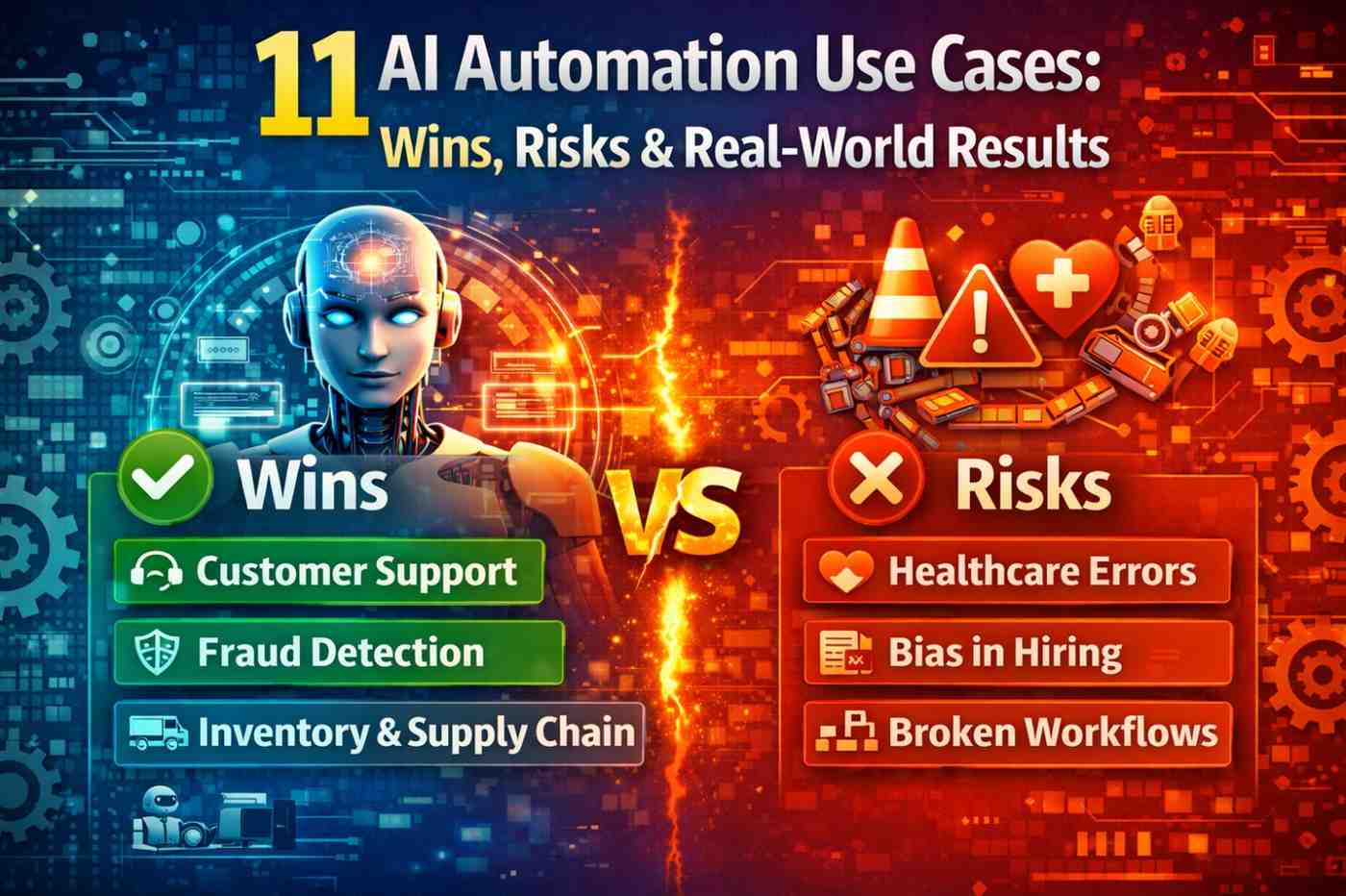
AI transformation is no longer theoretical — organizations are actively deploying AI to automate tasks, improve customer experience, and cut costs. Understanding which AI automation use cases deliver consistent value and which ones tend to fail is essential for leaders who want practical results rather than experimentation for its own sake. This guide breaks down 11 high-impact AI automation use cases, examines what works, what fails, and why, and offers pragmatic steps to prioritize and implement the right projects.
Table of Contents
11 High-Impact AI Automation Use Cases: What Works
1. Intelligent Document Processing (IDP)
Intelligent Document Processing uses AI to extract structured data from invoices, contracts, and forms. This AI automation use case works well when there are consistent document formats or when a robust training set of labeled documents exists. Benefits include faster processing times, fewer manual errors, and easier auditability. It tends to fail when organizations try to apply IDP to wildly inconsistent or multilingual documents without sufficient training data or human-in-the-loop validation.
2. Customer Support Automation (Chatbots & Virtual Assistants)
Automated chat and voice assistants are classic AI automation use cases that reduce response times and handle high-volume, repetitive queries. When designed to route complex issues to human agents and to escalate appropriately, these systems improve satisfaction and reduce cost-per-ticket. They fail when they attempt to handle nuanced, context-heavy topics without fallback options or when training data is biased or out-of-date.
3. Predictive Maintenance
Predictive maintenance monitors equipment signals to forecast failures before they occur, saving downtime and repair costs. This AI automation use case succeeds where sensor data is reliable, labeled failure events exist, and there is a direct maintenance workflow to act on predictions. It fails in settings with sparse sensor coverage, noisy data, or where maintenance teams lack processes to act on predictions.
4. Personalized Marketing Automation
Personalization engines that tailor offers, content, and timing are powerful AI automation use cases for revenue growth. When models are trained on comprehensive customer data and integrated with marketing platforms, conversion rates improve. These projects can fail due to privacy constraints, poor data hygiene, or over-personalization that creates privacy or user experience problems.
5. Sales Forecasting and Lead Scoring
AI-driven lead scoring and revenue forecasting help sales teams prioritize outreach and predict pipeline performance. The use case works with clean CRM data and consistent sales stages; it fails when sales processes vary across teams or data is incomplete, leading to mistrust of model outputs.
6. Fraud Detection and Risk Scoring
AI automation use cases in fraud detection combine behavioral signals, transaction patterns, and anomaly detection to stop abuse in real time. They perform well when continuously retrained on recent fraud patterns and integrated with human review. They fail when models become stale, adversaries change tactics, or false positives disrupt legitimate customers.
7. Supply Chain and Inventory Optimization
Demand forecasting, automated replenishment, and route optimization are high-value AI automation use cases in logistics. Success depends on rich historical data, integration with ERP systems, and alignment with supplier constraints. These projects fail when downstream systems cannot execute recommendations or when forecasts ignore non-repeatable events like sudden market shocks.
8. Hiring and Resume Screening
Automated resume parsing and candidate ranking speed up recruiting, but this AI automation use case is fraught with ethical risk. It works when algorithms are transparent, audited for bias, and combined with structured interviews; it fails when models inherit historical hiring biases or when opaque criteria lead to unfair rejection of qualified candidates.
9. Code Generation and DevOps Automation
AI-assisted code completion, test generation, and automated deployment are practical AI automation use cases that cut developer time and reduce errors. They work when used as assistants with human review; they fail if organizations treat generated code as production-ready without adequate testing or governance.
10. Image and Video Analysis for Quality Control
Visual inspection with computer vision automates quality checks in manufacturing and content moderation. When trained on representative defect images and integrated into production lines, these AI automation use cases reduce rejects and speed throughput. They fail when lighting, camera angles, or product variations differ from training data, or when actionable thresholds are not clearly defined.
11. Financial Close and Reconciliation
AI that automates reconciliation and anomaly detection in finance reduces close cycles and detects irregularities. This use case succeeds when led by finance stakeholders and paired with rule-based checks for transparency. It fails when organizations apply opaque models to regulatory processes without clear explainability or adequate human oversight.
What Fails in AI Automation Use Cases (Common Pitfalls)
Poor Data Quality and Insufficient Labeling
Many AI automation use cases fail because the underlying data is incomplete, inconsistent, or unlabeled. Garbage in yields unreliable models. Investing early in data pipelines, labeling strategies, and data governance is non-negotiable.
Ignoring Human-in-the-Loop Design
Automation without human oversight often fails when edge cases arise. High-impact AI automation use cases typically include feedback loops, human review for high-risk decisions, and mechanisms to correct model drift.
Lack of Clear KPIs and Operational Integration
A frequent failure mode is building models that never reach production because they are not integrated into workflows or lack measurable KPIs. Define success metrics (time saved, error reduction, revenue uplift) and integrate outputs into existing systems from day one.
Underestimating Change Management
Even the best AI automation use cases can fail if staff are not trained, processes aren’t updated, or stakeholders aren’t aligned. Successful programs pair technical work with communication, training, and new role definitions.
How to Prioritize AI Automation Use Cases
Assess Impact, Effort, and Risk
Map candidate AI automation use cases by potential impact, technical effort, and operational risk. Prioritize quick wins that reduce manual labor and have clear ROI, while piloting higher-risk opportunities with limited scope.
Use Cross-Functional Pilots
Run small pilots that involve the teams who will use the system, data engineers, and compliance officers. Pilot outcomes inform whether a candidate becomes a full-scale AI automation use case or is shelved.
Implementation Roadmap for AI Automation Use Cases
1. Discovery and Data Readiness
Document current workflows, identify data sources, and perform a data quality assessment. This stage determines whether a given AI automation use case is feasible and what engineering work is required.
2. Build, Test, and Human Oversight
Develop models iteratively, validate on held-out data, and define human review points. Combine AI with rule-based safeguards for predictable, auditable behavior.
3. Deploy, Monitor, and Iterate
Deploy with monitoring dashboards to track accuracy, latency, and business KPIs. Set up retraining triggers and root-cause processes when performance degrades. For further context on evolving priorities and patterns, review industry AI automation trends.
Measuring Impact and Scaling AI Automation Use Cases
Define Clear Metrics
Quantify success with operational metrics (cycle time, error rate), financial metrics (cost savings, revenue lift), and user experience signals (CSAT, NPS). Measure before-and-after to attribute improvements to the AI automation use case.
Governance and Responsible AI
Establish model governance, explainability, and periodic bias audits. For broader industry perspectives and frameworks, consult resources like Mhttps://www.mckinsey.com/featured-insights/artificial-intelligencecKinsey AI use cases and World Economic Forum AI insights.
Examples and Inspiration
Real-World Implementations
Companies across sectors have found success by starting small and scaling. If you want concrete implementations and walkthroughs, explore curated resources such as AI automation examples that show patterns you can adapt to your organization.
Key Success Factors
- Strong data foundations and observability
- Human-in-the-loop and escalation paths
- Clear KPIs and integration into operational systems
- Continuous monitoring, retraining, and governance
AI automation use cases can deliver transformative value when selected and executed thoughtfully. Focus on problems with clear operational pain, accessible data, and measurable outcomes.
AI automation use cases are not one-size-fits-all. By learning from what works—document processing, predictive maintenance, personalization—and from common failures—bad data, poor change management—you can build a practical portfolio of projects that provide steady returns. Start with high-impact, low-risk pilots, ensure strong governance, and scale the AI automation use cases that demonstrate real business benefit.



Leave a Reply