
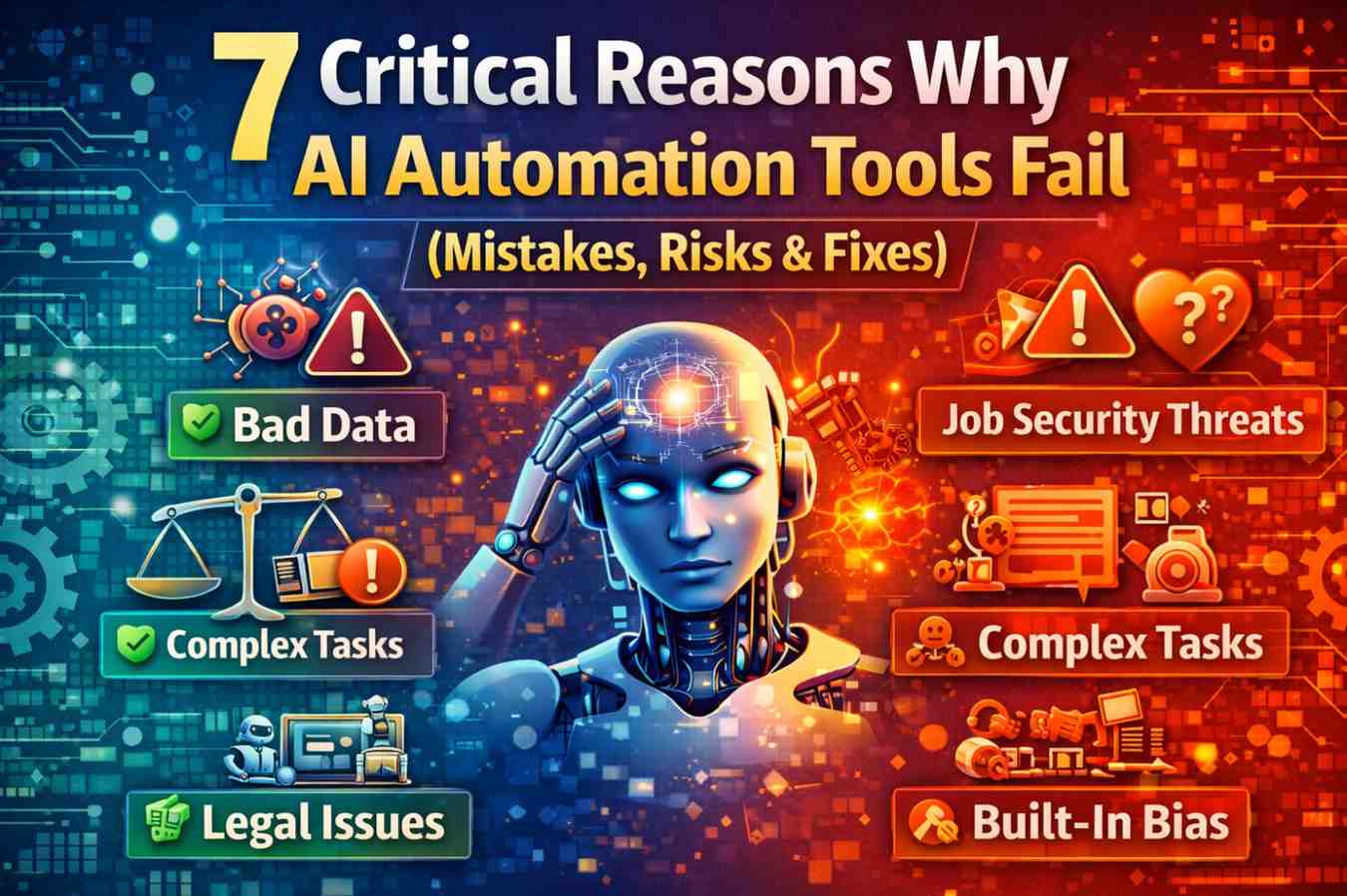
AI promises massive efficiency gains, but many initiatives falter. Understanding why AI automation tools fail is essential for leaders, developers, and operations teams who want durable automation rather than expensive experiments. This post breaks down seven critical reasons projects collapse, the common mistakes and risks behind them, and practical fixes you can apply immediately to increase success rates.
Table of Contents
Reason 1: why AI automation tools fail — poor data quality and governance
Poor data is the single largest root cause of why AI automation tools fail. Models trained on incomplete, biased, or inconsistent records produce unreliable outputs that cascade through automated workflows. Teams often underestimate the effort required to clean, label, and maintain training data, then assume the tool will adapt magically.
Common mistakes with data
Organizations skip data audits, mix incompatible data sources, or ignore drift after deployment. These errors turn accurate-sounding automation into brittle systems that break when inputs change.
Fixes: practical data governance
Implement a data quality framework, version datasets, and monitor input distributions in production. Create clear ownership for data pipelines and adopt incremental retraining schedules. Track performance metrics tied to data slices so you can detect degradation early.
Reason 2: inadequate problem definition — why AI automation tools fail at the start
Ambiguous goals explain a lot of why AI automation tools fail. When stakeholders haven’t agreed on success metrics, scope creep and unrealistic expectations arise. Automation that optimizes the wrong metric can undermine business objectives and erode trust.
How vague requirements hurt outcomes
Teams may automate a task without understanding edge cases, regulatory constraints, or user experience needs. This results in high exception rates and manual workarounds that negate projected ROI.
Fixes: clarify objectives and metrics
Define measurable success criteria, acceptable error rates, and rollback triggers. Start with a small, well-scoped pilot that targets high-impact, low-risk tasks. Use A/B tests or shadow deployments to validate real-world effects before wide rollout.
Reason 3: fragile integration and architecture
Technical fragility explains why AI automation tools fail after deployment. Poor system integration, undocumented interfaces, and mono-repo spaghetti code create brittleness: one external API change or a small schema update can stop an entire automation chain.
Integration pitfalls
Directly hard-coding dependencies, bypassing feature flags, and failing to implement retries make automations brittle. Lack of observability compounds the problem because teams struggle to pinpoint the failure point.
Fixes: resilient design and testing
- Design idempotent and decoupled services.
- Use feature flags and contract tests for external APIs.
- Build end-to-end test harnesses and chaos tests for critical paths.
Reason 4: why AI automation tools fail due to lack of human-in-the-loop
Automation without human oversight is a frequent reason why AI automation tools fail. Removing humans entirely from the loop ignores nuance, edge cases, and situational judgment that models cannot capture reliably. Overconfidence in full automation leads to unmonitored failures and compliance risks.
Risks of full automation
Fully automated decisions can amplify biases, make irreversible actions, or fail silently. In regulated industries this can create legal exposure or reputational harm.
Fixes: design for human oversight
Implement human-in-the-loop checkpoints for ambiguous cases and high-impact decisions. Use confidence thresholds and escalation workflows so that automated recommendations become team-augmented decisions rather than unilateral actions.
Reason 5: poor change management and stakeholder alignment
Organizational factors explain a lot about why AI automation tools fail. Automation touches processes, roles, and incentives—without change management, adoption stalls. Users revert to manual processes if they don’t trust or understand the tools.
Common organizational mistakes
Failing to involve frontline staff in design, ignoring training needs, and not adjusting performance incentives all undermine adoption. Technology alone cannot change behavior.
Fixes: engage users and measure adoption
- Co-design solutions with operators and subject matter experts.
- Provide role-based training and timely feedback channels.
- Track adoption metrics and tie automation improvements to performance reviews.
For context on evolving practices, review current AI automation trends that highlight how teams should plan both technology and people changes.
Reason 6: insufficient monitoring, observability, and maintenance
A common operational reality is that teams forget that models and rules require ongoing care. This is another reason why AI automation tools fail: lack of observability means problems are detected too late or not at all. Without clear metrics for accuracy, latency, and business impact, degradation goes unnoticed.
What to monitor
Monitor prediction confidence, input distribution drift, latency, error types, and downstream business KPIs. Establish alert thresholds and automated rollback procedures.
Fixes: build a maintenance playbook
- Automate data and model health checks.
- Schedule versioned retraining and canary rollouts.
- Document incident response and post-mortems to prevent repeat failures.
Understanding common pitfalls helps; for examples of practical failures and lessons learned, see this guide on AI automation pitfalls.
Reason 7: ethical, legal, and compliance oversights
Regulatory and ethical blind spots are another key reason why AI automation tools fail. Ignoring data privacy, fairness, and transparency can halt projects, invite fines, or damage trust. Well-meaning teams that skip impact assessments find their systems blocked by governance.
Risks and roadblocks
Failure to document model lineage, disclose automated decision-making, or implement consent mechanisms puts organizations at risk. Even when technology works, noncompliance can kill a program quickly.
Fixes: integrate governance and legal review
- Conduct AI impact assessments during design.
- Implement explainability tools and record decision logs.
- Coordinate with legal and compliance teams before scaling.
For perspective on enterprise-level considerations and research, consult resources like Harvard Business Review on AI and Gartner automation research to align technical plans with governance best practices.
Mitigation checklist: reduce the risk that AI automation tools fail
Combine technical, operational, and organizational measures to prevent failures. Use this checklist as a starting point:
- Clarify goals, KPIs, and rollback conditions before building.
- Audit and version training data; monitor input drift continuously.
- Design for resilience: decoupled services, contract tests, and retries.
- Retain human oversight for ambiguous or high-impact decisions.
- Engage users, run pilots, and measure adoption and trust.
- Implement observability, alerting, and scheduled maintenance.
- Conduct ethical and regulatory reviews early and often.
Knowing why AI automation tools fail helps you design systems that are robust, compliant, and adopted by users. Addressing data quality, clarity of purpose, resilient integration, human oversight, organizational alignment, monitoring, and governance substantially increases the odds of sustained success.
Conclusion: If you want automation that endures, treat AI as a product requiring continuous care. Understanding why AI automation tools fail is step one; putting in place the fixes above and learning from trends and pitfalls will turn risky experiments into reliable capabilities.



Leave a Reply