Introduction: Why Love Needs Help in 2026
Love today is not failing because people don’t care.
It’s failing because people are exhausted.
In 2026, couples are dealing with:
- Work pressure and financial stress
- Constant digital distractions
- Emotional burnout
- Long-distance relationships
- Lack of time for meaningful conversations
Most relationship problems don’t start with betrayal or big mistakes. They start with miscommunication, emotional distance, and unresolved feelings.
This is where AI tools like ChatGPT and Gemini are quietly stepping in—not to replace love, but to support healthier communication and emotional understanding.
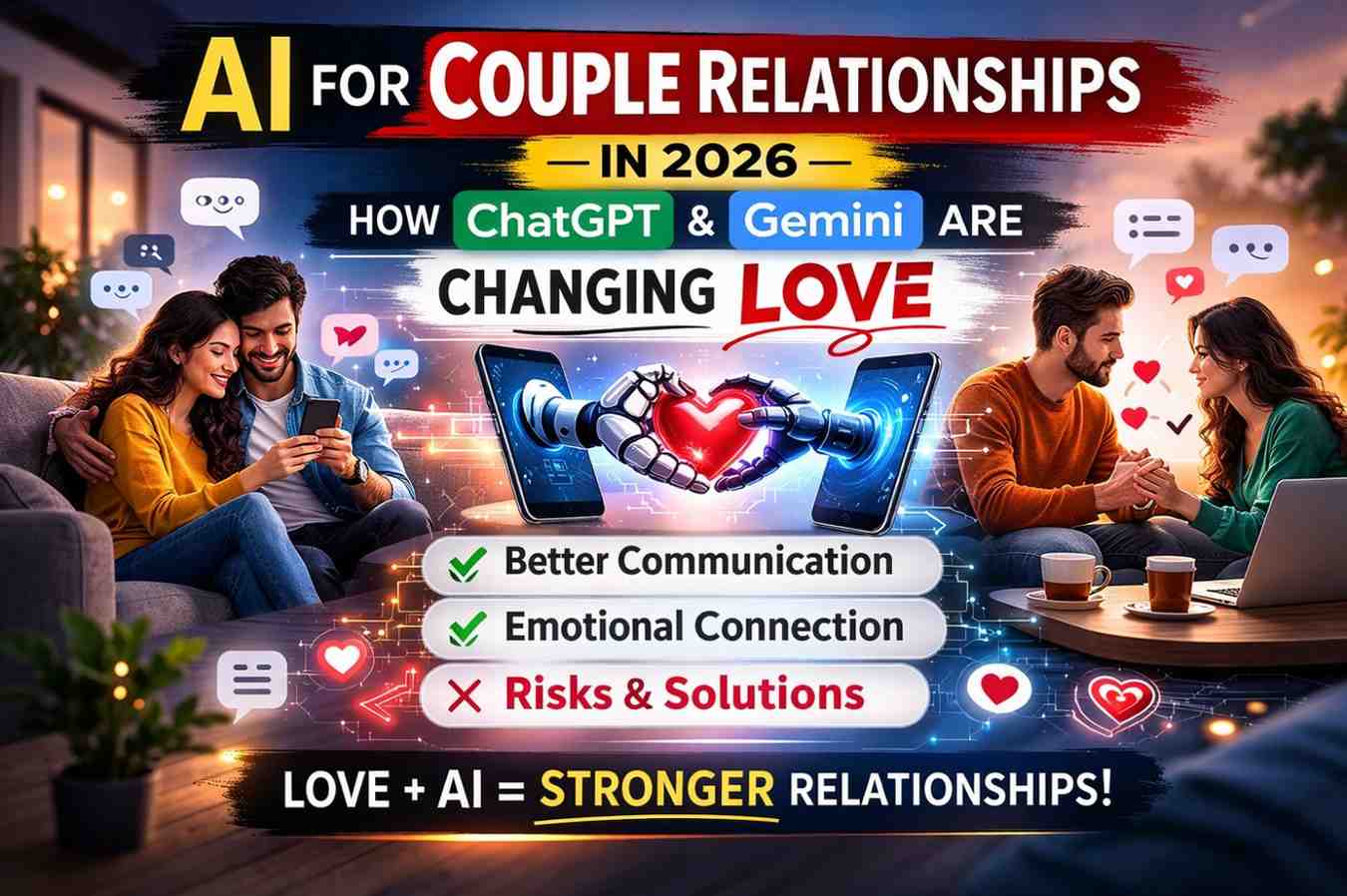
Discover how AI for Couple Relationships is transforming love in 2026. Learn how ChatGPT and Gemini improve communication, emotions, and trust.
AI for Couple Relationships is emerging as one of the most talked-about trends in 2026, as couples increasingly turn to tools like ChatGPT and Gemini for emotional clarity and better communication. From improving difficult conversations to supporting emotional understanding, AI is quietly influencing how modern relationships function. While AI helping relationships offers powerful benefits, it also raises important questions about emotional dependency, authenticity, and balance. This guide explores both the positive and negative aspects of using AI in relationships, helping couples understand whether ChatGPT relationship advice and Gemini AI for couples can truly strengthen emotional connection—or unintentionally weaken it.
Table of Contents
AI Is Not Replacing Love — It Is Supporting It
Let’s be clear from the start:AI for Couple Relationships
AI cannot feel love.
AI cannot replace a partner.
AI cannot understand emotions the way humans do.
But AI can help people:
- Say things better
- Think before reacting
- Reflect instead of fighting
- Understand emotions more clearly
Used correctly, AI becomes a relationship assistant, not a relationship substitute.
1. AI for Couple Relationships Helps Couples Communicate Without Hurting Each Other
One of the most common relationship problems is how things are said, not what is said.
Couples often:
- Speak in anger
- Use blaming language
- Say things they regret later
AI helps couples reframe their words.
Example:
Instead of:
“You never care about me.”
AI helps turn it into:
“I feel ignored sometimes, and I’d like us to talk about it.”
This single change can:
- Reduce defensiveness
- Prevent arguments
- Create safer conversations
In many cases, better wording saves relationships.
If you’re wondering how to practically use AI in daily conversations, you may find our detailed guide on ChatGPT prompts for couple communication extremely useful. It includes ready-to-use prompts that help couples express emotions clearly, resolve conflicts calmly, and improve emotional understanding without arguments.
2. A Neutral Listener When Emotions Are High
Friends and family often:
- Take sides
- Add bias
- Increase confusion
AI does neither.
ChatGPT and Gemini act as:
- Neutral listeners
- Calm reflectors
- Balanced responders
Couples can explain their situation honestly without fear of judgment. This neutrality helps individuals:
- See their own mistakes
- Understand their partner’s perspective
- Calm down before reacting
Sometimes, being heard calmly is all a person needs.
Research consistently shows that emotional intelligence plays a crucial role in relationship success. According to psychology experts, developing emotional awareness, empathy, and self-regulation significantly improves long-term relationship satisfaction. This aligns closely with how AI tools support reflection and calmer communication rather than emotional reactions.
3. Emotional Support During Lonely or Overwhelming Moments
There are moments when:
- One partner is busy
- One partner is emotionally unavailable
- One partner is overwhelmed
In these moments, AI offers temporary emotional grounding.
AI helps people:
- Organize their thoughts
- Calm emotional spirals
- Feel supported instead of alone
This is especially valuable for:
- Long-distance couples
- Night-shift workers
- Couples with different schedules
AI doesn’t replace emotional bonding—but it prevents emotional isolation.
4. AI for Couple Relationships Helping Long-Distance Relationships Stay Emotionally Alive
Long-distance relationships struggle not because of distance—but because of emotional disconnection.
AI helps couples by:
- Creating deep conversation prompts
- Suggesting meaningful questions
- Helping write thoughtful messages
- Planning virtual date ideas
Instead of repetitive “How was your day?” conversations, couples experience emotional depth and curiosity.
Small emotional efforts create big emotional closeness.
5. AI for Couple Relationships Encouraging Self-Reflection Instead of Blame
Healthy relationships require self-awareness.
But self-reflection is hard when emotions are high.
AI helps individuals:
- Identify emotional triggers
- Understand insecurity patterns
- Recognize unhealthy reactions
Instead of saying:
“My partner always causes problems”
People begin asking:
“Why did this trigger me so strongly?”
This shift from blame to reflection is transformational for relationships.
6. AI for Couple Relationships Preparing Couples for Difficult Conversations
Some topics are emotionally risky:
- Marriage timelines
- Financial responsibilities
- Career priorities
- Family boundaries
AI helps couples prepare before talking.
People use AI to:
- Structure conversations
- Choose respectful language
- Anticipate emotional reactions
This leads to:
- Fewer fights
- More understanding
- Clearer decisions
Preparation turns emotional conversations into constructive discussions.
7. AI for Couple Relationships A Safe Space Without Judgment or Shame
Many couples avoid seeking help because of:
- Social stigma
- Fear of gossip
- Fear of being misunderstood
AI provides:
- Privacy
- Confidentiality
- No embarrassment
This safety allows people to open up honestly—often for the first time.
Honesty is the foundation of healing.
8. AI for Couple Relationships Reducing Overthinking and Emotional Assumptions
Overthinking quietly destroys relationships.
AI helps people:
- Question negative assumptions
- Gain logical perspective
- Slow down emotional reactions
Instead of imagining worst-case scenarios, individuals learn to seek clarity before conflict.
9. AI for Couple Relationships Making Emotional Guidance Accessible to Everyone
Therapy is powerful—but not always accessible.
AI provides:
- 24/7 availability
- Low or no cost
- Immediate support
For many people, AI becomes the first step toward emotional awareness, not the final solution.
AI for Couple Relationships Why Couples Are Quietly Using AI More in 2026
Couples aren’t talking openly about using AI for relationships—but they are using it.
Because it:
- Feels safe
- Feels private
- Feels supportive
- Reduces emotional chaos
AI is becoming a silent relationship tool behind the scenes.
So far, we’ve seen how AI:
✔ Improves communication
✔ Supports emotional clarity
✔ Strengthens long-distance love
✔ Encourages maturity and reflection
But there is another side to this story.
The Other Side of AI for Couple Relationships
While AI tools like ChatGPT and Gemini can strengthen relationships, unchecked or careless use can quietly weaken emotional bonds.
AI is powerful—but power without awareness always carries risk.
This second half explores what can go wrong, why some couples may struggle because of AI, and how to maintain a healthy balance between technology and real emotional connection.
1. Emotional Dependency on AI for Couple Relationships Instead of Your Partner
One of the biggest dangers is emotional substitution.
Some individuals begin to:
- Share feelings more with AI than with their partner
- Seek comfort from AI instead of real conversation
- Avoid emotional vulnerability with their partner
Over time, this creates emotional distance, not connection.
When AI becomes the primary emotional outlet, the relationship slowly loses intimacy.
2. Avoiding Difficult but Necessary Conversations
AI can feel easier than real conversations.
Instead of addressing issues directly, some people:
- Vent to AI repeatedly
- Delay important discussions
- Choose comfort over resolution
This leads to:
- Temporary relief
- Long-term resentment
- Unresolved emotional tension
Real relationships grow through honest, uncomfortable conversations, not avoidance.
3. AI for Couple Relationships Does Not Truly Understand Emotions
AI can simulate empathy—but it does not experience emotion.
It cannot:
- Read facial expressions
- Understand shared memories
- Sense emotional tone
- Feel emotional history
This limitation means AI advice can sometimes:
- Oversimplify complex emotions
- Miss emotional depth
- Provide logical answers to emotional problems
Human emotions are not always logical—and AI struggles here.
4. Risk of Manipulation and Control
AI can be misused.
Some individuals use AI to:
- Craft persuasive messages
- Win arguments unfairly
- Control emotional narratives
This turns communication into strategy instead of sincerity.
Once trust is damaged, relationships suffer deeply.
5. One-Sided Validation Can Increase Conflict
AI responds based on input quality.
If one partner:
- Shares only their perspective
- Hides important context
- Seeks validation
AI may unintentionally reinforce bias.
This can make individuals feel:
- Overly justified
- Less open to compromise
- More emotionally rigid
Healthy relationships require mutual understanding, not validation alone.
6. Not a Replacement for Therapy or Professional Help
AI cannot replace professional care in cases involving:
- Trauma
- Abuse
- Severe anxiety or depression
- Addiction
- Emotional neglect
Relying on AI in serious situations may delay proper healing.
AI should be a support tool—not a substitute for professional help.
7. Reduced Emotional Effort in the Relationship
Over-reliance on AI can lead to:
- Less emotional effort
- Reduced initiative
- Lower emotional responsibility
If one partner always:
- Uses AI to write messages
- Depends on AI for emotional clarity
The relationship risks becoming emotionally lazy.
Love requires effort—not automation.
How to Use AI for Relationships in a Healthy Way
AI is not good or bad—it is neutral.
The outcome depends on how couples use it.
Healthy AI Usage Guidelines:
✔ Use AI to improve communication, not avoid it
✔ Reflect first, then talk to your partner
✔ Share insights openly with your partner
✔ Keep AI as a tool, not an emotional replacement
✔ Balance AI input with real conversations
When used with awareness, AI strengthens—not replaces—relationships.
The Ideal Role of AI in Love and Relationships
AI should act as:
- A mirror, not a mask
- A guide, not a decision-maker
- A support, not a substitute
The strongest relationships will be those where:
- Technology supports emotional intelligence
- Humans remain emotionally responsible
What the Future of Relationships Looks Like
In the coming years:
- AI will become more emotionally responsive
- Couples will use AI more discreetly
- Emotional intelligence will become a key relationship skill
But one truth will remain unchanged:
Love requires presence, effort, and vulnerability.
No technology can replace that.
Final Verdict: Is AI Good or Bad for Couple Relationships?
AI is powerful—but relationships are fragile.
When Used Wisely:
AI improves communication, clarity, and emotional maturity.
When Used Poorly:
AI creates emotional distance, dependency, and avoidance.
The choice lies with the couple—not the technology.
Closing Thoughts
AI will not replace love.
But emotionally aware people using AI responsibly will build stronger, calmer, and more conscious relationships.
The future of love is not artificial.
It is emotionally intelligent.


Leave a Reply