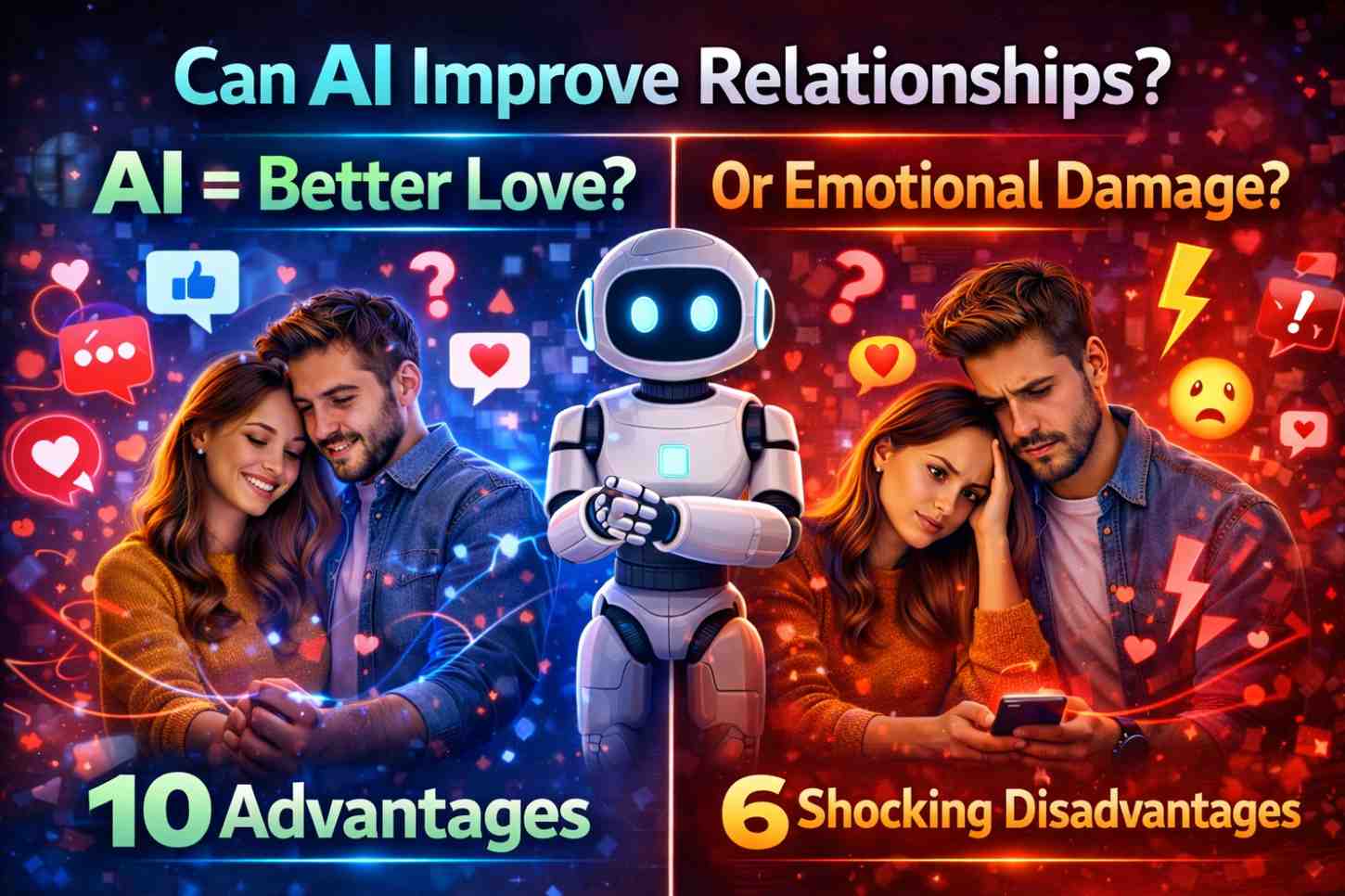
Can AI Improve Relationships is a question many couples, friends, and therapists are asking in 2026 as artificial intelligence tools move from novelty to daily companion. In this post I’ll explore how emerging tools actually change communication, empathy, conflict resolution and long-term bonding, while pointing to practical ways to get benefits and avoid harm. Whether you’re skeptical or curious, this balanced look will help you decide how — and if — AI should play a role in your closest connections. For a practical walkthrough, see the Can AI improve relationships guide that summarizes tools and use-cases.
Table of Contents
Can AI Improve Relationships: 10 Proven Advantages
Answering “Can AI Improve Relationships” requires separating hype from helpful use-cases. Below are ten advantages where AI has shown measurable or widely reported benefits for relationship health in 2026.
1. Personalized communication coaching
AI-driven feedback can analyze tone, pacing, and word choice in real time or from recorded conversations and offer suggestions to reduce escalation and increase clarity. Couples report that gentle prompts and post-conversation summaries help them spot recurring patterns they previously missed.
2. Practice difficult conversations safely
Role-playing with AI chatbots gives people a low-risk environment to rehearse apologies, boundary setting, or delivering hard news. This reduces anxiety and improves actual performance in live interactions, which is one reason many ask, “Can AI Improve Relationships?”
3. Improved scheduling and shared life management
Shared AI assistants handle calendars, reminders, and household logistics, reducing friction and the resentment that comes from dropped responsibilities. That practical support frees emotional energy for connection rather than coordination.
4. Detecting emotional drift early
AI can identify subtle changes in communication frequency, sentiment, or content that often precede distancing. Early alerts give partners a chance to address issues before they become entrenched, making the question “Can AI Improve Relationships” more than theoretical.
5. Facilitating empathy with perspective-taking tools
Some AI tools summarize a partner’s viewpoint in neutral language or propose phrasing that acknowledges feelings. These summaries encourage empathy by translating heated statements into why the other person might feel that way.
6. Access to evidence-based relationship advice
AI curates and synthesizes findings from psychology and therapy models into digestible, actionable steps for couples. When combined with professional guidance, these summaries can reinforce healthy habits between sessions. Trusted resources and frameworks inform these suggestions; for example, professionals emphasize the importance of trust in relationships when integrating tools.
7. Supporting long-distance and asynchronous intimacy
AI helps craft messages that feel personal, schedules meaningful virtual dates, and prompts small gestures that maintain connection when partners live apart or keep different hours.
8. Reducing stigma around seeking help
Anonymous, AI-guided tools lower barriers for people who might otherwise avoid therapy. Early engagement often leads to healthier outcomes and a higher likelihood of pursuing professional help when needed.
9. Preventing small problems from growing
By offering micro-interventions—like suggesting a brief check-in routine or a timeout mechanism—AI reduces the accumulation of unresolved issues. Over time this contributes to more stable relationships.
10. Custom reminders for emotional maintenance
Tailored nudges—send a thoughtful message, share gratitude, or schedule quality time—help partners maintain the positive behaviors that sustain intimacy. These small interventions answer the practical side of “Can AI Improve Relationships” in everyday life.
Can AI Improve Relationships? 6 Shocking Disadvantages
While many advantages exist, asking “Can AI Improve Relationships?” also means acknowledging risks. Here are six disadvantages that can be surprising or severe if AI is misused or unregulated.
1. Over-reliance and loss of interpersonal skill
When partners rely on AI to mediate every difficult talk or draft every vulnerable message, they risk atrophying direct communication skills. Authenticity can suffer if a third-party algorithm shapes most emotional expression.
2. Privacy and surveillance concerns
Shared assistants and conversation-analysis tools collect sensitive data. Without strict controls, that data could be exposed or used in ways that betray intimacy—undermining the very trust AI was meant to protect.
3. Misaligned suggestions and cultural blindspots
AI models trained on broad datasets may offer advice that conflicts with a couple’s cultural values or personal boundaries. Blind trust in automated prompts can escalate conflicts rather than resolve them.
4. Amplifying manipulation or gaslighting
Bad actors can use AI to craft persuasive messages designed to manipulate a partner, and sophisticated tools can simulate voices or messages, making deceit easier and harder to detect.
5. Erosion of privacy through data monetization
Some platforms monetize behavioral data. If relationship signals are sold or analyzed for ad targeting, couples lose control over intimate information, a worrying trade-off for convenience.
6. Changes to human behavior and emotional norms
AI is reshaping expectations about response times, emotional labor, and conflict styles. Research and commentary suggest this influence is profound; see ongoing coverage of AI and human behavior for evolving perspectives. When norms shift too quickly, partners may struggle to adapt together.
How to Use AI in Relationships Safely
Deciding whether “Can AI Improve Relationships” for you depends on clear rules and boundaries. Follow these practical safety steps to maximize benefit and minimize harm.
- Set explicit data rules: agree what the AI can monitor, store, and share.
- Use AI for rehearsal and logistics, not as a substitute for emotional labor.
- Prefer tools with transparent privacy policies and local data options.
- Regularly review and delete conversation logs you don’t want persisted.
- Keep a human fallback: commit to seeing a therapist or mediator for serious issues.
For hands-on workflows and suggested apps, consult the AI relationship pros and cons write-up that lists safe tools and governance tips.
Signs AI Is Helping — and When to Stop
Monitor outcomes rather than features. AI is helping when partners report increased understanding, fewer recurring fights, and better coordination without decreased authenticity. Stop or scale back AI use when it becomes a substitute for hard conversations, when privacy feels compromised, or when one partner feels excluded from decisions about tool use.
Quick checklist
- Are both partners consenting to the tool’s scope?
- Do you still handle core emotional tasks without AI prompts?
- Is data storage and sharing acceptable to both of you?
Evaluating “Can AI Improve Relationships” is less about a binary yes/no and more about fit, governance, and limits. When thoughtfully applied, AI can amplify empathy and reduce friction; without guardrails, it can damage trust and autonomy.
As with any technology that touches intimacy, keep ethics, consent, and privacy central to your decisions. Use the tools that assist growth, not substitute for it, and revisit your agreements regularly as both the technology and your relationship evolve.
Conclusion: Can AI Improve Relationships? In many cases, yes — but only when used intentionally, transparently, and with boundaries that protect privacy and human skill. AI can be a powerful ally for communication, scheduling, empathy building, and early problem detection, yet it also poses real risks like dependency, privacy loss, and manipulation. Weigh pros and cons, set clear rules, and combine AI with human judgment to make it a constructive part of your relationship toolkit.


Leave a Reply