
AI Chatbots for Business are no longer a novelty; they are a strategic tool reshaping customer service, sales, and internal workflows. When deployed thoughtfully, AI Chatbots for Business can reduce response times, personalize experiences at scale, and free human teams to focus on higher-value work. But the promise comes with caveats: implementations often fall short because of poor data, unrealistic expectations, or weak integration. This post cuts through the hype to explain the benefits, the common failures, and the real truth about adopting AI Chatbots for Business.
Table of Contents
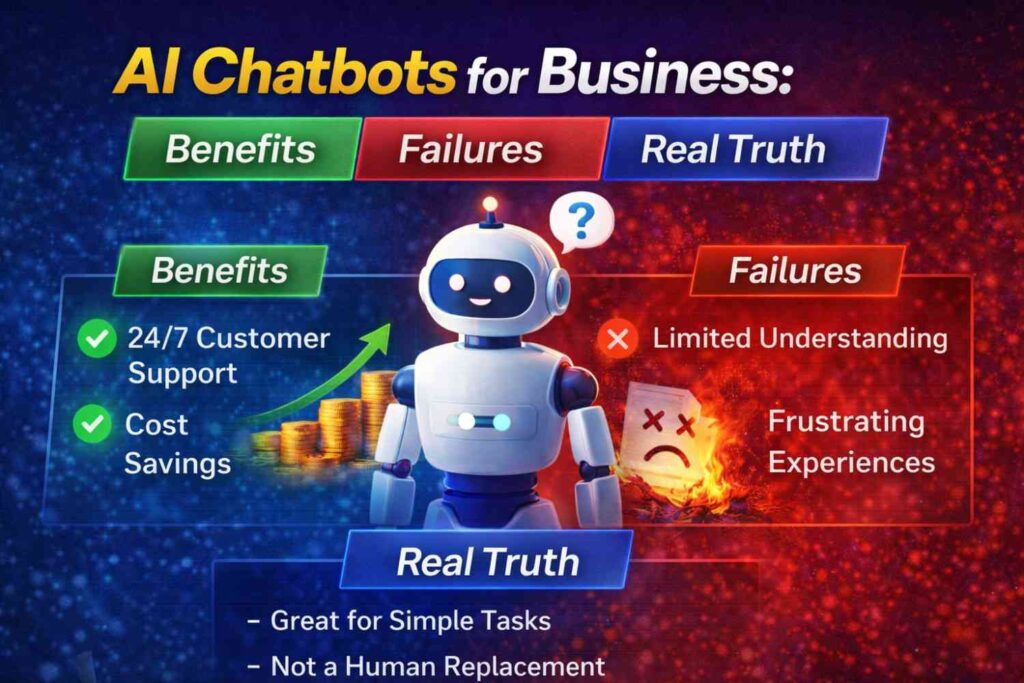
Benefits of AI Chatbots for Business
AI Chatbots for Business deliver measurable advantages across many touchpoints. They operate 24/7, handle repetitive requests, and can scale instantly during peak periods. For customer-facing roles, chatbots reduce average handling time and improve first-response rates. For internal operations, they automate routine HR queries, IT support tasks, and basic procurement approvals.
Faster response and improved availability
Customers expect immediate answers. Deploying AI Chatbots for Business ensures round-the-clock support without adding shift costs. Even if a bot only handles triage, it can collect necessary context and route complex issues to the right human agent, improving overall resolution speed.
Cost efficiency and scalability
Replacing manual handling for repetitive queries reduces operational costs. AI Chatbots for Business can manage thousands of concurrent conversations, making them ideal for seasonal spikes or high-volume campaigns. Savings typically appear in reduced support headcount and lower average handling times.
Personalization and data-driven insights
Modern chatbots use context and transaction history to deliver tailored recommendations. AI Chatbots for Business can cross-sell and upsell by recognizing intent and suggesting relevant products or services. They also gather structured feedback and conversation analytics, which help refine marketing and product strategies.
Common Failures of AI Chatbots for Business
Despite the benefits, many deployments fail to meet expectations. Understanding why helps avoid the same pitfalls.
Poor training data and unrealistic expectations
Some projects rush to deploy without adequate training data. AI Chatbots for Business perform poorly when they lack domain-specific examples or when teams expect chatbots to solve complex, nuanced cases immediately. This mismatch creates frustration and undermines trust.
Weak integration and siloed workflows
Chatbots that operate in isolation produce limited value. If an AI Chatbots for Business implementation cannot access CRM records, order systems, or knowledge bases, it will offer little beyond scripted responses. Integration with backend systems and workflows is essential to deliver real outcomes.
Neglecting user experience and escalation paths
Failure to design clear handoffs from bot to human leads to poor experiences. Users expect an easy escalation path when a chatbot cannot resolve an issue; without that, even a capable AI Chatbots for Business can create friction and dissatisfaction.
How to Implement AI Chatbots for Business Successfully
Successful rollouts follow a structured approach: start small, measure, iterate, and expand. Below are practical steps that align expectations with achievable outcomes.
Start with a focused use case
Identify high-volume, low-complexity interactions first—order status, password resets, appointment booking. These provide quick wins and reliable training data. As confidence grows, broaden the chatbot’s scope.
Design for handoff and transparency
Make it clear when a conversation transfers to a human agent and preserve context. Ensure the chatbot logs and summarizes the user’s problem so the human agent doesn’t ask the same questions again. This approach increases customer satisfaction and agent productivity.
Integrate with core systems
AI Chatbots for Business must be connected to CRM, inventory, billing, and knowledge bases to be useful. Integration allows bots to pull personalized information and perform actions—like initiating refunds or rescheduling appointments—reducing friction for users.
For teams exploring initial ideas or looking for tools, pair chatbot projects with broader experiments in automation. See resources like AI business ideas for beginners and evaluate vendors that classify as AI tools for business to build a practical roadmap.
Technology and Vendor Considerations for AI Chatbots for Business
Choosing the right platform and technology stack is a critical decision. Consider the following dimensions when evaluating vendors and tools.
Natural language capabilities and customization
Assess if the platform supports the languages and dialects your customers use and whether you can customize intents and responses. Not every solution is equally effective at domain-specific language; some require more manual rules while others excel at learning from examples.
Security, privacy, and compliance
AI Chatbots for Business may handle sensitive personal or financial data. Ensure the provider meets your regulatory requirements and supports encryption, role-based access, and data retention controls. Include privacy impact assessments in your design phase.
Operational metrics and analytics
Measure performance with metrics like containment rate, escalation rate, customer satisfaction (CSAT), and time to resolution. A robust analytics dashboard helps you spot failures and prioritize improvements. Vendors vary widely in the quality of their reporting, so test this capability early.
Real Truth: What Works, What Doesn’t
The real truth about AI Chatbots for Business is pragmatic: they work best when they augment humans rather than replace them, and when organizations commit to continuous improvement.
What works
– Clear use-case selection and narrow scope during initial rollout.
– Strong integrations that let bots access real-time data and perform actions.
– Continuous monitoring and retraining using real conversation logs.
– Human-in-the-loop processes for edge cases and quality control.
What doesn’t
– Expecting instant, perfect performance without training data or iterative tuning.
– Using chatbots as a cost-cutting bandage instead of improving underlying processes.
– Ignoring customer feedback and failing to route unresolved issues quickly.
For a high-level primer on chatbot capabilities and market context, consult vendor-agnostic resources like Chatbots explained and practical definitions such as What is a chatbot.
Measuring ROI and Continuous Improvement for AI Chatbots for Business
ROI for AI Chatbots for Business combines cost savings, revenue enablement, and customer experience gains. Realistic measurement requires baseline metrics and a timeline for improvement.
Key metrics to track
– Containment rate: percentage of queries resolved without human help.
– Resolution time and first-response time.
– Customer satisfaction and Net Promoter Score (NPS) changes attributable to the chatbot.
– Cost per interaction and total support cost savings.
– Conversion and revenue lift for sales-focused bots.
Iterate based on data
Use conversation transcripts to identify friction points and update intents and knowledge base entries. Regularly review escalation reasons and retrain models. Small, frequent updates typically deliver better results than infrequent, large overhauls.
Final Recommendations for Leaders Considering AI Chatbots for Business
Executives should treat AI Chatbots for Business as part of a broader digital transformation effort, not as an isolated project. Set realistic goals, budget for integration and ongoing tuning, and define governance to manage data, security, and performance.
Checklist before launch
– Define target use cases and success metrics.
– Prepare training data and knowledge base content.
– Ensure integrations with core systems are in place.
– Design escalation workflows and measure outcomes from day one.
– Plan for ongoing improvements, staffing, and governance.
When you align strategy, technology, and people, AI Chatbots for Business become a powerful lever for efficiency and customer experience. Start small, track the right metrics, and expand only after you’ve proven tangible value.
AI Chatbots for Business can transform how organizations interact with customers and run internal processes, but the real truth is that success requires discipline: clear use cases, integration, monitoring, and human oversight. With the right approach, the benefits outweigh the risks—delivering faster service, lower costs, and better insights.


Leave a Reply