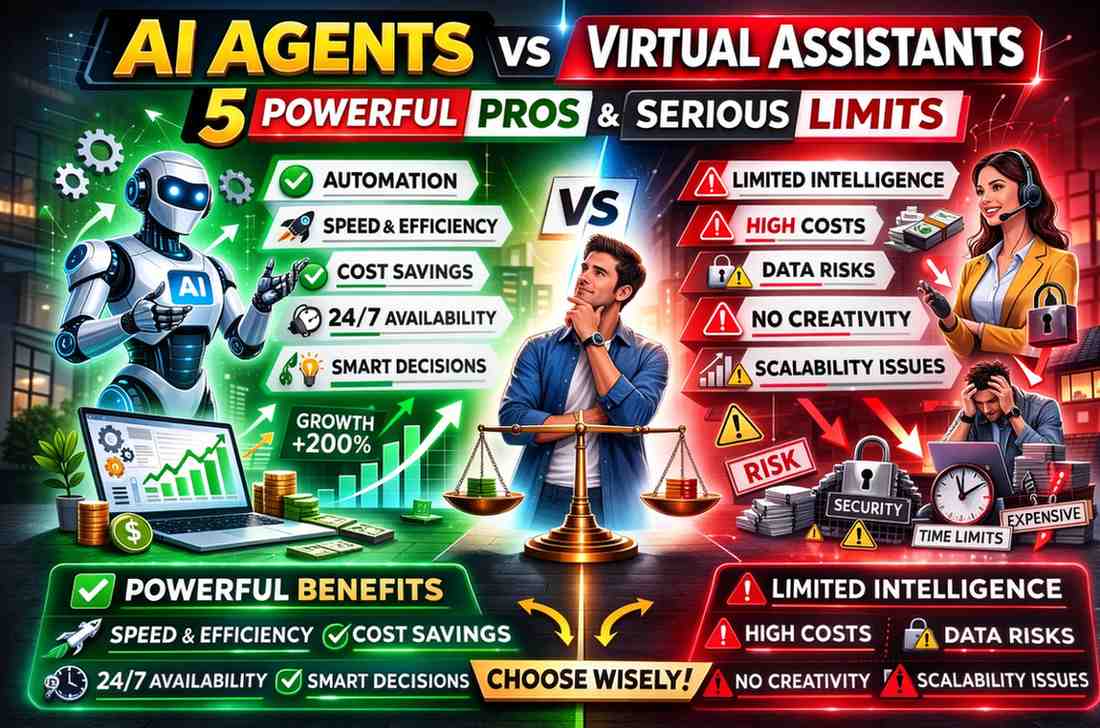
The debate around AI agents vs virtual assistants USA has shifted from theoretical to practical as American businesses look for scalable ways to automate tasks and augment human teams. Whether you’re a small e-commerce owner or a large enterprise CIO, understanding the difference between AI agents and virtual assistants, and what each can realistically deliver in the USA market, matters for budgeting, compliance, and user experience. This article walks through five key advantages and five serious limits so you can make a clearer decision for your organization.
Table of Contents
AI agents vs virtual assistants USA: 5 Key Pros
The comparison of AI agents vs virtual assistants USA often highlights capabilities that go beyond simple chat replies. Below are five tangible advantages that AI agents typically offer over traditional virtual assistants in US contexts, from automation depth to 24/7 scaling.
1. Autonomous task orchestration
AI agents are designed to plan, prioritize, and execute multi-step workflows with minimal human intervention. In the AI agents vs virtual assistants USA conversation, this autonomy means agents can coordinate calendar bookings, data pulls, report generation, and follow-ups across systems—reducing manual coordination costs for American teams.
2. Contextual decision-making
Unlike scripted virtual assistants, modern AI agents use context from previous interactions and external data to make decisions. When assessing AI agents vs virtual assistants USA, this contextual edge often translates into fewer handoffs to human staff and better customer outcomes for US-based support centers with high transaction volumes.
3. Integration with enterprise systems
AI agents are commonly built to integrate deeply with CRMs, ERPs, and messaging platforms. If you’re evaluating AI agents vs virtual assistants USA for implementation, consider compatibility with your existing stack and whether you need specialized connectors for legacy systems. Tools and connectors are evolving quickly—there are resources on practical implementation like AI automation tools that many US teams reference when planning deployments.
4. Scalability and cost efficiency
For organizations operating across multiple time zones or high-volume customer service operations, AI agents can scale elastically without linear staffing increases. In discussions about AI agents vs virtual assistants USA, leaders often prioritize this scalability as a decisive business benefit, especially for seasonal spikes.
5. Continuous learning and improvement
AI agents often include feedback loops that let them improve over time with supervised corrections and new data. That ongoing learning capability is a big point in the AI agents vs virtual assistants USA debate, enabling higher accuracy for intent recognition and better task completion rates across US customer interactions.
AI agents vs virtual assistants USA: 5 Serious Limits
Despite clear advantages, the AI agents vs virtual assistants USA story also includes limits that organizations must plan around. Overlooking these constraints can lead to failed pilots, wasted budget, or customer frustration.
1. Data privacy and compliance hurdles
Operating in the USA means navigating federal and state privacy laws. AI agents that access or process personal data can trigger complex compliance requirements. For many companies comparing AI agents vs virtual assistants USA, the need to implement logging, consent workflows, and audit trails becomes a major operational requirement.
2. Reliability and edge-case handling
AI agents perform well on routine scenarios but can falter on complex, ambiguous, or novel problems. When you weigh AI agents vs virtual assistants USA, it’s important to identify the edge cases that require human escalation and build clear fallback mechanisms to preserve service quality.
3. Integration cost and technical debt
Deep integration with business systems is powerful but expensive. The AI agents vs virtual assistants USA trade-off here is between richer functionality and longer, costlier implementation cycles. Many teams underestimate connector maintenance, versioning issues, and data mapping headaches that arise after initial deployment.
4. Ethical and bias concerns
AI agents learn from historical data, and if that data contains bias, outputs can reproduce unfair patterns. In the AI agents vs virtual assistants USA context, US organizations must consider fairness, transparency, and stakeholder expectations—especially in sectors like finance, healthcare, and hiring where decisions can have major consequences.
5. Overpromised capabilities and user trust
Marketing language sometimes suggests AI agents can fully replace humans. In reality, AI agents and virtual assistants have complementary strengths. When evaluating AI agents vs virtual assistants USA, it’s wise to set realistic expectations with internal stakeholders and customers to preserve trust if something goes wrong.
How US businesses should evaluate AI agents vs virtual assistants USA
Choosing between AI agents and virtual assistants—or deciding how to combine them—starts with clear criteria aligned to business outcomes. Consider the following evaluation steps tailored to the USA market:
- Define outcomes: Specify KPIs (response time, resolution rate, cost per contact) and expected ROI.
- Map user journeys: Identify where automation can reduce friction and where human judgment is required.
- Assess data readiness: Inventory available data, integration endpoints, and privacy constraints relevant to US regulations.
- Run small pilots: Start with a tightly scoped use case, measure performance, and iterate before scaling.
- Plan governance: Establish human-in-the-loop monitoring, audit processes, and a clear escalation path for failures.
To support evaluation and vendor selection, many US teams consult research and industry guidance. For market trends and frameworks, sources such as Gartner AI and McKinsey AI offer useful perspectives on maturity, ROI benchmarks, and adoption patterns. When building a shortlist, don’t forget to review practical implementation resources including specific product guides and case studies like those listed under AI chatbots for business.
Deployment patterns and hybrid strategies
In practice, many US organizations adopt hybrid strategies that combine the strengths of AI agents and virtual assistants. Common patterns include:
- Frontline virtual assistants for first contact and routing, with AI agents handling backend processes and orchestration.
- AI agents that prepare draft responses or reports for human review, improving throughput while retaining oversight.
- Domain-specific virtual assistants for narrow tasks (e.g., scheduling) and general-purpose AI agents for cross-system coordination.
Selecting the right mix depends on risk tolerance, compliance needs, and the technical maturity of your IT environment. A phased rollout can help manage integration complexity and build trust among staff and customers in the USA.
Monitoring and continuous improvement
Whatever the chosen pattern, ongoing monitoring is essential. Track performance metrics, collect human feedback, and implement model governance processes. Continuous improvement will reduce false positives and ensure your approach to AI agents vs virtual assistants USA evolves with changing user needs and regulatory expectations.
Cost-benefit considerations
Cost modeling should include direct licensing, integration work, staffing for oversight, and contingency for regulatory compliance. When comparing AI agents vs virtual assistants USA, factor in both one-time engineering costs and recurring monitoring/maintenance expenses to understand total cost of ownership.
Finally, invest in training your teams so they can interpret agent outputs and manage escalation effectively. Human operators who understand the limits and capabilities of automation will get more value and reduce the chance of public-facing mistakes.
Choosing between AI agents vs virtual assistants USA is not a binary decision for most organizations; it’s about matching tools to tasks and risks. Use pilots, measure carefully, and combine resources like industry analysis and practical tool guides to make informed choices.
Conclusion: AI agents vs virtual assistants USA will remain a central decision for US enterprises as automation matures. The five pros—autonomy, context, integration, scalability, and learning—are compelling, but the five limits—privacy, reliability, integration cost, bias, and trust—are real and require planning. With thoughtful evaluation, pilot testing, and governance, organizations can capture benefits while mitigating risks.


Leave a Reply