Adopting intelligent conversational assistants can transform patient experience, reduce administrative burden, and speed triage—but only when they are hipaa compliant AI chatbots designed with privacy and security at their core. Health organizations considering these technologies must balance clear benefits with complex legal responsibilities, ensuring that every implementation respects patient rights and aligns with federal guidance such as the HIPAA Rules.
Table of Contents
Benefits of hipaa compliant AI chatbots for healthcare
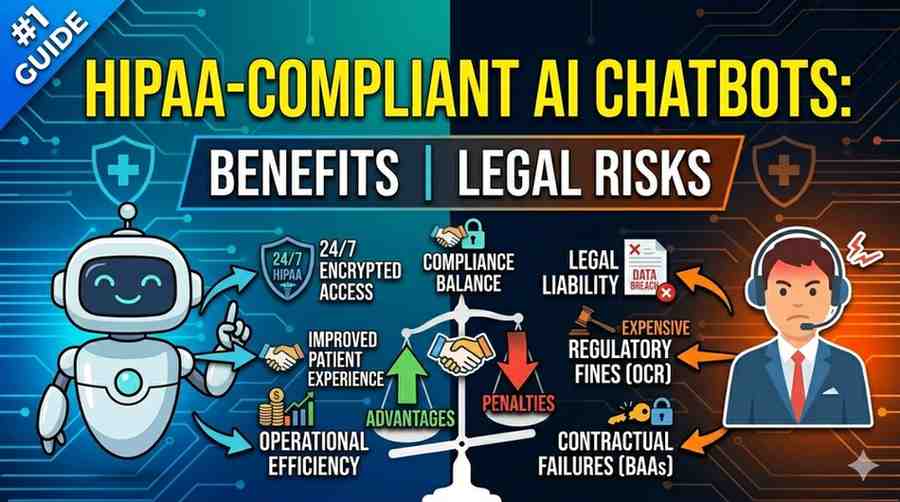
When built and deployed correctly, hipaa compliant AI chatbots offer measurable advantages across clinical and administrative settings. They can handle routine inquiries, schedule appointments, support medication adherence, and collect structured symptom data before a visit. For many practices and hospitals, the operational uplift is immediate: fewer hold times, higher patient satisfaction scores, and clearer communication workflows.
Improved access and patient engagement
Hipaa compliant AI chatbots can operate 24/7, providing timely answers to common questions and triaging urgent concerns to clinicians. This continuous availability improves access for patients who cannot call during business hours and supports multilingual or accessibility features that expand reach without straining staff.
Operational efficiency and cost reduction
Organizations using hipaa compliant AI chatbots report fewer repetitive calls and reduced front-desk workload. Automating scheduling, reminders, and basic intake frees clinical staff to focus on higher-value tasks. When integrated with electronic health records (EHRs), these chatbots can pre-fill data fields and reduce transcription errors—saving time and lowering administrative costs.
Legal risks associated with hipaa compliant AI chatbots
Despite their promise, hipaa compliant AI chatbots introduce legal and compliance risks that healthcare entities cannot ignore. Misconfigurations, inadequate encryption, unclear data retention policies, or undisclosed third-party processing can all lead to violations of federal law and costly enforcement actions. Understanding these risks is essential before any deployment.
Privacy and data security pitfalls
One common danger is treating an AI chatbot as a generic consumer tool rather than a component of a regulated health information system. If protected health information (PHI) is input and stored without appropriate safeguards, organizations can face breaches. Ensuring data is encrypted at rest and in transit, enforcing strict access controls, and auditing API connections are practical steps to mitigate this risk.
Vendor agreements and business associate concerns
Many healthcare providers rely on third-party platforms to power AI capabilities. When a vendor handles PHI, a formal Business Associate Agreement (BAA) is typically required to allocate responsibilities and liability. Failure to secure a BAA, or accepting one with vague security commitments, exposes providers to compliance failures and enforcement by regulators such as OCR.
How to implement hipaa compliant AI chatbots safely
Safe implementation is a mix of technical controls, contractual safeguards, and governance. The following framework helps organizations adopt hipaa compliant AI chatbots while minimizing exposure.
Assess risk and classify data
Begin with a risk assessment that catalogs what data the chatbot will handle and maps data flows between systems. Classify inputs that qualify as PHI and design the chatbot to avoid requesting unnecessary sensitive information. Documented risk assessments also demonstrate due diligence if questions arise later.
Secure architecture and technical controls
Security should be baked into the architecture: end-to-end encryption, least-privilege access, network segmentation, and regular vulnerability scanning. Use logging and monitoring to detect anomalous behavior in real time, and apply automatic redaction where appropriate to prevent PHI from being stored in plain text during testing or analytics.
Strong vendor selection and contracts
When choosing platforms, prioritize vendors with healthcare experience and a willingness to sign a robust BAA. Evaluate their compliance posture, certifications, and incident response processes. For digital transformation support, consider integrating vetted AI automation tools and proven AI chatbots for business offerings that describe healthcare-grade controls.
Design principles for hipaa compliant AI chatbots
Design choices directly influence compliance outcomes. Thoughtful UX combined with privacy-by-design principles reduces risks while improving usefulness.
Minimize data collection
Collect only what is necessary to complete a task. For example, avoid requesting full medical histories for appointment scheduling unless clinically required. Limiting data collection decreases the surface area for breaches and simplifies retention policies.
Transparent consent and disclosure
Inform users how their information will be used, stored, and shared. Provide clear options to opt out or request human escalation. This transparency helps meet legal obligations and builds patient trust—critical when deploying hipaa compliant AI chatbots that interact with sensitive information.
Regulatory guidance and resources
Understanding regulatory expectations reduces uncertainty when deploying hipaa compliant AI chatbots. Federal agencies and industry groups publish useful guidance that should shape policy and technical design.
Relevant agencies and guidance
The U.S. Department of Health and Human Services provides the foundational HIPAA Rules that set privacy and security obligations for PHI. The Office of the National Coordinator for Health Information Technology offers resources and standards on interoperability and health IT practices at ONC Health IT. Together, these resources help define the technical and administrative controls expected of organizations using health-focused chatbots.
Documentation and audit readiness
Maintain documentation that ties technical controls to policy: risk assessments, penetration testing results, BAAs, and incident response plans. Regulators expect auditable evidence that an organization proactively managed risk when sensitive systems like hipaa compliant AI chatbots are in use.
Monitoring, training, and continuous improvement
Compliance is not a one-time checklist; it requires ongoing vigilance. Monitoring usage, retraining models to avoid drift, and educating staff are essential practices for organizations using hipaa compliant AI chatbots.
Staff training and governance
Train staff on appropriate uses of the chatbot, PHI handling rules, and escalation paths for anomalies. Clear governance structures that assign responsibility for model updates, privacy impact assessments, and vendor oversight reduce organizational risk.
Incident response and breach management
Prepare for the possibility of a data incident. Incident playbooks should define notification timelines, remediation steps, and communications strategies. Quick, transparent responses often mitigate regulatory and reputational damage following a breach involving hipaa compliant AI chatbots.
Choosing the right use cases for hipaa compliant AI chatbots
Not every interaction should be automated. Select high-value, low-risk use cases first—such as appointment scheduling, medication reminders, and basic triage questionnaires. For complex diagnostic conversations or mental health crises, design the system to escalate to qualified clinicians immediately.
Pilot, measure, and scale
Run pilots with defined success metrics: reduction in call volumes, time-to-triage, or patient satisfaction. Use pilot results to refine workflow integration and privacy controls before scaling broadly.
Adopting hipaa compliant AI chatbots can unlock significant benefits in patient experience and operational efficiency, but only when paired with rigorous security, clear policies, and smart vendor management. By following regulatory guidance, limiting data collection, and maintaining strong contractual safeguards, organizations can harness conversational AI while respecting patient privacy and legal obligations.
Conclusion: As health systems modernize, hipaa compliant AI chatbots will become central to patient engagement strategies. Prioritize privacy-by-design, robust vendor agreements, and continuous monitoring to realize benefits without taking on unnecessary legal risk.


Leave a Reply