Choosing and budgeting for conversational AI requires clarity: AI chatbot pricing USA varies widely by vendor, feature set, and expected return. Whether you’re a startup exploring a low-cost subscription or an enterprise assessing an on-premises deployment, understanding how AI chatbot pricing USA is structured helps you compare offers, forecast ROI, and avoid surprise costs. This guide breaks down typical fees, pricing models, hidden expenses, and how to measure the business impact so you can make an informed procurement decision.
Table of Contents
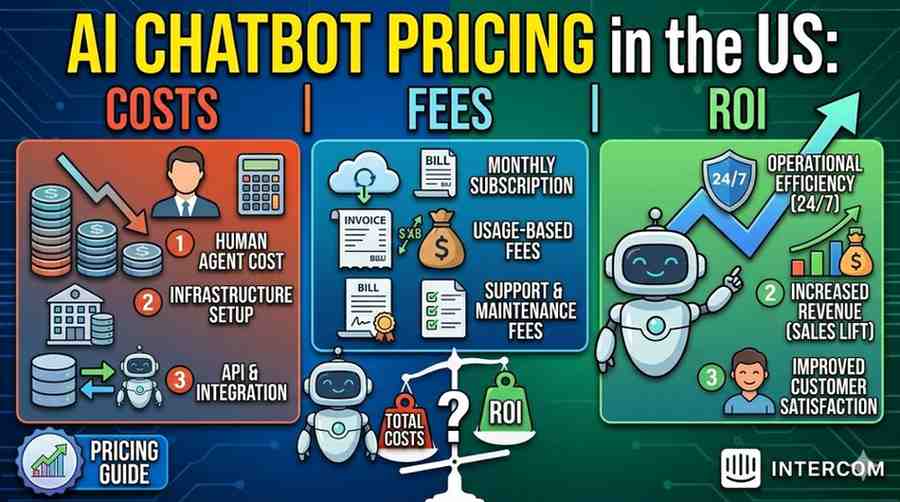
AI chatbot pricing USA: Overview of typical cost components
AI chatbot pricing USA usually includes several distinct components rather than a single line item. Vendors often combine setup fees, subscription or usage charges, customization and integration costs, and ongoing maintenance or support. Understanding each piece makes it easier to compare quotes side-by-side.
Subscription and usage charges
Most cloud-based providers use monthly or annual subscriptions paired with usage-based fees such as conversations, messages, or API calls. Pricing tiers often scale with the number of active users, the number of concurrent sessions, or the volume of AI compute consumed. When evaluating AI chatbot pricing USA, ask whether tiers include limits on integrations, channels (web, mobile, messaging apps), or access to advanced natural language models.
Implementation, customization, and training
Many vendors charge one-time professional services fees for implementation: customizing conversation flows, connecting back-end systems, training models on company data, and designing the user experience. These costs can be significant for complex workflows or industries with strict compliance requirements. Factor these into any AI chatbot pricing USA comparison.
Support, hosting and maintenance
Ongoing costs such as SLA-backed support, cloud hosting, security patches, and periodic retraining of models are commonly billed annually or as a support add-on. For mission-critical applications, higher-tier support levels raise the price but can reduce risk and downtime.
AI chatbot pricing USA: Common pricing models explained
Vendors use several standard models. Understanding them helps you pick a contract that aligns with usage patterns and growth projections.
Per-seat or per-agent licensing
Per-seat pricing works well for internal virtual assistants or agents that supplement human staff. It’s predictable but can be expensive if many staff members need access. Consider whether each “seat” requires full access or can be limited by role to lower costs in AI chatbot pricing USA proposals.
Usage-based (conversations or API calls)
Usage-based pricing charges per conversation, message, or API call. It’s scalable for fluctuating demand and attractive for pay-as-you-grow strategies, but costs can spike with seasonal traffic or unexpected usage—be sure to model peak scenarios when evaluating AI chatbot pricing USA.
Tiered subscriptions
Tiered plans package features into defined levels (basic, pro, enterprise). They provide a balance of predictability and value; however, hidden limits on features or throughput can lead to unexpected upgrade needs in AI chatbot pricing USA negotiations.
Hidden costs and things vendors often don’t include
Bright quotes can mask long-term costs. When comparing AI chatbot pricing USA, watch for these common omissions so you can calculate total cost of ownership.
- Data migration and cleansing expenses for training models
- Costs for custom integrations with CRM, ERP, or legacy systems
- Premium connectors (payment gateways, telephony, analytics) billed separately
- Costs for compliance, auditing, or industry-specific certifications
- Fees tied to overages of usage-based plans or exceeding user caps
Security, compliance, and data residency
Enterprises in regulated sectors frequently require dedicated hosting, audit logs, and compliance support. These add to AI chatbot pricing USA and are non-negotiable in healthcare, finance, and government projects—plan accordingly.
How to calculate ROI from AI chatbot pricing USA
Assessing ROI requires mapping costs to measurable benefits. AI chatbot pricing USA should be compared against gains in efficiency, revenue impact, and customer experience metrics.
Direct cost savings
Estimate reductions in support headcount, average handle time, and time-to-resolution. For example, if a chatbot automates 30% of routine inquiries, translate that into eliminated full-time equivalent (FTE) costs and factor in the vendor fee from AI chatbot pricing USA.
Revenue and conversion uplift
Chatbots that assist in sales or cart recovery can drive measurable revenue. Calculate incremental conversions multiplied by average order value, then compare that gain to the total AI chatbot pricing USA over the same period.
Customer lifetime value and retention
Improvements in satisfaction and retention can increase customer lifetime value (CLV). Model conservative uplift estimates and include those longer-term benefits when justifying AI chatbot pricing USA.
Choosing between vendors: comparison checklist
Use a structured checklist to validate proposals and align them with your business needs and the nuances of AI chatbot pricing USA.
- What pricing model matches expected usage patterns?
- Are implementation and integration costs itemized?
- What support and SLA levels are included at each price point?
- Does the vendor provide transparent overage pricing and rate limits?
- Are advanced features (analytics, sentiment, handoff to humans) included or add-ons?
Vendor reviews and market research
Before shortlisting, review independent marketplaces to validate vendor claims and discover real-world pros and cons. Resources like Capterra CX and G2 Chatbots provide user reviews, feature matrices, and cost indicators that help contextualize AI chatbot pricing USA numbers.
Negotiation tips and cost control strategies
Smart contracting can reduce the effective AI chatbot pricing USA while improving outcomes. Try these approaches during procurement and renewal.
Start with a pilot and performance-based clauses
Negotiate a pilot period with clear KPIs and success metrics. Consider linking part of the fee to performance outcomes such as containment rate or customer satisfaction to align vendor incentives with your ROI targets from AI chatbot pricing USA.
Bundle and cap usage
Bundle features you need into a single package or negotiate caps on usage spikes to avoid surprise charges. For fast-growing businesses, commit to stepped increases rather than open-ended per-usage billing in AI chatbot pricing USA agreements.
Leverage internal expertise
Reduce professional services fees by using in-house developers for integrations and automation. Some vendors offer self-serve tools—validate whether those tools remove the need for expensive customization in your AI chatbot pricing USA plan.
Where to start: quick checklist before you request quotes
Prepare this information before contacting vendors to get realistic AI chatbot pricing USA estimates and shorter procurement cycles.
- Projected monthly conversations, messages or API calls
- Channels required (web, mobile, SMS, WhatsApp, voice)
- Required integrations (CRM, ticketing, databases)
- Compliance and data residency constraints
- Desired metrics for the pilot and production ROI goals
For broader automation initiatives, consider reviewing related tools to see how a chatbot fits into your ecosystem: AI automation tools can complement conversational interfaces, and if you’re evaluating conversational platforms with business use in mind, explore options for AI chatbots for business as part of your vendor shortlist.
AI chatbot pricing USA varies with scale, complexity, and industry demands. By breaking down quotes into components, modeling ROI conservatively, and negotiating terms that align incentives, organizations can control costs and maximize business impact. Use pilots, third-party reviews, and a clear checklist to compare offers objectively and avoid surprises in ongoing fees.



Leave a Reply