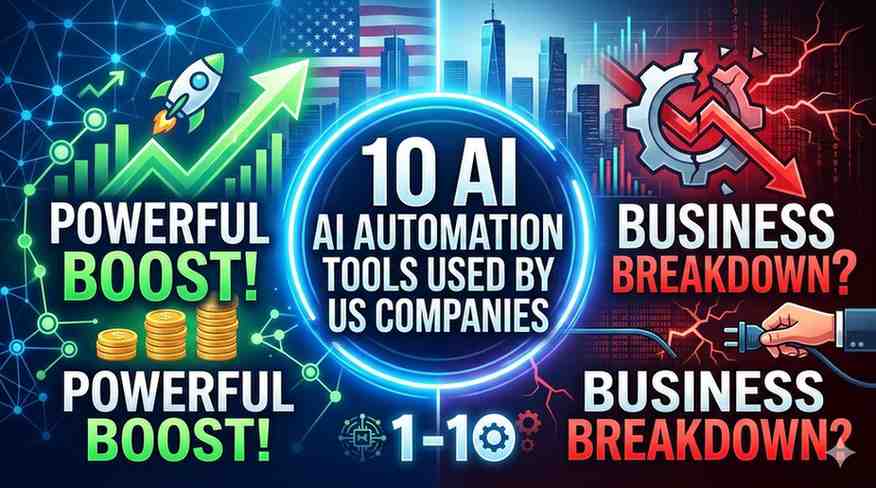
The race to automate routine work has accelerated, and today many organizations evaluate which platforms to trust with mission-critical processes. When US firms evaluate vendors they’re often asking the same question: will these AI automation tools USA deliver a measurable boost, or set off a costly breakdown? This article examines ten AI automation tools used by US companies, compares strengths and risks, and helps leaders decide which solutions will truly scale in a US environment where compliance, talent, and legacy systems all matter.
Table of Contents
AI automation tools USA: What adoption looks like in practice
Adoption of AI automation tools USA ranges from simple workflow connectors to full robotic process automation (RPA) infused with machine learning. Enterprises that succeed often combine tools, for example pairing an RPA platform with an intelligent document processing engine and an AI-powered conversational layer. That combination lets a finance department automate invoice processing, route exceptions, and respond to vendor inquiries with an AI automation tools strategy that spans multiple teams.
Top 10 AI automation tools USA companies use
1. UIPath
UIPath is a leader in RPA that many US companies use to automate repetitive desktop and web tasks. Its visual studio and orchestration capabilities let business users scale automation quickly. For more on the vendor, see UIPath. Companies choosing UIPath often pair it with AI models for document understanding, which reinforces how AI automation tools USA are rarely one-size-fits-all.
2. Automation Anywhere
Automation Anywhere offers cloud-native RPA and intelligent automation that many U.S. organizations adopt for high-volume transactional work. The platform’s built-in analytics and bot management are practical for regulated industries; check the vendor at Automation Anywhere. Organizations that implement Automation Anywhere find it simplifies orchestration in multi-vendor AI automation tools USA stacks.
3. Blue Prism
Blue Prism emphasizes enterprise-grade governance and scalability, appealing to financial services and healthcare firms. It integrates with AI services for language and vision to handle sophisticated processes, illustrating how Blue Prism fits into broader AI automation tools USA strategies focused on control and auditability.
4. Microsoft Power Automate
Microsoft Power Automate connects systems and applies automation within the Microsoft ecosystem. US companies that rely on Office 365, Dynamics 365, and Azure often choose Power Automate as a low-friction way to introduce automation into business units, complementing other AI automation tools USA investments.
5. IBM Watson
IBM Watson brings strong NLP and AI services that power virtual assistants and document processing at scale. Enterprises using Watson are often aiming for conversational AI integrated into enterprise workflows, one example of how AI automation tools USA can expand from back-office tasks to customer-facing automation.
6. Google Cloud AutoML
Google Cloud AutoML lets companies build custom ML models for image, text, and structured data without deep data science teams. Firms using AutoML plug models into workflow engines, demonstrating that modern AI automation tools USA are frequently model-driven rather than purely rule-based.
7. Amazon SageMaker
Amazon SageMaker supports end-to-end model development and deployment. US companies that have in-house ML teams often deploy SageMaker alongside orchestration tools so predictions trigger automated downstream tasks — a pattern increasingly common in AI automation tools USA deployments.
8. Zapier
Zapier is favored by smaller teams for point-to-point automation between cloud apps. While not designed for enterprise governance, Zapier is an on-ramp to automation that many US companies use to validate ideas before moving to heavier AI automation tools USA platforms.
9. Workato
Workato combines integration, workflow automation, and recipes that support complex integrations with enterprise systems. It’s often used as the glue between SaaS and on-prem systems, showing how AI automation tools USA can be implemented as hybrid solutions bridging legacy and cloud.
10. OpenAI (ChatGPT and GPT models)
OpenAI’s GPT models power conversational agents and knowledge assistants. Many US companies use these models for drafting, triage, and customer interactions — turning generative AI into an operational tool. Integrating GPT-powered chat with RPA or workflow engines is a growing pattern among AI automation tools USA adopters. For teams focused on chat implementations, resources on AI chatbots for business can be helpful.
Benefits of AI automation tools USA employers report
Across industries, companies implementing AI automation tools USA cite several consistent benefits:
- Faster transaction cycles: automation reduces manual handoffs and accelerates throughput.
- Cost savings: reduced processing time and fewer errors translate to lower operational costs.
- Improved compliance and audit trails: mature tools provide logging and controls necessary for regulated sectors.
- Better employee experience: teams move from repetitive work to higher-value tasks.
- Enhanced customer service: chat and automation reduce response time and improve consistency.
These benefits explain why organizations invest in a spectrum of AI automation tools USA, from low-code connectors to enterprise-grade RPA and AI platforms.
Risks and when AI automation tools USA can lead to a breakdown
Adoption is not automatic success. Several failure modes can turn AI automation tools USA into a costly headache:
- Poor governance: unattended bots and weak change control create operational risk.
- Data quality problems: AI models and automations are only as good as the inputs they receive.
- Overextension: using heavyweight platforms for simple tasks creates unnecessary complexity.
- Security and compliance gaps: improper access controls can expose sensitive data.
- User resistance: lack of training or stakeholder alignment stalls adoption.
Mitigation strategies
To avoid breakdowns when deploying AI automation tools USA, teams should:
- Start with clear use cases and measurable KPIs so benefits are trackable.
- Establish governance frameworks covering bot lifecycle, change control, and role-based access.
- Invest in data quality and monitoring to ensure models and automations remain reliable.
- Choose the right tool for the job — sometimes a low-code connector is preferable to an enterprise RPA suite.
- Plan for ongoing maintenance; bots and models need updates as systems and regulations change.
How to choose among AI automation tools USA
Selection criteria often include integration depth, governance features, ease of use, cost, and vendor ecosystem. Practical steps US teams use when evaluating AI automation tools USA:
- Map current processes and quantify the expected time and error reductions.
- Run a pilot with defined success metrics rather than a broad roll-out.
- Assess vendor roadmaps and community support; ecosystems matter for long-term viability.
- Consider hybrid architectures: combine RPA, low-code, and ML services to balance speed and control.
- Factor in talent: a tool that matches your team’s skills shortens time to value.
Practical checklist before purchase
Before buying, confirm:
- Access controls and audit logging exist for compliance.
- APIs and connectors support critical internal systems.
- There is clear licensing and predictable scaling costs.
- Support and training resources are available to upskill teams quickly.
Companies that follow these steps find they can combine systems like UIPath or Automation Anywhere with modern ML platforms to create resilient, auditable automation — a hallmark of successful AI automation tools USA deployments.
Future trends for AI automation tools USA
Looking ahead, AI automation tools USA will continue to evolve along several themes:
- Tighter integration between generative AI and RPA so natural language prompts can trigger complex processes.
- Greater emphasis on observability and model governance to manage risk.
- Low-code AI that democratizes automation beyond IT teams, expanding the pool of users building automations.
- Composable automation platforms that let organizations swap components as needs change.
These trends mean that selecting vendors and designing architectures today should account for future extensibility, avoiding lock-in while retaining governance.
Ultimately, the right mix of platforms — whether an enterprise RPA vendor, a cloud ML service, or a lightweight connector — depends on the organization’s goals and constraints. By piloting, governing, and measuring, US organizations can tip the balance toward boost rather than breakdown when adopting AI automation tools USA.
Conclusion: AI automation tools USA offer significant upside but are not risk-free. With deliberate selection, governance, and a phased rollout that includes pilot metrics and cross-functional ownership, companies can capture productivity gains without sacrificing compliance or control. The tools listed above have powered successful automation programs in the United States, but success depends on how they are combined, managed, and measured.


Leave a Reply