
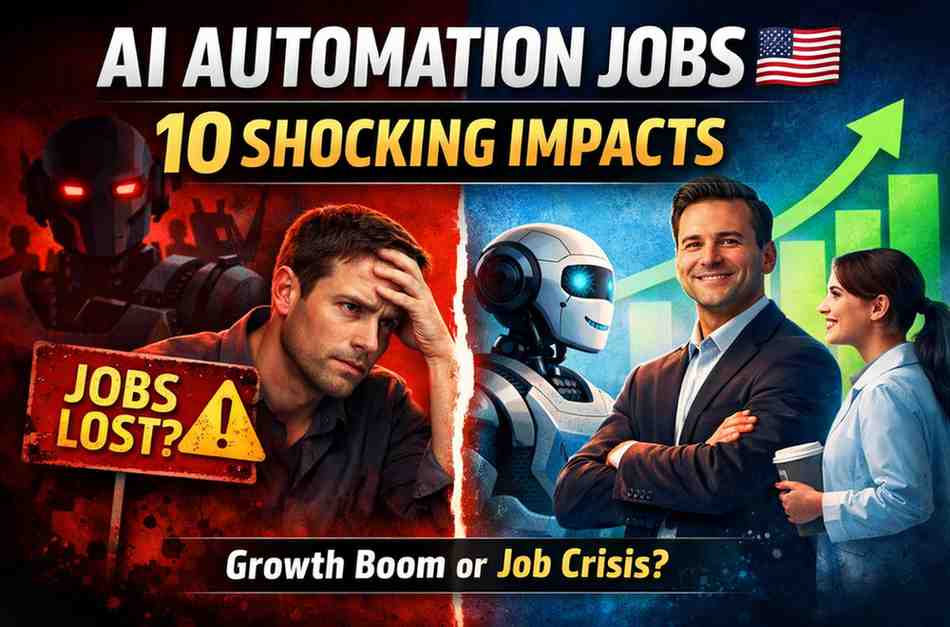
AI automation jobs USA is a phrase that captures a central anxiety and opportunity in today’s labor market: can machines truly replace American workers? As companies deploy automation and AI at scale, discussions about job displacement, job creation, wage pressure, and reskilling become urgent. This article examines the truth about how AI automation jobs USA affect employment, the realistic limits of automation, and the broader economic and social impacts—grounded in data, expert analysis, and practical examples.
Table of Contents
AI automation jobs USA: The Truth About Replacement Risk
Concerns that AI automation jobs USA will wipe out millions of positions are not unfounded, but they are often overstated. Historical technological shifts show that automation changes the composition of work rather than eliminating work outright. The key questions are which tasks are automatable, how quickly change occurs, and how policy and business decisions shape outcomes.
Data from institutions such as the Bureau of Labor Statistics show that while certain routine tasks decline, other roles grow or evolve. The World Economic Forum’s research on the future of work further highlights that AI tends to augment human labor in many sectors rather than fully replacing it (World Economic Forum).
Which roles are most at risk?
Roles centered on repetitive, predictable tasks face the highest risk in discussions about AI automation jobs USA. These include:
- Data entry and basic bookkeeping
- Certain manufacturing assembly jobs
- Some customer service tasks that follow scripted pathways
- Basic legal and medical document review
However, even in these areas automation often handles parts of workflows, creating hybrid roles where humans supervise, interpret, and manage exceptions.
Which roles are more resilient?
Jobs that require complex decision-making, emotional intelligence, creativity, and cross-disciplinary judgment tend to be more resilient to AI automation jobs USA trends. Examples include managers, therapists, creative professionals, skilled tradespeople, and roles requiring nuanced interpersonal negotiation.
How AI automation jobs USA Are Changing Industries
AI automation jobs USA manifest differently across sectors. Manufacturing sees robotic process automation and cobots enhancing productivity. Finance leverages algorithmic risk assessment and automated compliance. Healthcare uses AI for diagnostic support, workflow optimization, and administrative automation. Each transformation creates winners and losers within industries.
Manufacturing and logistics
Automation in manufacturing has long reshaped employment, but modern AI introduces greater flexibility. Instead of replacing entire plants, AI automation jobs USA often enable higher-value tasks—workers program and maintain systems, optimize production, and handle complex maintenance. Logistics benefits from route optimization and inventory forecasting, altering the nature of warehouse work.
Professional services and white-collar work
In white-collar environments, AI automation jobs USA can accelerate research, draft documents, and automate repetitive analysis. This shifts roles toward oversight, interpretation, and client relationships. Tools that automate rote legal discovery or tax computations free professionals to focus on strategy and complex problem-solving.
Limits of AI: What Machines Can’t (Easily) Do
Understanding the limits of AI is crucial to realistic planning. AI excels at pattern recognition, optimization, and handling well-defined tasks with ample data. It struggles with general common-sense reasoning, unstructured social interaction, deep creativity, and ethical judgment—areas where humans maintain a clear advantage.
Context, nuance, and trust
Many jobs involve trusting relationships, tacit knowledge, or rapid adaptation to novel situations. These qualities are difficult to encode in models. Even when AI can perform a task technically, organizations may prefer human involvement for accountability, legal reasons, or customer expectations—factors that slow wholesale replacement by AI automation jobs USA.
Infrastructure and integration costs
Large-scale automation requires investment in technology, training, and process redesign. Small and medium-sized enterprises may find these costs prohibitive. That reality moderates how quickly AI automation jobs USA will spread across the economy.
Net Job Effects and New Opportunities
While some roles decline, AI automation jobs USA also create new categories of employment. Data science, AI operations, model auditors, prompt designers, and roles in digital service delivery expand. There is also growth in related hardware maintenance, cybersecurity, and regulatory compliance roles.
Reskilling and workforce mobility
Transitioning workers requires targeted reskilling programs and pathways that align with industry demand. Employers can adopt apprenticeship-style models and partner with education providers to smooth moves from declining roles to in-demand positions created by AI automation jobs USA.
Policy levers to shape outcomes
Public policy matters: from unemployment supports and retraining subsidies to incentives for human-centered job creation. Labor regulations, tax policies, and investment in regional economic development influence how benefits and burdens of AI automation jobs USA are distributed.
Practical Steps Companies and Workers Can Take
Businesses and employees can take concrete steps to adapt to AI automation jobs USA realities:
- Assess tasks, not jobs: identify automatable tasks and reskill workers for higher-value responsibilities.
- Invest in continuous training: create learning pathways for data literacy, human-centered design, and AI oversight.
- Adopt hybrid models: use AI as an augmentation tool, preserving human roles for oversight and relationship work.
- Partner with public institutions: collaborate with local colleges and workforce boards to align curricula with emerging needs.
For businesses exploring tools to support these changes, practical guidance on implementation and user-facing automation is available via resources such as AI automation tools and solutions that include conversational systems like AI chatbots for business.
Economic and Social Impact: A Balanced View
The economic impact of AI automation jobs USA will be uneven. Productivity gains can boost GDP and lower costs, but benefits may concentrate in capital- or skill-intensive sectors unless mitigated. Inequality, geographic divergence, and industry-specific dislocation are realistic risks.
Regional and demographic disparities
Regions specialized in automatable industries may face sharper displacement, requiring targeted investment. Demographic groups with lower access to education and reskilling opportunities risk being left behind, amplifying existing labor market inequities connected to AI automation jobs USA.
Social safety nets and the role of government
Effective social policies—from active labor market programs to portable benefits—can help workers transition. Policymakers can use labor market data (for example, from the Bureau of Labor Statistics) and international research (see the World Economic Forum) to design evidence-based responses to AI automation jobs USA challenges.
What Employers Should Communicate
Transparency about technology adoption plans and clear pathways to retraining build trust. Employers that explain how AI tools will be used—emphasizing augmentation over substitution—are more likely to retain morale and maintain productivity during transitions related to AI automation jobs USA.
Designing human-centered automation
Human-centered design principles ensure that AI supports workers rather than replacing them abruptly. Involving employees in redesign efforts reduces resistance and uncovers domain knowledge that improves AI performance.
AI automation jobs USA present a complex mixture of disruption and opportunity. The most likely near-term outcome is not mass elimination of jobs but a reconfiguration of tasks, the creation of new roles, and an increased premium on skills that machines cannot easily replicate. Stakeholders across business, government, and education must act deliberately to shape transitions so that benefits are widely shared.
Conclusion: As the U.S. adapts, preparing workers, investing in education, and adopting human-centered approaches to technology will determine whether AI automation jobs USA become a driver of inclusive growth or a source of widening inequality. The choices made now will shape the labor market for decades to come.



Leave a Reply