
AI Agents Explained: today’s conversation about artificial intelligence often centers on large models, but one of the most promising — and misunderstood — developments is the rise of AI agents. These autonomous, goal-oriented pieces of software can plan, act, and interact with tools or users. In this post we’ll cover what AI agents do, how they differ from other AI systems, real-world uses, why they fail in surprising ways, and what responsible deployment looks like.
Table of Contents
AI Agents Explained: What They Are and How They Work
At its simplest, AI agents are systems designed to take actions to reach goals with minimal human intervention. They combine perception (understanding inputs), decision-making (choosing actions), and execution (interacting with tools, APIs, or interfaces). If you want a concise technical primer, this What are AI agents resource is a good starting point.
Core components of an agent
An AI agent typically includes:
- Goal representation — a way to describe objectives (short-term tasks or long-term aims).
- Planner or policy — logic or model that chooses the next action.
- Perception module — processes input from text, images, sensors, or APIs.
- Actuators — means to perform actions: API calls, web interactions, or messages to users.
- Memory and state — to retain context across steps and learn from outcomes.
How models and agents differ
Large language models provide predictions or outputs given prompts, but they do not inherently take multi-step actions over time. AI agents use models as components but add planning, memory, tool use, and feedback loops to complete multi-step tasks. For more background on the larger field, see this overview of AI fundamentals from IBM: Artificial intelligence explained.
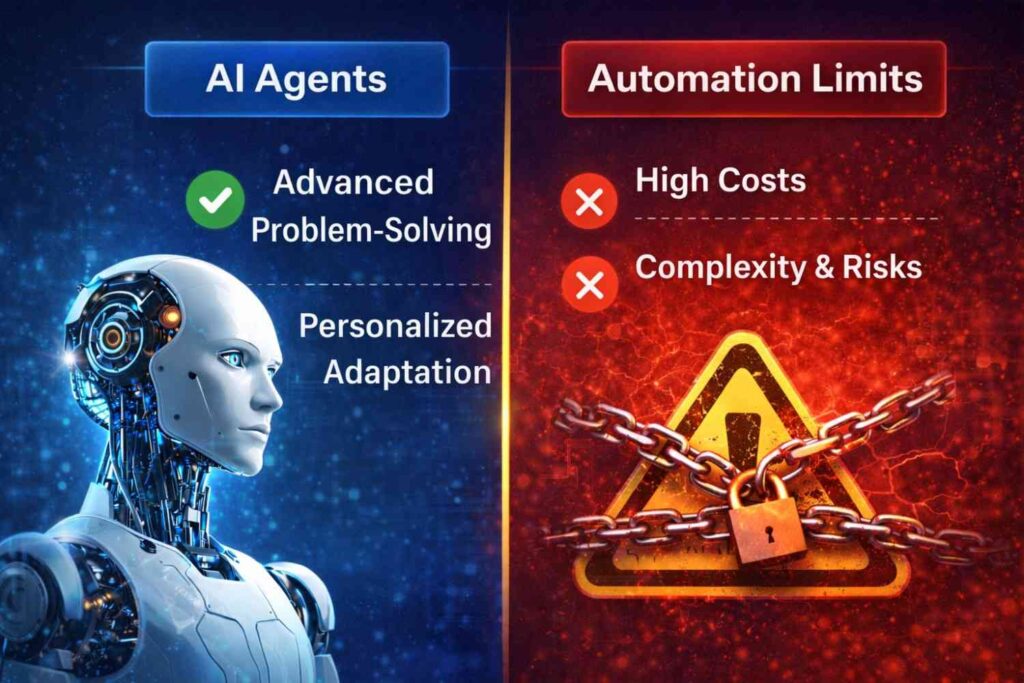
AI Agents Explained: Capabilities, Use Cases, and Business Potential
AI agents can automate workflows that require reasoning across multiple steps, integration with external services, or ongoing monitoring. They are already useful in customer support, scheduling, research assistance, code generation, and e-commerce automation.
Practical use cases
Examples where AI agents shine include:
- Automated customer triage: reading a user message, classifying intent, and either resolving it or routing to the right human team.
- Personal assistants that book travel, manage calendars, and handle follow-ups without repeated human prompts.
- Software development helpers that write, test, and iterate on code by calling build systems and tests.
- Business process automation that chains APIs to complete procurement, invoicing, or reporting tasks.
If you’re considering starting a project or company around these capabilities, you might want to explore ideas tailored to newcomers like AI business ideas for beginners or inspiration geared toward new ventures such as AI startup ideas.
Why agents appeal to businesses
Agents promise reduced human labor for repetitive or structured tasks, faster decision cycles, and the ability to monitor and react continuously. Their modularity means teams can build agents atop existing APIs and models rather than reengineering entire systems.
Limits and Failure Modes of AI Agents
Understanding the limits is as important as understanding the capabilities. Even when AI Agents Explained sounds like a silver-bullet pitch, there are persistent challenges that change how and where agents can be deployed safely and effectively.
Common limitations
- Reliability and hallucination: Agents using language models can produce plausible-sounding but incorrect actions or facts, leading to erroneous API calls or decisions.
- Safety and unpredictable behavior: Goal mis-specification can cause agents to take harmful shortcuts when optimizing for an objective.
- Context and memory drift: Over long interactions, agents lose or misinterpret earlier context unless carefully architected with structured memory.
- Action granularity: Some tasks need fine-grained control or human judgment that agents cannot replicate reliably.
- Security and access control: Granting agents authority to act across systems introduces new attack surfaces and privilege management concerns.
Real-world examples of failure
There are many public and internal examples where agents misinterpreted commands, executed inappropriate transactions, or made decisions that required human rollback. These failures often stem from inadequate prompts, missing constraints, or insufficient validation of outputs before execution.
Design Principles to Mitigate Risks with AI Agents
Designing safe, effective agents requires combining engineering controls, human oversight, and principled objective-setting. When thinking about AI Agents Explained in practice, focus on constraint-first design and clear human-in-the-loop checkpoints.
Practical safeguards
- Constrain actions: Limit what an agent can do (read-only operations, simulated runs, approval gates).
- Validation layers: Add checks that verify outputs against rules or secondary models before execution.
- Transparent logging: Keep auditable trails of decisions and the data that led to them.
- Human oversight: Use humans for edge cases, confirmations, and periodic reviews of agent behavior.
- Least privilege: Give agents the minimal permissions necessary to reduce impact from errors or compromise.
Building and Evaluating AI Agents Explained: Practical Steps
Whether you’re a developer or a product leader, a pragmatic path helps turn prototypes into reliable systems. When considering AI Agents Explained in a development roadmap, break work into clear stages: prototype, safety sandbox, staged deployment, and continuous monitoring.
Development checklist
- Start with a narrowly-scoped agent and well-defined success criteria.
- Create an environment to simulate and test actions without causing real-world effects.
- Implement robust observability: metrics, traces, and human-readable explanations of agent decisions.
- Run red-team scenarios to discover abuse cases and edge failures.
- Plan rollback and recovery processes before wide rollout.
Measuring success
Evaluate agents not just on task completion but on precision, error type frequency, time saved, and human trust. Tracking regressions after model or policy updates is essential to avoid silent degradations.
Ethical and Legal Considerations
AI agents introduce questions about accountability, data privacy, and compliance. When deploying agents that touch personal data or make decisions impacting people, legal and ethical frameworks should guide system design. The responsibility for an agent’s actions is shared among builders, deployers, and sometimes the organizations that authorize its actions.
Key governance points
- Data minimization and purpose limitation: collect and use only what is necessary.
- User consent and transparency: inform users when and how agents act on their behalf.
- Accountability: define who reviews agent behavior and is responsible for errors.
AI agents represent a powerful paradigm shift: they extend automation from single-step outputs to multi-step, adaptive activity. But when discussing AI Agents Explained, it’s crucial to balance enthusiasm with sober engineering and governance so that automation scales without causing avoidable harm.
In short, AI Agents Explained are tools that can transform workflows, launch new services, and change how organizations operate — but only when their limits are respected and mitigations are in place.
Conclusion: AI Agents Explained are a compelling combination of models, planners, and tool use that enable new forms of automation. They offer real business value, which can be explored through resources like AI business ideas for beginners and AI startup ideas, yet they also demand careful design, monitoring, and governance to avoid failures described earlier in this article.



Leave a Reply