
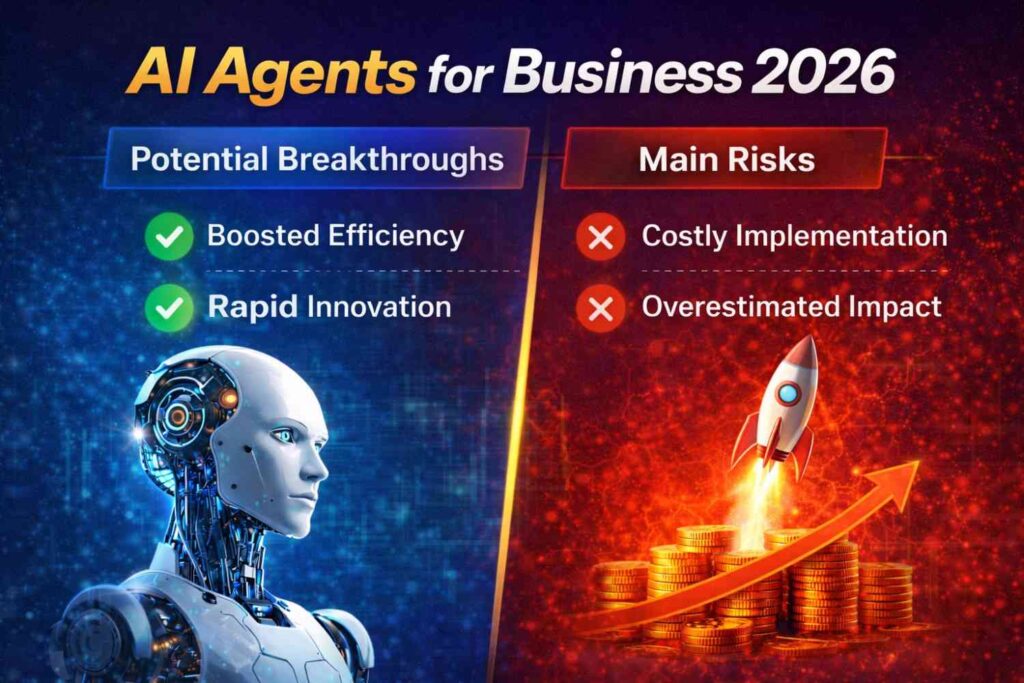
AI Agents for Business are reshaping how organizations automate complex tasks, make decisions, and scale personalized interactions. From autonomous customer-support assistants to process-optimizing orchestration tools, AI Agents for Business promise efficiency gains that many leaders find irresistible—but they also introduce new operational, ethical, and security risks. This post explores whether AI Agents for Business are a clear game-changer or an overhyped risk, offering practical guidance for leaders who must decide when and how to deploy them.
Table of Contents
What are AI Agents for Business?
At their core, AI Agents for Business are software entities that perceive their environment, reason about goals, and take actions to accomplish tasks with varying degrees of autonomy. Unlike simple chatbots or rule-based automations, these agents can plan across multiple steps, collaborate with other systems or humans, and adapt based on feedback. The combination of natural language understanding, planning algorithms, and integration frameworks makes AI Agents for Business distinctively powerful for real-world workflows.
Key characteristics of modern agents
Modern AI agents typically include:
- Perception: interpreting inputs such as text, data streams, or API responses
- Reasoning: selecting goals and planning multi-step actions
- Execution: calling services, updating records, or engaging users
- Learning: improving from outcomes, user corrections, or new data
Why AI Agents for Business are gaining traction
Businesses adopt AI Agents for Business for reasons that go well beyond hype. They can reduce manual workload, accelerate response times, and surface insights that would be hidden in large data sets. For example, an AI agent can autonomously handle invoice processing from receipt through reconciliation, freeing accounting teams to focus on exception management and strategy. Industry reports such as The state of AI report document rapid adoption curves and increasing value capture from AI-driven automation.
Business benefits
Major benefits include:
- Scalability: agents can operate continuously and scale far beyond human capacity
- Consistency: reduced variability in repetitive tasks
- Speed: faster decision loops and time-to-insight
- Personalization: tailoring interactions at scale
Real-world use cases for AI Agents for Business
Real-world examples illustrate both the promise and the limits of AI Agents for Business. Common applications include:
- Customer service agents that resolve common issues and escalate complex ones
- Sales assistants that qualify leads and schedule demos
- IT operations agents that detect incidents, triage, and execute remediation steps
- Finance agents that reconcile accounts, flag anomalies, and prepare audit trails
Some organizations are exploring entirely new business models around autonomous agents, and if you are exploring next steps, resources like AI business ideas for beginners and broader AI business opportunities can help surface practical, low-cost pilots.
Examples across industries
In retail, agents handle inventory forecasting and dynamic pricing adjustments. In healthcare, agents triage patient inquiries and streamline administrative workflows. In logistics, they optimize routing and dynamically reassign drivers based on real-time conditions. Each use case demonstrates how AI Agents for Business can integrate domain knowledge, data, and operational systems to deliver measurable outcomes.
Risks and governance considerations
Where there is power, there are risks. Deploying AI Agents for Business introduces several governance and operational challenges:
- Safety and reliability: autonomous agents may make incorrect decisions if training data is biased or incomplete
- Security: agents with broad system privileges can become attack vectors
- Compliance: data handling and transparency requirements can be difficult to meet when decisions are made autonomously
- Human trust and accountability: unclear ownership of outcomes creates organizational friction
Mitigation strategies
Good governance practices include:
- Role-based access controls and least-privilege principles for agent actions
- Human-in-the-loop checkpoints for high-risk decisions
- Explainability and auditing logs for traceability
- Robust testing across edge cases and adversarial scenarios
How to evaluate and implement AI Agents for Business
Adopting AI Agents for Business should follow a disciplined approach rather than ideation-driven trial and error. Consider the following phased path:
1. Identify high-value, low-risk pilots
Start where outcomes are clear and reversal strategies exist. For instance, automating routine ticket routing or scheduling tasks is lower risk than authorizing financial transactions without oversight. Use pilot results to quantify time savings and error reductions.
2. Define success metrics and controls
Establish KPIs such as cycle time reduction, error rate, cost per transaction, and user satisfaction. Pair each metric with acceptance criteria and rollback plans.
3. Build integrations and data contracts
AI Agents for Business rely on reliable data inputs and well-defined APIs. Invest in data contracts, observability, and monitoring to ensure agents operate on accurate, timely signals.
4. Implement governance and human oversight
Design approval gates and human review points proportional to business impact. Ensure remediation workflows are clear if an agent behaves unexpectedly.
5. Scale with templates and guardrails
Once pilots prove value, scale using standardized templates for common tasks, and embed guardrails—rate limits, permissions, and audit trails—to prevent drift and uncontrolled proliferation of agents.
Measuring ROI and setting realistic expectations
Calculating the return on investment for AI Agents for Business requires balancing direct savings with less tangible benefits like improved customer experience. Typical ROI sources include reduced labor costs, faster processing times, and fewer downstream errors. However, initial costs can include integration engineering, data cleanup, governance frameworks, and staff training. Leaders should model both upfront and ongoing costs over a realistic time horizon.
Practical tips for ROI
- Track end-to-end throughput rather than isolated task speed to capture full value
- Account for continuous improvement—agents often improve after deployment as they learn
- Measure user acceptance; human augmentation often yields higher long-term returns than full automation
Future outlook: transformative or incremental?
The future of AI Agents for Business will likely be a mix of both transformation and incremental improvement. In roles characterized by routine decision-making and abundant structured data, agents can be transformative—redefining job roles and operational models. In domains requiring deep expertise, nuance, and high-stakes judgment, they will more often serve as assistants that augment human capabilities. Industry discussions and research continue to evolve; for ongoing context, sources like AI in business insights provide timely perspectives on trends and leadership practices.
Preparing teams and tech stacks
Organizations that succeed will prepare both their teams and infrastructure. Technical readiness includes modular APIs, observability, and scalable compute. Cultural readiness includes training programs, change management, and clear policies for accountability. If you are exploring how to monetize or build new offerings around autonomy, check out practical marketplaces and idea resources for inspiration, such as those that surface early-stage AI business ideas for beginners.
Making the call: game-changer or overhyped risk?
AI Agents for Business are neither a universal panacea nor a mere fad. They are game-changing in contexts where rules are well-defined, data is reliable, and outcomes are measurable. They can be overhyped when organizations underestimate governance, data quality, or the cultural changes required. The right approach is pragmatic: experiment quickly with guardrails, measure outcomes rigorously, and scale selectively.
Decisions about AI Agents for Business should be driven by clear business problems and a willingness to invest in controls and monitoring. When applied thoughtfully, these agents can unlock productivity, improve customer experiences, and create new business models. When applied carelessly, they can amplify bias, expose systems to risk, and erode trust.
Conclusion: AI Agents for Business offer meaningful advantages and real risks. With disciplined evaluation, strong governance, and a focus on human augmentation, most organizations can capture value while managing downside. Consider pilot projects that deliver fast feedback, prioritize transparency and security, and treat AI agents as part of a broader transformation rather than a silver bullet.


Leave a Reply