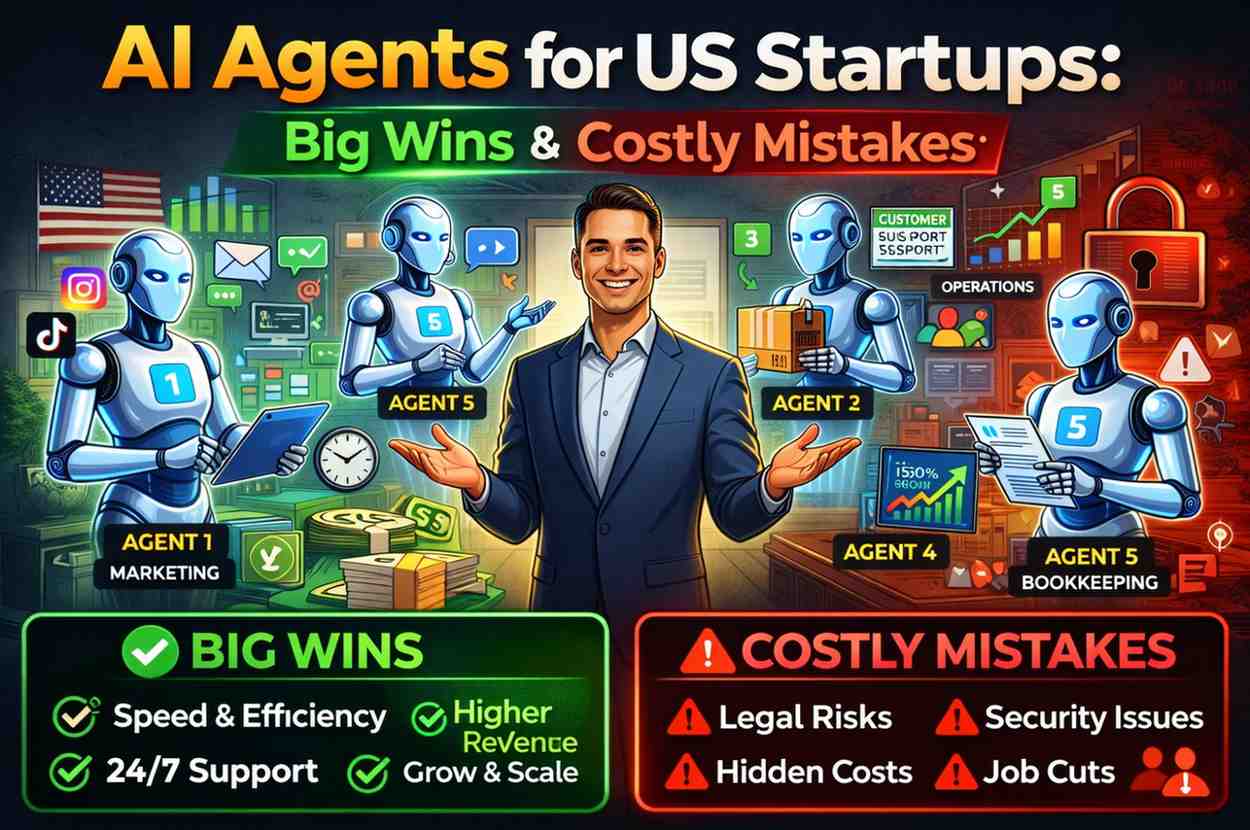
AI agents for startups USA are changing how early-stage companies operate, automating repetitive tasks, personalizing customer experiences, and accelerating product development. For founders and CTOs in the United States, deploying AI-driven agents can mean the difference between scaling quickly and wasting precious runway. This article walks through real big wins and costly mistakes seen across US startups, offering practical guidance so your team can extract value without common pitfalls.
Table of Contents
Big Wins: How AI agents for startups USA accelerate growth
Many US startups have reported outsized returns after integrating AI agents for startups USA into key workflows. These agents—ranging from task-specific bots to multi-step orchestration systems—help teams be leaner and more responsive to customers. Below are repeatable wins that founders can pursue today.
Faster product iteration with autonomous testing
AI agents for startups USA can automate testing pipelines, generate realistic synthetic data, and run regression checks far faster than manual teams. Startups that use these agents shorten feedback loops, release more frequent updates, and reduce defect rates—improving product-market fit velocity.
Customer support and revenue uplift
When startups deploy conversational agents and escalation logic, basic issues are resolved instantly and human agents focus on high-value cases. Investing in conversational AI agents has shown measurable improvements in conversion and retention. For teams building customer-facing flows, consider integrating AI chatbots for business that route, summarize, and escalate smartly.
Efficient marketing and lead qualification
Marketing teams use AI agents for startups USA to triage inbound leads, personalize outreach, and run A/B experiments at scale. Agents can score leads based on multi-channel signals and recommend the next best action. This reduces wasted SDR time and increases touch-to-close rates.
Cost savings through automation
Well-implemented AI agents for startups USA reduce operational overhead by automating repetitive manual tasks like invoice processing, scheduling, and data entry. Many startups recoup implementation costs within months, enabling them to redeploy human talent to strategic initiatives. For enterprise-focused startups, pairing automation with clear governance—using vetted platforms and monitoring—is essential. Explore practical automation stacks and consider platforms labeled as AI automation tools to speed adoption.
Hidden costs: Common mistakes with AI agents for startups USA
While success stories are compelling, many US startups trip over the same obstacles when deploying AI agents for startups USA. Understanding and avoiding these mistakes saves time, money, and reputation.
Poor data hygiene and unrealistic expectations
AI agents are only as good as the data that trains and feeds them. Startups that rush rollout without cleaning historical records, structuring inputs, or validating labels often produce unreliable behavior. Combine incremental pilots with measurable KPIs to align expectations with reality.
Underestimating integration complexity
Many founders assume AI agents will plug into existing systems smoothly. In practice, integrations with CRMs, billing systems, and analytics platforms require mapping, transformation logic, and error handling. Failing to invest in robust connectors leads to brittle systems that break under scale.
Neglecting human-in-the-loop design
Removing humans entirely is rarely the best approach. Successful teams design human-in-the-loop workflows where agents handle routine tasks and humans intervene for edge cases, reviews, and continuous improvement. This hybrid approach balances automation and quality while reducing risk.
Compliance and security oversights
Startups operating in regulated verticals often overlook privacy, data residency, and audit requirements when deploying AI agents for startups USA. Implement strict access controls, encryption, and logging from day one. For research-backed perspectives on industry trends and risk, consult resources such as CB Insights AI.
Choosing the right agent architecture for US startups
There is no one-size-fits-all. Your choice depends on product stage, team expertise, and customer expectations. Below are architectures commonly adopted by startups across the US.
Assistant agents for internal productivity
These agents focus on automating administrative tasks (calendar, notes, simple data entry) and are typically low-risk to deploy. Use them to prove ROI quickly and build internal champions.
Customer-facing conversation agents
For external use, prioritize natural language understanding, escalation pathways, and sentiment detection. Balance automation with clear messaging about when users are interacting with an agent vs. a human. Resources like the Y Combinator Library provide startup playbooks on product-market fit and customer development that can inform agent design.
Hybrid orchestration agents
These agents coordinate multiple services—APIs, internal databases, third-party tools—to carry out multi-step workflows. They are powerful but require strong observability and transaction tracing.
Operational best practices when deploying AI agents for startups USA
Operational discipline determines whether AI agents become strategic assets or liabilities. The following practices help US startups scale agents responsibly.
Start with narrowly scoped pilots
Define measurable success criteria, pick a non-critical workflow, and run a short pilot. Use pilot results to refine prompts, data flows, and handoff logic before broader rollout.
Monitor performance and set guardrails
Implement monitoring for accuracy, latency, and user satisfaction. Establish thresholds that trigger human review and versioning for model updates. Continuous evaluation reduces drift and keeps agents aligned with business goals.
Invest in explainability and documentation
Document training data sources, decision logic, and escalation rules. This helps on-board new hires, meet audit demands, and debug unexpected behavior.
Budget for ongoing maintenance
AI agents require maintenance: retraining models, updating integrations, and fixing edge cases. Budget recurring cycles for iteration rather than viewing deployment as a one-time project.
Investor and hiring considerations for startups using AI agents for startups USA
Investors and talent assess a startup’s ability to deploy AI responsibly. Demonstrating governance, reproducible results, and a clear roadmap increases confidence.
Hiring for the right skills
Look for generalist engineers who can build reliable connectors, data engineers who can ensure clean pipelines, and product managers who understand human-machine workflows. These roles help turn agent prototypes into production-ready systems.
Investor questions you should be ready to answer
Prepare to explain how your agents impact unit economics, the roadmap for agent enhancement, and contingency plans for failures. Show metrics and case studies, not just theoretical benefits.
Practical toolkit and next steps
If you’re evaluating AI agents for startups USA, begin with a checklist and toolkit that simplifies experimentation:
- Define a measurable pilot objective (time saved, deflection rate, conversion uplift).
- Choose an initial workflow with clear inputs and outputs.
- Use modular platforms for rapid integration and rollback.
- Design human-in-the-loop escalation and logging from day one.
- Measure and iterate—track user satisfaction and operational costs.
Leverage available resources on product development and AI trends to inform strategy—both the Y Combinator Library and sector research like CB Insights AI can provide useful playbooks. For practical toolsets, investigate vendor lists and integrations labeled as AI automation tools and consider customer-facing options such as AI chatbots for business.
Adopting AI agents for startups USA is a high-leverage move when executed with discipline. Start with clear metrics, prioritize safety and observability, and scale incrementally to capture the big wins while avoiding the common costly mistakes.
Conclusion: Thoughtful deployment of AI agents for startups USA can transform operations and customer experience, but the difference between a strategic advantage and a costly failure lies in planning, data quality, and governance. Follow the practices outlined above to maximize upside and minimize risk.




Leave a Reply