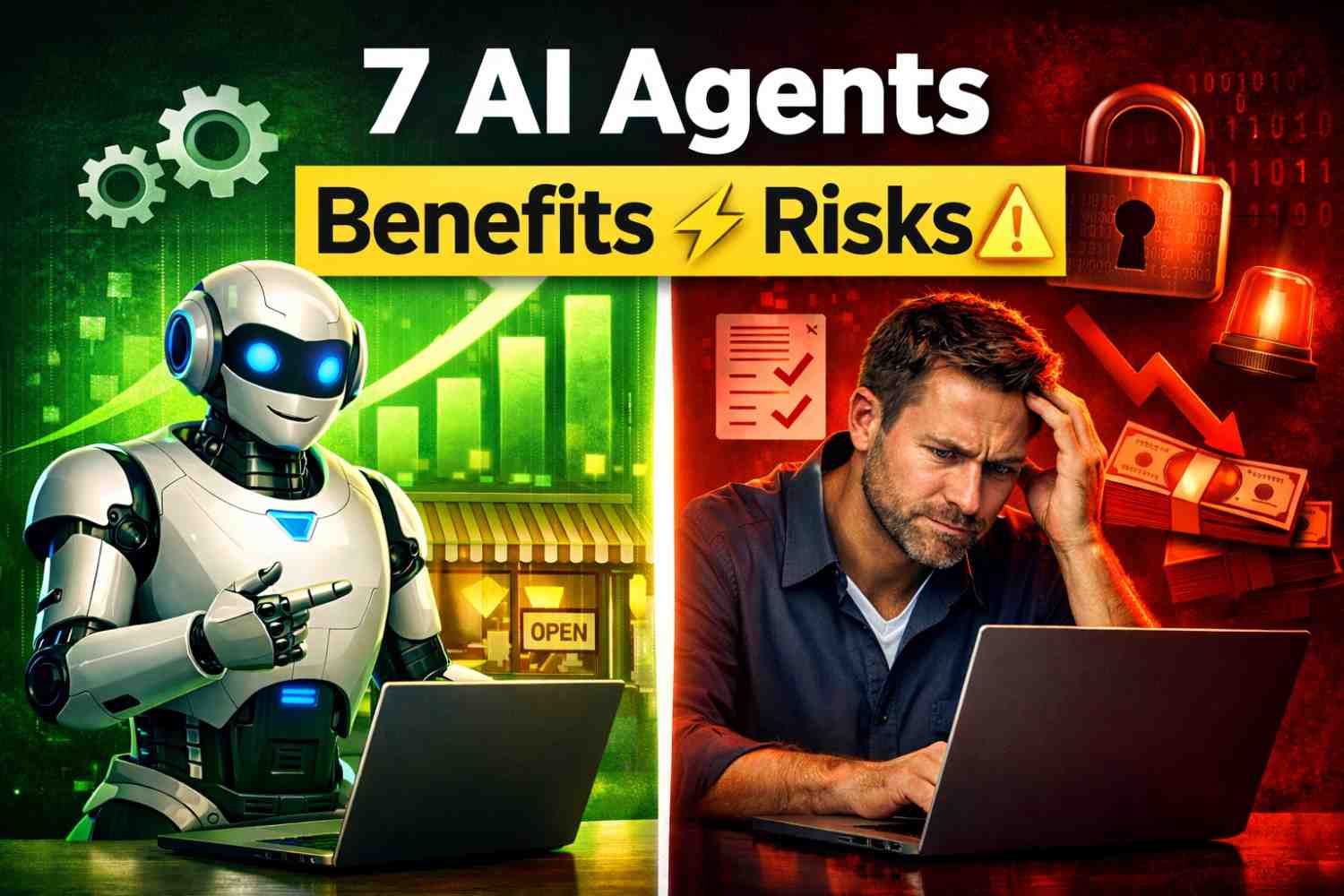
AI agents for US small businesses are transforming how owners handle repetitive tasks, engage customers, and make data-driven decisions. For many entrepreneurs, these autonomous or semi-autonomous systems promise time savings, lower costs, and professional-quality outputs without hiring large teams. Yet adoption comes with real trade-offs — from data privacy issues to reliance on third-party platforms. This post outlines seven practical AI agents that US small businesses can deploy, shows where they deliver the most value, and highlights real risks you must manage before hitting “deploy.”
Table of Contents
Top 7 AI agents for US small businesses
Virtual administrative assistant
A virtual administrative assistant is one of the most accessible AI agents for US small businesses, automating scheduling, email triage, and simple document preparation. These agents can integrate with calendars and CRM systems to reduce back-and-forth and free owners to focus on strategy rather than coordination.
- Benefits: saves hours on scheduling and follow-ups, reduces missed appointments, improves response time.
- Risks: calendar access creates privacy exposures; mistakes in auto-responders can appear unprofessional.
Customer support and conversational agent
AI agents for US small businesses often include customer-facing chat agents that answer FAQs, route tickets, and escalate complex issues to humans. When trained properly, they keep response times low and maintain consistent service during off-hours.
- Benefits: 24/7 availability, scalable handling of common questions, reduced support costs.
- Risks: misunderstanding user intent, failing on edge cases, and giving incorrect or legally sensitive advice.
Sales lead qualification agent
A sales lead qualification agent can analyze inbound leads, score prospects, and even draft personalized outreach. Small sales teams can use these AI agents for US small businesses to focus on closing rather than initial triage.
- Benefits: faster lead response, higher conversion rates, better lead prioritization.
- Risks: biased scoring models, missed nuance from human interactions, potential CRM integration mistakes.
Marketing content and campaign agent
Content-generation agents help create email copy, social posts, and ad variations. For many owners, these AI agents for US small businesses deliver a consistent content cadence without hiring a full marketing staff.
- Benefits: speeds content production, supports A/B testing, repurposes assets across channels.
- Risks: generic or off-brand voice, copyright concerns, and the need for human editing to maintain quality.
Bookkeeping and finance agent
Automated bookkeeping agents categorize transactions, reconcile accounts, and prepare basic reports. These AI agents for US small businesses can reduce accounting overhead and highlight cash flow issues earlier.
- Benefits: lower bookkeeping time, fewer human errors, faster month-end close.
- Risks: errors in categorization, overreliance without human review, and sensitive financial data exposure.
HR and hiring agent
Recruiting agents screen resumes, schedule interviews, and help keep candidate pipelines organized. For small teams, these AI agents for US small businesses can dramatically shorten hiring cycles.
- Benefits: faster screening, consistent candidate experiences, automated interview setup.
- Risks: biased screening, legal exposure around hiring practices, and misclassification of candidate suitability.
Security and monitoring agent
Security-focused AI agents monitor networks and flag suspicious activity. Small businesses can use these AI agents for US small businesses to gain enterprise-grade alerting without hiring a full security operations center.
- Benefits: early detection of threats, automated incident triage, continuous monitoring.
- Risks: false positives that create alert fatigue, missed novel threats, and dependence on vendor detection rules.
Powerful benefits of AI agents for US small businesses
Across these seven examples, the common benefits of adopting AI agents for US small businesses are clear: improved efficiency, cost reduction, better customer experiences, and data-driven decision-making. Small teams gain leverage — a single owner can accomplish far more with a toolset that automates rote work and delivers analytics.
When exploring options, many businesses start by combining background automation with customer-facing conversational systems. For workflow automation, consider looking into curated resources like AI automation tools, and for client-facing interactions explore implementations referenced in AI chatbots for business. For further reading on broader enterprise AI research and trends, reputable sources like IBM AI and reporting from Forbes AI provide useful context.
Risks of AI agents for US small businesses
Deploying AI agents for US small businesses introduces risks that are often less visible until they materialize. Data privacy and compliance top the list: many agents require access to customer records, financials, or proprietary workflows. Misconfiguration can lead to leaks or regulatory violations.
Other risks include model bias, poor training data, over-automation, and vendor lock-in. Small companies should recognize that an AI agent’s decision is only as good as its training and monitoring.
Legal, privacy, and compliance concerns
AI agents for US small businesses that process personal data must comply with privacy laws (federal and state-level, such as CCPA/CPRA where applicable). Maintaining data subject access controls, retention schedules, and consent records is critical. Work with counsel when agents touch sensitive categories like health, financial, or children’s data.
Operational and reputational risks
If an AI agent gives a customer bad advice, posts inaccurate content, or leaks data, small brands can suffer reputational harm that is disproportionate to their size. Mitigation requires clear escalation paths, human review of critical outputs, and transparent customer communication about automated interactions.
How to evaluate and implement AI agents safely
Adopting any of these AI agents for US small businesses should follow a short checklist to reduce risk:
- Define the problem and success metrics before buying or building an agent.
- Start small with pilot projects and a human-in-the-loop review process.
- Audit training data for bias and accuracy; validate outputs against real cases.
- Limit data access using least-privilege principles and strong encryption.
- Document vendor responsibilities, SLAs, and exit strategies to avoid lock-in.
Remember that many vendors provide pre-built agents, while some businesses will prefer to stitch together functionality using AI automation tools and custom integrations. For customer-facing features, evaluate options in the AI chatbots for business space and test them on real users before broad rollout.
Governance and monitoring
Set up simple governance: a list of approved agents, data access logs, and monthly performance reviews. Use alerts for anomaly detection so that when an AI agent behaves unexpectedly you can quickly disable or quarantine it. Ensure human oversight for any high-impact decisions (refunds, contract changes, hiring).
Cost and ROI expectations
Small businesses should calculate expected time savings and the cost of human supervision when forecasting ROI. Some AI agents pay off in a few months by eliminating repetitive tasks; others are long-term investments that improve outcomes over time. Keep a realistic view of implementation costs, integration effort, and the need for ongoing maintenance.
Finally, stay informed. The AI landscape changes quickly: new capabilities, regulations, and vendor offerings emerge regularly. Trusted industry sources like IBM AI and editorial coverage such as Forbes AI can help you make better strategic choices.
AI agents for US small businesses offer powerful advantages but are not zero-risk commodities. By understanding specific agents—virtual assistants, chatbots, sales engines, content generators, finance tools, hiring aides, and security monitors—and by applying careful governance and pilot-driven implementation, small companies can capture efficiency gains while limiting exposure.
Conclusion: As you evaluate AI agents for US small businesses, prioritize clear objectives, human oversight, and strong data safeguards. With those guardrails in place, the seven agents outlined here can deliver outsized value for small teams while keeping real risks manageable.



Leave a Reply