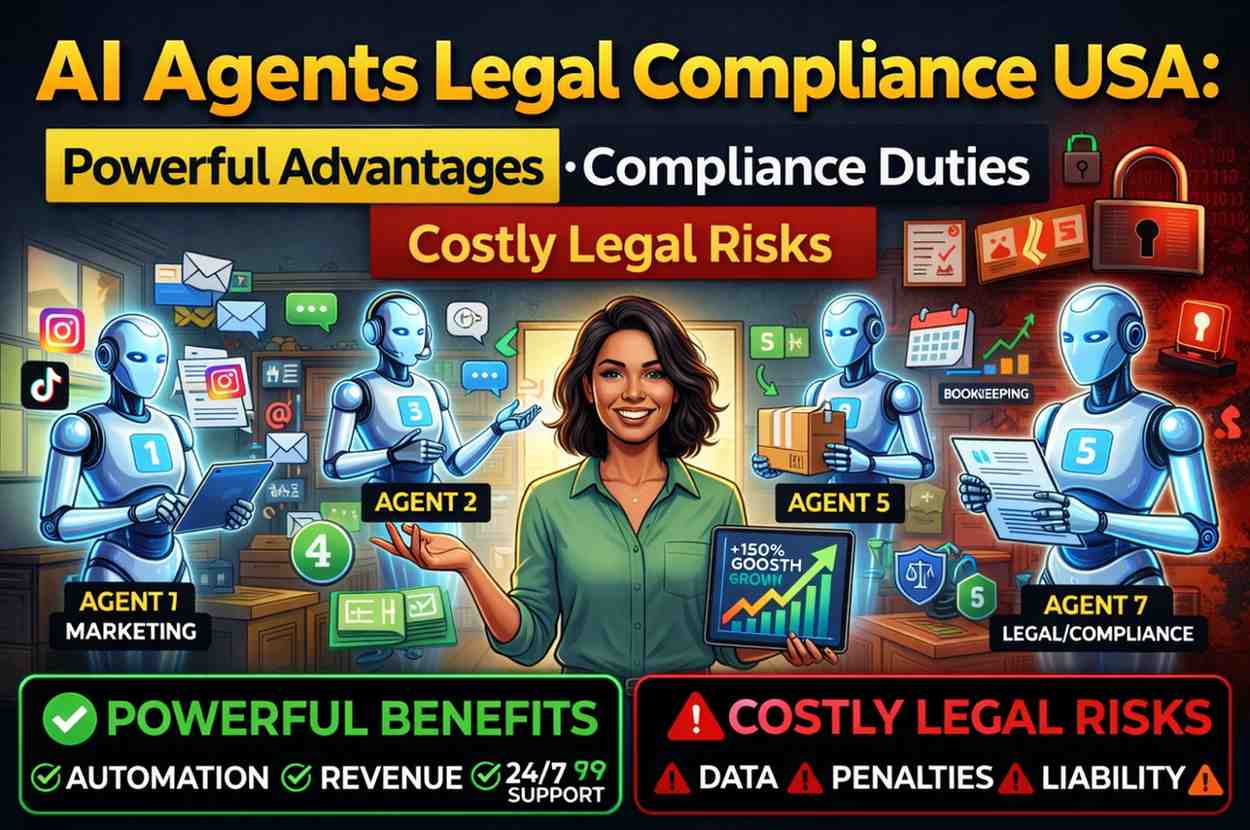
Adopting AI agents is no longer a futuristic choice for American organizations — it’s a strategic imperative. But careful attention to AI agents legal compliance USA is essential: businesses that deploy autonomous systems gain productivity and scalability, yet they also assume legal responsibilities that can affect contracts, privacy, and consumer safety. This article explains the legal benefits, compliance pathways, and hidden risks U.S. companies must weigh when implementing AI agents legal compliance USA as part of their operations.
Table of Contents
AI agents legal compliance: Legal benefits for US businesses
When companies prioritize AI agents legal compliance , they unlock several legal and commercial advantages. Clear rules and documented compliance processes reduce litigation exposure, speed contract negotiations, and enhance trust with customers, partners and regulators. Demonstrating a commitment to AI agents legal compliance USA can also support bids for government contracts and strengthen investor confidence.
Reduced liability through governance
Robust governance policies help map responsibility for decisions made by AI systems. By establishing auditable records, decision logs, and human oversight, firms practicing AI agents legal compliance can limit the legal uncertainty around causation and foreseeability. This reduces the risk of negligence claims where plaintiffs might otherwise argue that an AI agent acted unpredictably.
Commercial and contractual advantages
Contract provisions that reflect AI agents legal compliance — like warranties about data use, audit rights, and indemnities — create clearer expectations with vendors and clients. As courts and regulators increasingly expect demonstrable compliance, companies citing AI agents legal compliance USA in procurement and vendor agreements can streamline disputes and preserve revenue streams.
AI agents legal compliance USA: Regulatory frameworks and practical steps
Understanding how AI agents legal compliance USA intersects with U.S. law requires a practical compliance program. A program built around risk assessment, documentation, and continuous monitoring aligns technology practices with current U.S. regulatory expectations and helps prepare for future rules.
Key regulatory touchpoints
Several federal and state authorities have interest in AI-related conduct. For consumer-facing systems, expectations set by the Federal Trade Commission about unfair or deceptive practices are particularly relevant. In healthcare, adherence to HIPAA Compliance rules is mandatory when AI agents handle protected health information. Integrating these touchpoints into an AI agents legal compliance USA strategy prevents downstream enforcement risks.
Practical compliance steps
Companies taking AI agents legal compliance USA seriously should adopt a stepwise program:
- Conduct an AI inventory and map high-risk use cases.
- Perform algorithmic impact assessments and document decision logic where possible.
- Implement data governance controls and retention policies consistent with applicable privacy laws.
- Establish human-in-the-loop processes and escalation protocols for high-stakes outcomes.
- Create contractual clauses that reflect AI-specific warranties, audit rights, and liability allocations.
Hidden risks of AI agents legal compliance USA: Privacy, bias and third-party reliance
Even with the best intentions, hidden pitfalls can undermine AI agents legal compliance USA. These risks include inadvertent privacy breaches, discriminatory outputs, and third-party dependencies that transfer regulatory obligations.
Privacy and data protection
AI agents often require large datasets. Without appropriate controls, training or inference can expose personal data or re-identify individuals, which contradicts AI agents legal compliance USA commitments. For healthcare and life sciences companies, blending AI with clinical data without satisfying HIPAA Compliance obligations can trigger significant penalties and reputational harm.
Algorithmic bias and discrimination
Biases in training data can produce unlawful disparate impacts. Firms that ignore bias mitigation undermine their AI agents legal compliance USA posture and invite investigations or private lawsuits. Regular bias testing, remediation plans, and transparent reporting help reduce the legal susceptibility of AI deployments.
Third-party models and vendor risk
Off-the-shelf models and vendors accelerate deployment, but they can complicate AI agents legal compliance USA. Contracts should require vendors to support audits, provide model provenance, and maintain security certifications. Failing to manage vendor risk can leave organizations accountable for noncompliant model behavior.
Operationalizing AI agents legal compliance USA: Governance, contracts and training
Tactical implementation is where legal exposure meets operational reality. An effective approach to AI agents legal compliance USA combines governance structures, contractual safeguards, technical controls, and employee training.
Governance and accountability
Set up an interdisciplinary governance board that brings together legal, compliance, engineering, product, and privacy representatives. A governance team enforces the AI agents legal compliance USA requirements and reviews high-risk projects before deployment.
Contracting and liability allocation
When buying or licensing AI technology, negotiate terms that reflect AI agents legal compliance USA needs: clear service-level expectations, indemnities for regulatory fines when attributable to vendor fault, data usage limits, and audit rights. These provisions reduce ambiguity and distribute risk more predictably across parties.
Training and change management
Human oversight matters. Train product teams, customer support, and legal staff on AI agents legal compliance USA essentials: how to recognize risky outputs, how to escalate issues, and how to document corrective actions. Continuous education ensures that compliance is embedded into daily workflows.
Enforcement landscape and what to watch next for AI agents legal compliance USA
Enforcement trends are evolving rapidly. Agencies have signaled interest in AI-related harms, and private plaintiffs are already testing legal theories. To stay ahead, organizations should monitor regulatory guidance such as the consumer protection materials from the Federal Trade Commission, and adapt internal policies accordingly as part of their AI agents legal compliances USA roadmap.
State laws and sector-specific rules
Several states are exploring AI disclosure and accountability statutes. In regulated industries — finance, healthcare, transportation — sectoral rules may impose additional compliance duties that extend ordinary AI agents legal compliances USA obligations. Mapping these variations is essential for multi-state operations.
Litigation risks and record-keeping
Good records are defensive assets. Maintain documentation of risk assessments, model testing, and remediation steps to defend decisions. Courts and regulators increasingly expect organizations to show proactive steps toward AI agents legal compliance USA rather than reactive fixes after harm occurs.
Practical tools and resources to support AI agents legal compliance USA
Several practical resources can accelerate compliance efforts. Technology solutions for monitoring, explainability, and audit trails pair with legal templates and governance checklists. Organizations can also explore trusted platforms for automation and customer interaction, including AI automation tools that integrate compliance controls, and adopt tailored solutions such as AI chatbots for business that offer built-in data handling safeguards.
When to involve counsel and regulators
Bring legal counsel in early for high-risk projects and notify regulators when required. Early engagement can mitigate enforcement outcomes and align product design with AI agents legal compliance USA priorities. In sectors with specific regulatory oversight, pre-submission consultations can be particularly valuable.
AI agents offer compelling benefits, but realizing them safely in the United States requires a disciplined approach to AI agents legal compliance USA. By combining governance, contractual protections, technical controls, and continuous monitoring — and by leveraging available resources such as specialized automation tools and compliant chatbot platforms — organizations can minimize hidden risks while maximizing legal and commercial benefits.
Conclusion: Prioritizing AI agents legal compliance USA is not optional; it is central to responsible adoption. Companies that build compliance into the lifecycle of AI projects will protect customers, reduce legal exposure, and secure lasting business value in a landscape where regulators and stakeholders increasingly demand accountability.



Leave a Reply