
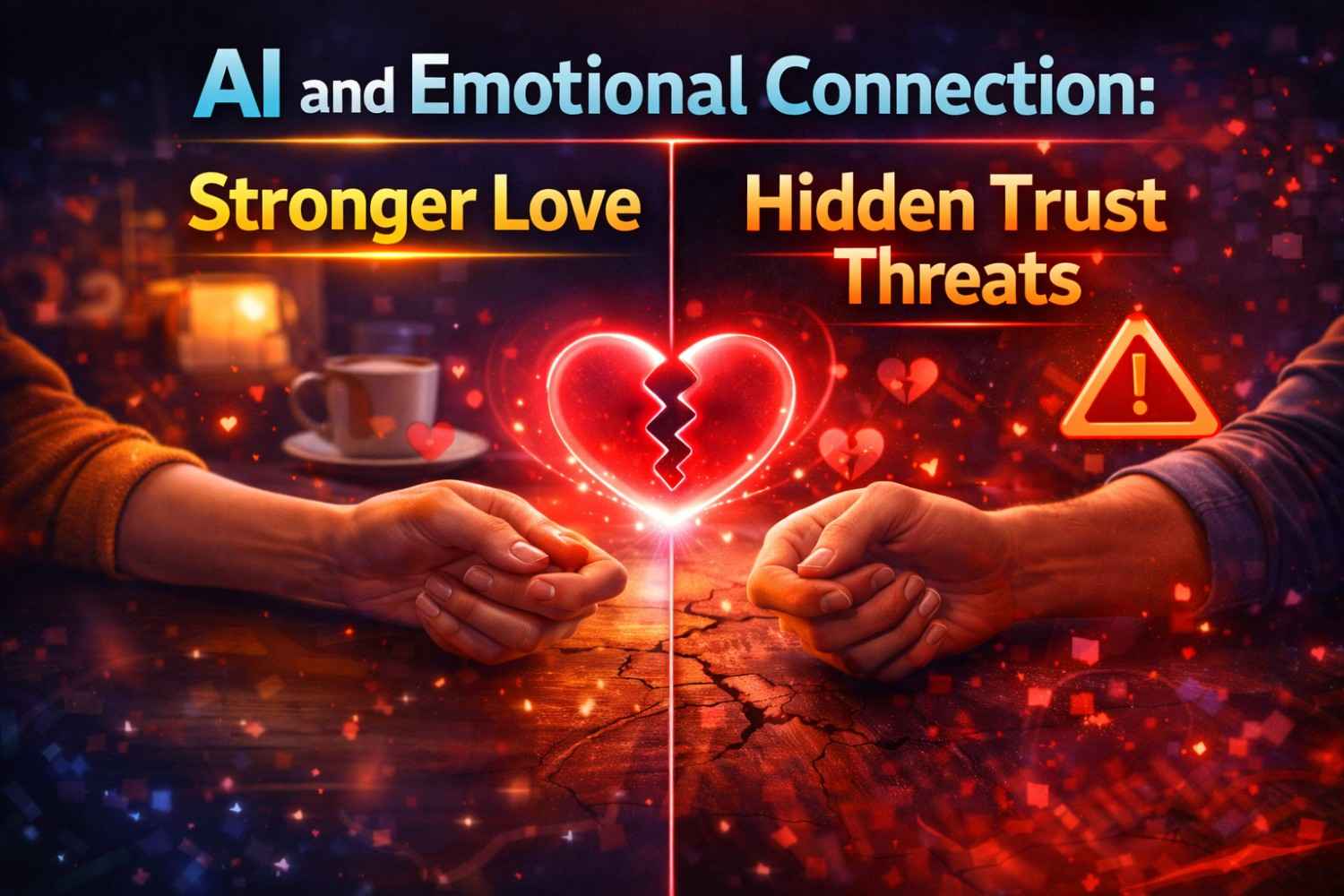
AI and Emotional Connection is no longer a futuristic phrase — it’s an everyday reality shaping how people give and receive affection. From gentle reminders that help partners celebrate milestones to conversational agents that model empathetic listening, AI can deepen intimacy and make emotional care more consistent. For couples curious about integrating technology thoughtfully, resources like the AI emotional connection guide offer practical starting points. In this post I’ll explore six concrete ways AI strengthens love, five hidden threats to trust, and clear steps to keep technology aligned with human needs.
Table of Contents
AI and Emotional Connection: 6 Ways AI Strengthens Love
1. Personalized reminders that preserve memory and meaning
Small actions — remembering an anniversary, checking in after a long day — are the glue of long-term relationships. AI tools can learn patterns of important dates and preferences, prompting thoughtful behaviors without nagging. When a calendar agent suggests a surprise dinner because it learned one partner prefers quiet celebrations, the act feels thoughtful rather than automated. These micro-supports help partners feel seen, reinforcing emotional safety and strengthening the AI and emotional connection within daily life.
2. Improving communication with reflective prompts
AI-driven apps can coach couples to communicate more clearly by offering reflective prompts or rephrasing tense messages before they are sent. By introducing a cooling-off prompt or suggesting “I feel” language, AI reduces reactive conflict and fosters constructive dialogue. Over time, these habits change how partners interact, and the AI and emotional connection becomes a scaffold that nurtures healthier communication patterns.
3. Enhancing emotional intelligence through feedback
Some platforms analyze tone and emotional cues in conversations and provide gentle feedback about empathy or active listening. That feedback helps people become more attuned to subtle emotional shifts. When used respectfully, this kind of augmentation can accelerate emotional learning and make the AI and emotional connection feel less like technology interference and more like supportive coaching.
4. Facilitating shared rituals and experiences
AI can curate playlists, suggest date ideas, or coordinate schedules so partners have more shared time. By reducing friction in planning and discovery, AI helps couples invest in rituals that deepen attachment. These shared experiences — suggested by algorithms tuned to both partners’ tastes — can amplify closeness and strengthen the AI and emotional connection as a cooperative tool.
5. Providing low-risk practice spaces for vulnerability
Role-play bots and simulated conversations give individuals a safe place to rehearse hard talks or express emotions they find difficult in the moment. Practicing vulnerability with a neutral AI can increase confidence and translate into more openness with a partner. That bridge between private practice and real-life courage is a subtle but powerful way AI and emotional connection can reinforce intimacy.
6. Supporting mental health and relational resilience
AI-enabled symptom trackers, mood journals, and therapy-adjacent chat tools make it easier to notice when stress or depression affects a relationship. When partners have early signals, they can seek help sooner or adjust expectations compassionately. Integrating AI into emotional care routines — while keeping human support available — strengthens the safety net for couples and the broader idea of AI and emotional connection.
AI and Emotional Connection: 5 Hidden Threats to Trust
1. Erosion of perceived authenticity
When AI crafts messages, schedules surprises, or manages apologies, partners may wonder whether expressions of care are genuine. If one person suspects that a heartfelt text was actually generated by an assistant, feelings of betrayal can follow. Addressing authenticity requires transparency: partners should agree on how AI will be used so the AI and emotional connection remains a trusted enhancement rather than a replacement for sincere effort.
2. Privacy leaks and unintended exposure
AI systems often rely on sensitive conversational data. If such data is breached, intimate details can be exposed, damaging trust irreparably. Couples using AI tools should evaluate data handling policies, opt for local processing when possible, and limit what they share with third-party services to reduce risk to the AI and emotional connection that depends on privacy.
3. Bias and misinterpretation
AI models can misread cultural cues, sarcasm, or idiosyncratic expressions, leading to inappropriate advice or harmful suggestions. That misinterpretation can inflame conflicts rather than resolve them. Being mindful of an AI’s limitations and combining its input with human judgment helps protect relational trust and keeps the AI and emotional connection constructive.
4. Over-reliance on automation for emotional labor
Emotional labor — remembering preferences, comforting after a bad day — is part of intimate relationships. Offloading too much of this labor to AI may leave partners feeling unvalued if the human element diminishes. Maintaining balance means using AI to assist but not replace the emotional work that builds mutual appreciation, safeguarding the warmth at the core of AI and emotional connection.
5. Manipulation through hyper-personalization
Highly personalized recommendations can be used to steer behavior in subtle ways. In relationships, this could mean nudges that prioritize one partner’s agenda over another’s, or targeting vulnerabilities during conflict. Awareness, clear boundaries, and selecting tools with ethical design principles help couples preserve autonomy and trust in their AI and emotional connection.
Practical Ways to Preserve Trust While Using AI
Set shared agreements about AI use
Before introducing assistants or apps into your relationship routines, discuss what feels acceptable: will an AI draft love notes, or only suggest date ideas? Clear, shared agreements prevent surprises and increase mutual comfort with technology’s role in emotional life.
Prioritize tools with transparent data policies
Choose platforms that explain how they store and use data. When privacy practices are clear, it’s easier to maintain confidence that personal conversations won’t be repurposed or exposed, preserving the trust that underpins AI and emotional connection.
Use AI as a supplemental coach, not a substitute
Allow AI to help improve skills — like active listening or scheduling quality time — while keeping the responsibility for emotional labor human. When AI is framed as a coach, partners remain the primary agents of care and affection.
Combine AI insights with professional support when needed
AI tools can surface patterns that suggest a need for deeper help. If relationship issues persist, professional guidance available through services like online relationship support or resources on emotional bonding in couples can provide context and therapeutic strategies beyond algorithmic suggestions.
Regularly review and recalibrate
Relationships evolve, and so should the role of technology in them. Schedule periodic check-ins about AI usage, adjust permissions, and remove features that no longer serve both partners. Continuous conversation helps maintain a healthy AI and emotional connection over time.
Bringing It Together: Designing for Connection
Favor empathy-first design
Products that prioritize emotional safety, consent, and explainability are better suited for intimate contexts. Developers and users who demand empathy-first features help ensure AI enhances rather than harms closeness.
Educate couples about realistic expectations
Understanding what AI can and cannot do reduces disappointment. Use guides like the Technology and relationships resource to set realistic intentions and discover tools that align with your values.
Blend human care with thoughtful automation
When AI handles routine tasks and supports emotional skill-building while humans provide meaning and authenticity, the combination amplifies intimacy. That balanced approach is the healthiest path for an enduring AI and emotional connection.
AI and Emotional Connection holds remarkable promise: it can amplify empathy, reduce friction, and help partners grow together. But it also carries risks to authenticity, privacy, and trust if deployed without care. By setting boundaries, choosing transparent tools, and leaning on human judgment (and professional resources like online relationship support or research on emotional bonding in couples), couples can enjoy the benefits while minimizing harm. Explore practical recommendations in the AI emotional connection guide and continue the conversation about how Technology and relationships should evolve to support genuine, lasting love.
Conclusion: Thoughtful use of AI can deepen bonds, but trust requires transparency and human attention; keeping the AI and Emotional Connection aligned with shared values will let technology be an ally rather than a threat.



Leave a Reply