
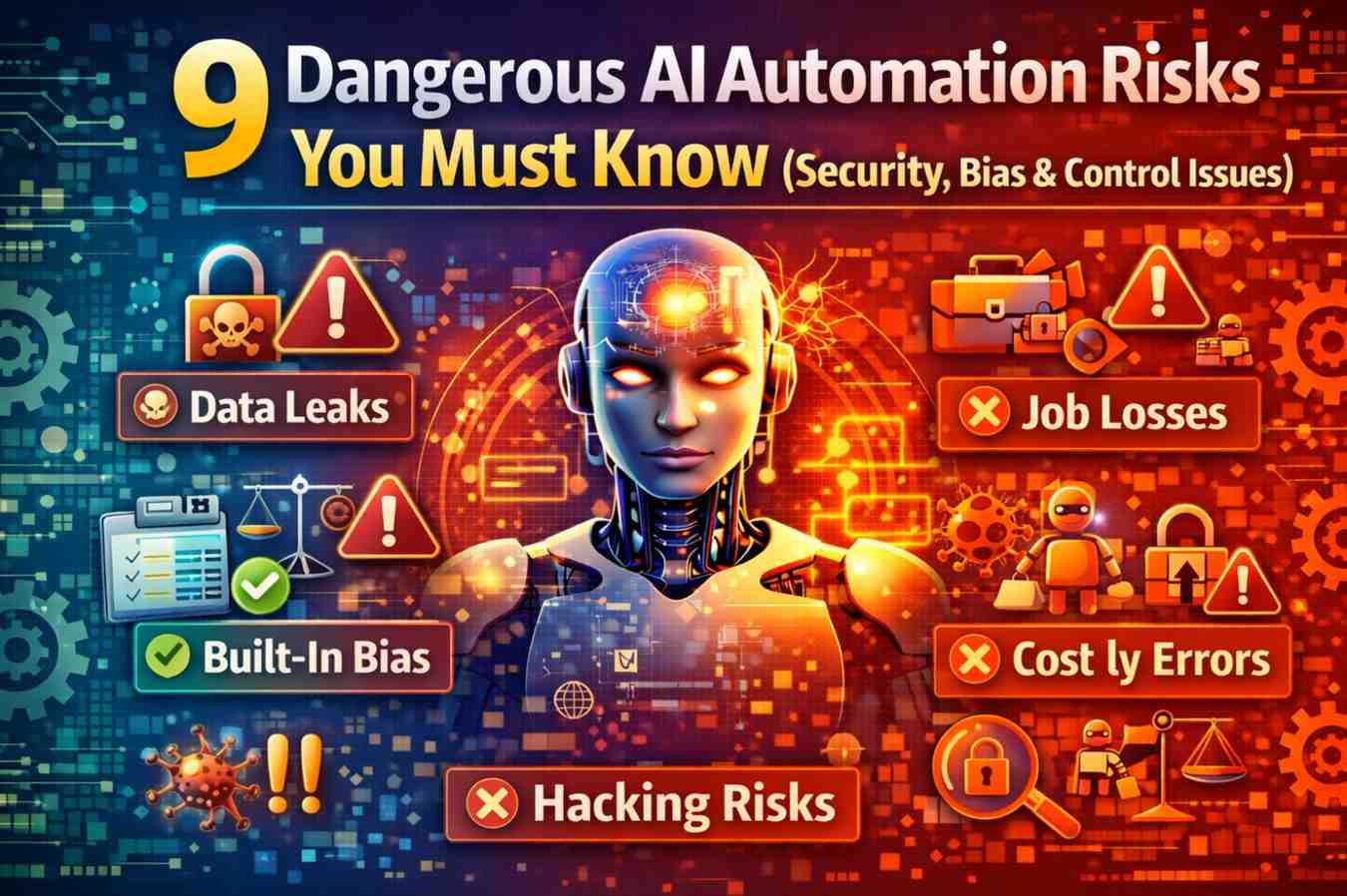
AI automation risks are no longer theoretical — they are urgent operational, ethical, and security challenges that every organization using AI must confront today. From subtle algorithmic bias to outright system takeover by adversaries, understanding the full spectrum of AI automation risks helps teams design safer systems, set realistic controls, and prioritize mitigation where it matters most.
Table of Contents
9 Serious AI automation risks You Must Know
1. Security vulnerabilities and attack surfaces
AI systems expand attack surfaces in new ways. Models and their deployment pipelines can expose endpoints, secrets, or model weights that attackers exploit to manipulate outputs or extract sensitive information. These security-related AI automation risks include unauthorized model access, exposed APIs, and misconfigured cloud resources that make it easier for bad actors to cause harm at scale.
2. Data leakage and privacy breaches
Automated systems often process massive datasets, increasing the chance of inadvertently exposing personal or proprietary data. Training pipelines, logging, and model explanations can leak information. Addressing these AI automation risks requires strong data governance, encryption in transit and at rest, and careful logging practices to prevent accidental disclosure.
3. Embedded bias and discriminatory outcomes
Bias in training data or model design can produce unfair outcomes when AI is deployed. Automated decision-making amplifies these effects, turning isolated errors into systemic harms. Recognizing and correcting embedded bias is vital to reduce long-term reputational, legal, and social harms that are a core part of AI automation risks.
4. Loss of human oversight and control
Automation can drift into autonomy if human controls are poorly designed. Overreliance on automated actions without meaningful human-in-the-loop checks increases the chance of incorrect or harmful decisions going unchecked. This control problem is central among AI automation risks: systems must be designed so humans can understand, intervene, and stop processes quickly.
5. Supply chain and third-party model risks
Many organizations rely on third-party models, datasets, or toolchains. Compromise or poor practices upstream propagate downwards, making supply chain vulnerabilities a significant class of AI automation risks. Validating third-party components and maintaining a chain-of-custody for models helps reduce exposure.
6. Automation cascades and systemic failures
When multiple automated systems interact, small errors can cascade into large failures. Feedback loops and tightly coupled automation increase fragility. Recognizing how interconnected services amplify individual faults is essential to managing AI automation risks at scale.
7. Adversarial manipulation and model exploitation
Adversarial attacks—carefully crafted inputs that confuse models—are a specialized but growing set of AI automation risks. Attackers can degrade model performance or trigger harmful behaviors. Defenses like robust training and continuous red-teaming reduce risk, but these attacks remain a persistent challenge.
8. Regulatory non-compliance and legal exposure
Laws and regulations around AI are evolving rapidly. Failing to meet emerging standards causes fines and operational disruption. Legal exposure is both a consequence and driver of AI automation risks: teams must keep pace with policy, documentation, and compliance requirements to operate safely.
9. Workforce displacement and operational dependency
Automation can reduce costs but also displace roles and institutional knowledge. Over-dependence on automated systems without adequate reskilling plans or fallback procedures creates operational risk. These social and organizational dimensions are often overlooked when assessing AI automation risks.
How to mitigate AI automation risks
Technical controls and secure design
Mitigating AI automation risks starts with secure-by-design practices: threat modeling for model endpoints, secure CI/CD for training pipelines, access control for artifacts, and encryption for sensitive data. Regular penetration testing and adversarial robustness evaluations should be part of model lifecycle management.
Operational governance and policies
Clear governance reduces ambiguity and improves response. Establish roles for model owners, reviewers, and incident commanders. Create policies that require documentation, versioning, and approval gates before automation changes go live. Tying governance to operational metrics ensures teams can detect drift early and reduce overall AI automation risks.
Testing, monitoring, and observability
Continuous monitoring helps detect anomalies, bias drift, and performance degradation. Implement automated checks for data quality, fairness metrics, and adversarial signs. Observability dashboards and alerting create the human-in-the-loop visibility needed to catch problems before they amplify into larger AI automation risks.
Incident response and recovery planning
No system is invulnerable; planning for incidents dramatically reduces impact. Develop playbooks for model failures, data leaks, and regulatory events. Run tabletop exercises and post-incident reviews to learn and harden systems against future AI automation risks.
Human-centered controls and training
Human oversight, clear escalation paths, and operator training limit dangerous automation. Encourage workers to question model outputs and provide mechanisms for rapid rollback. Investing in workforce education reduces the social and operational AI automation risks associated with automation-driven change. For deeper strategy and community perspectives, review current AI automation trends.
Policy, standards and the wider landscape
Standards and frameworks
National and international frameworks help organizations benchmark their controls. Integrating best practices from standards can lower compliance risk and make mitigation efforts more consistent. Useful references include the NIST AI risk framework, which outlines technical and governance recommendations to manage AI automation risks effectively.
International policy and cross-border concerns
Global coordination matters because AI systems often span jurisdictions. The OECD AI policy risks repository highlights policy approaches that reduce harms and foster responsible innovation. Aligning internal controls with such international guidance helps organizations anticipate regulatory shifts and reduce the chance that AI automation risks become existential.
Tooling and third-party risk reduction
Invest in tooling to validate third-party models, check for data provenance, and enforce contractual security requirements. Procurement policies that require security attestations and transparency clauses reduce supply-chain related AI automation risks. Where appropriate, consider certified model registries and reproducible pipelines as part of your vendor risk framework.
Practical checklist for reducing near-term AI automation risks
- Inventory models, datasets, and endpoints to understand your attack surface.
- Implement role-based access and least-privilege for model artifacts.
- Run bias and fairness audits on production outputs periodically.
- Establish monitoring for performance drift, adversarial signals, and data anomalies.
- Create incident response playbooks specific to model failures and data leaks.
- Require third-party security attestations and continuous validation for external models.
- Invest in operator training and clear human-in-the-loop protocols.
For teams beginning this work, pair technical investments with policy updates and training programs. Resources and playbooks for operationalizing these steps are available through emerging guides and industry practices, and targeted research into AI risk mitigation techniques can accelerate implementation.
AI automation risks span technical, legal, and social domains. They require a coordinated strategy that combines secure engineering, continuous monitoring, governance, and workforce engagement. By treating these risks as part of routine operational risk management rather than an afterthought, organizations can harness automation benefits while limiting preventable harms.
In short, acknowledging and managing AI automation risks is essential for resilient, trustworthy AI. Build layered defenses, stay informed on policy and standards, and keep humans strategically involved to reduce the chance that automation magnifies harm instead of value.




Leave a Reply