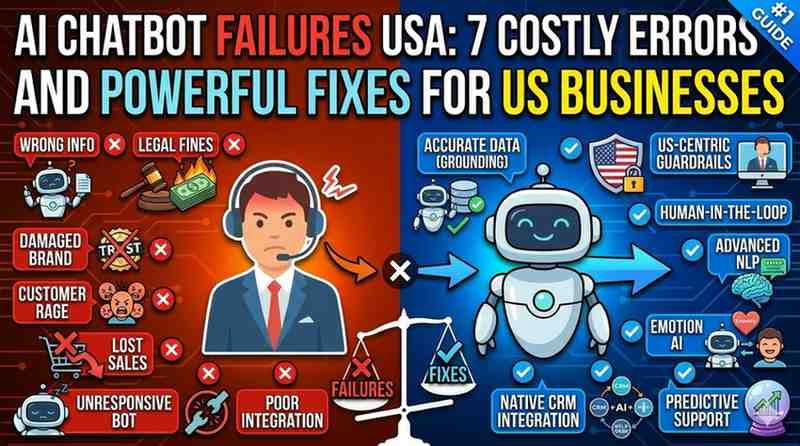
AI chatbot failures USA are increasingly visible as companies rush to adopt conversational AI without fully understanding the operational, technical, and human costs. From retail call centers to healthcare front desks, AI chatbot failures USA can damage customer trust, inflate costs, and undermine broader AI initiatives. This post examines seven costly errors that lead to these outcomes and shows practical steps US businesses can take to avoid repeating the same mistakes.
Table of Contents
Why AI Chatbot Failures USA Happen: common root causes
When analyzing AI chatbot failures USA, patterns emerge: rushed deployment, poor data quality, unclear goals, and weak integration with business systems. Leaders often treat chatbots as a checkbox for innovation rather than a component of a customer experience strategy. The result is a technically functional bot that fails to meet real user needs. Research and industry voices like Harvard Business Review and McKinsey AI highlight that strategy, not just models, predicts success.
Error 1: Undefined business goals and success metrics
Many AI chatbot failures USA trace back to ambiguous objectives. Is the chatbot meant to reduce call volume, increase conversions, or improve satisfaction? Without clear KPIs, teams cannot iterate effectively. Setting measurable targets such as resolution rate, containment rate, and customer satisfaction score prevents a chatbot from becoming a costly experiment.
Error 2: Poor conversational design and user experience
A common failure mode in AI chatbot failures USA is conversational design that feels robotic or confusing. Bots that push menu trees, misunderstand simple intents, or offer inscrutable error messages drive users to fallback channels. Investing in human-centered design, persona alignment, and continuous usability testing avoids this pitfall.
Error 3: Low-quality or biased training data
Training data shapes every response. When data is sparse, outdated, or biased, AI chatbot failures USA become inevitable. Teams need curated, diverse datasets and mechanisms to correct drift over time. Regular reviews of transcripts and active learning loops help ensure the model reflects current language and business realities.
Fixing AI Chatbot Failures USA: implementation and governance
Addressing AI chatbot failures USA requires both technical fixes and organizational governance. US businesses that succeed adopt staged rollouts, robust monitoring, and clear ownership for conversational outcomes. Below are four more costly errors and practical remedies that together form a roadmap to more reliable deployments.
Error 4: Inadequate integration with backend systems
Chatbots that cannot access CRM records, inventory, or order status frequently fail to resolve queries. This drives repeat contacts and escalations, a hallmark of AI chatbot failures USA. Proper API integrations and reliable data pipelines are essential. Consider building middleware that enforces data contracts and handles transient errors gracefully.
Error 5: Overreliance on out-of-the-box models without customization
Out-of-the-box solutions accelerate time-to-launch but can exacerbate AI chatbot failures USA when left uncustomized. Domain-specific language, compliance constraints, and brand tone require fine-tuning. Teams should prioritize model adaptation and layered intent classification that combines general models with business-specific rules.
Error 6: Weak escalation and human-in-the-loop processes
Failing to define clear handoffs causes frustrated customers and service breakdowns—another common attribute of AI chatbot failures USA. Implement explicit escalation rules, soft transfers, and visible human fallback options. Human-in-the-loop workflows also provide continuous feedback to improve training data and reduce future failures.
Error 7: Lack of ongoing measurement, monitoring, and governance
Many deployments treat chatbots as a one-time project. Without ongoing monitoring for accuracy, bias, and performance, AI chatbot failures USA accumulate over time. Establish automated alerts for rising fallback rates, regular transcript audits, and a governance forum that includes legal, compliance, operations, and product owners.
Operational steps to reduce AI chatbot failures USA
Reducing AI chatbot failures USA is a multifaceted effort. Below are practical steps that combine the technical and organizational changes outlined above.
- Define measurable goals before build: containment rate, time to resolution, NPS impact.
- Start with a narrow scope: limit intents and channels to build confidence and learn quickly.
- Invest in conversational design and UX research to reduce friction and clarify bot capabilities.
- Create robust data pipelines and integration layers so the chatbot can act on real information.
- Implement human-in-the-loop: enable agents to view chat context and take over gracefully.
- Monitor continuously: track fallbacks, escalations, sentiment, and business KPIs.
- Allocate cross-functional governance and a roadmap for iterative improvement.
For organizations looking to evaluate tools or assemble a platform, consider combining specialized AI automation tools with conversational platforms tailored to your industry. When planning vendor selection, look for demonstrated experience with US-specific regulatory needs and integrations with common enterprise systems.
Measuring ROI and learning from AI chatbot failures USA
Quantifying the cost of AI chatbot failures USA is essential to justify remediation budgets. Costs come from increased support staff, lost revenue from poor conversions, and brand damage. Conversely, a well-run chatbot can reduce handle time, improve customer satisfaction, and uncover product issues early. Use A/B tests, pre/post deployment metrics, and customer surveys to link improvements to business outcomes. Vendors and consultants can help, but internal ownership of measurement ensures continuous learning.
Tools, vendors and best practices
Vendors provide building blocks, but successful organizations treat them as parts of a system. Combine platform features with governance, testing, and training processes. If you need a starting point for what tools to explore, resources that compare capabilities and use cases can be helpful; pairing that research with overviews from outlets like Harvard Business Review and McKinsey AI gives context on enterprise impact. Also evaluate specific AI chatbots for business that demonstrate the integrations and governance features you require.
Culture, training and the human element in avoiding AI chatbot failures USA
Finally, many AI chatbot failures USA stem from organizational culture: treating AI as a replacement rather than as a collaborator. Invest in agent training so humans and bots complement each other. Encourage teams to use bot transcripts to identify product defects, policy gaps, and opportunities for automation. Transparency with customers about bot capabilities and privacy builds trust and reduces frustration.
AI chatbot failures USA are not inevitable. They are the predictable outcome of underestimated complexity and underinvestment in the full lifecycle of conversational deployments. By setting clear goals, prioritizing data quality, integrating tightly with backend systems, and maintaining strong governance, US businesses can shift from costly failures to sustainable value creation.
Conclusion: AI chatbot failures USA can be overcome through disciplined planning, iterative improvement, and cross-functional ownership. Address the seven costly errors outlined here to reduce risk, improve customer outcomes, and realize the promise of conversational AI.




Leave a Reply