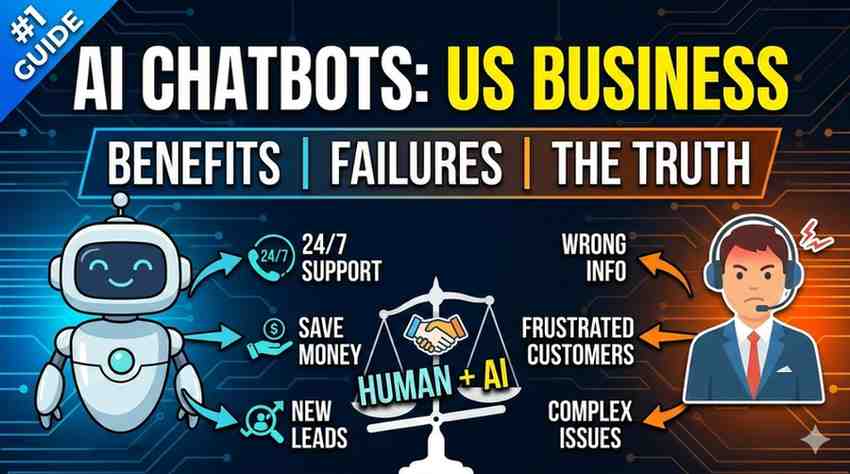
AI chatbots for US businesses are changing how companies handle customer service, sales, and internal workflows, and they’re no longer a novelty — they’re a practical tool that can scale operations while improving user experience. Many leaders ask whether these systems truly deliver, what pitfalls to avoid, and how to evaluate vendors. This post lays out the benefits, the common failure modes, and the realistic expectations U.S. organizations should have when adopting conversational AI.
Table of Contents
Benefits of AI chatbots for US businesses
AI chatbots for US businesses deliver measurable improvements when implemented with clear goals and proper data. Organizations see faster response times, increased self-service rates, and the ability to route complex queries to the right people. Beyond customer support, these solutions can automate appointment scheduling, gather pre-sales information, and provide product recommendations.
Faster service and cost savings
AI chatbots for US businesses reduce wait times by handling routine inquiries instantly and can cut staffing costs by reducing the volume of low-value interactions routed to human agents. For many small and medium-sized companies, the cost-per-interaction falls dramatically after initial setup and training.
Improved lead qualification and conversion
By engaging visitors immediately and asking qualifying questions, AI chatbots for US businesses can capture higher-quality leads and pass them directly to sales teams. This increases conversion efficiency and shortens the sales cycle, especially for companies with high web traffic.
Consistent support and analytics
Chat history and analytics provide insights into customer pain points, allowing teams to iterate on product messaging and workflows. Many platforms integrate with existing CRM systems, turning conversation data into actionable intelligence without manual transcription.
Challenges & Failures of AI chatbots for US businesses
Not every deployment succeeds. Understanding why AI chatbots for US businesses fail is essential to avoiding the same mistakes. Common failure causes include poor training data, unrealistic expectations, lack of escalation paths, and insufficient monitoring.
Poor training data and inaccurate responses
When underlying datasets are limited or biased, chatbots return irrelevant or incorrect answers. This erodes trust quickly; customers expect accurate, helpful responses. Regularly reviewing transcripts and retraining models prevents degradation in performance.
No clear escalation or human handoff
A frequent failure is treating the chatbot as the single channel rather than a first responder. If a chatbot cannot escalate complex queries to a human-agent workflow, customer frustration rises. Successful implementations design clear escalation triggers and easy transfers to live support.
Overpromising capabilities
Marketing often paints chatbots as fully autonomous assistants. In reality, AI chatbots for US businesses work best within defined scopes. Attempting to automate highly nuanced or regulated conversations without human oversight leads to compliance risks and poor user experiences.
How to implement AI chatbots for US businesses effectively
A structured approach increases the odds of success. Start small, define measurable KPIs, and iterate based on real interactions. Below are practical steps and vendor considerations.
Define scope and goals
Choose a narrow initial use case such as FAQs, order tracking, or appointment booking. Establish KPIs like containment rate (percentage of issues resolved without human agent), average response time, and customer satisfaction scores.
Integrate with existing systems
Integration with CRM, ticketing, and billing systems ensures the chatbot can take meaningful actions—fetch order statuses, create tickets, or update customer profiles. Many platforms now provide prebuilt connectors to reduce implementation time. Explore enterprise-grade options such as Salesforce AI if you need deep CRM integration, or look at specialized help-desk integrations like those described by Zendesk AI for support-centric workflows.
Train, test, and monitor
Use real chat logs to train intent recognition, and establish a continuous improvement process. Regularly review misclassified interactions, retrain models, and refine dialog flows. Set up dashboards to monitor containment, escalation, and satisfaction metrics.
Choosing technology and vendors for AI chatbots for US businesses
Selecting the right partner matters. Consider scale, compliance requirements, ease of integration, and support for conversational design. Ask vendors about data residency, model update cadence, and whether they provide tools for non-technical staff to edit flows.
Evaluate vendor claims and pilots
Run a short pilot with a subset of users and measure the KPIs you defined earlier. A pilot exposes integration gaps and highlights user acceptance. Avoid vendors promising instant perfection; look for partners that offer iterative roadmaps and transparent performance metrics.
Leverage automation and bot-management tools
A mature deployment will use a suite of tools to orchestrate conversation routing, automation, and analytics. Consider adopting a platform approach that supports both chatbots and broader AI automation tools to scale processes across customer service, sales, and operations. For self-serve information or lead capture, vendors that support omnichannel deployment help maintain consistency across web, mobile, and messaging apps.
Best practices and governance for AI chatbots for US businesses
Governance ensures chatbots adhere to company policies and regulatory requirements while preserving brand voice and data security.
Privacy, compliance, and transparency
Ensure customer data is handled according to federal and state regulations. Be transparent about when users are interacting with a bot and provide easy options to opt into human support. Maintain logs and consent records as part of your compliance strategy.
Design for empathy and clarity
Model simple, helpful language and avoid overcomplicated scripts. When a chatbot can’t help, provide clear options to escalate or retry. Human-like language helps engagement, but false expectations must be managed by signaling capabilities and limits early in the conversation.
Continuous measurement and improvement
Use A/B testing for dialog flows and monitor customer satisfaction at scale. Capture feedback after key interactions and use that data to refine intents and responses. Teams should meet regularly to review trends and prioritize updates.
Real-world outcomes and examples
Companies in retail, finance, healthcare, and hospitality have reported meaningful ROI from AI chatbots for US businesses when those bots are well-scoped and integrated. Examples include reduced average handle times in support centers, higher appointment throughput for clinics using scheduling bots, and increased lead qualification rates in e-commerce. When paired with CRM systems and human workflows, conversational AI often serves as a low-cost front door that improves conversion and satisfaction.
When they work best
They perform well in high-volume, repetitive tasks: order status checks, password resets, appointment scheduling, basic troubleshooting, and first-level triage. Combining bots with clear handoffs and analytics maximizes value.
When to be cautious
Avoid full automation for high-stakes conversations (legal, medical advice, or complex technical diagnostics) unless rigorous oversight and specialized models are in place. Overreliance without human supervision is a common path to failure.
In practice, pairing purpose-built chatbots with broader AI chatbots for business and workflow automation produces the strongest results, because it links conversational interactions to downstream operational actions rather than leaving them as isolated experiences.
AI chatbots for US businesses offer a powerful set of capabilities that can reduce costs, improve responsiveness, and generate new business value when deployed thoughtfully. The failures you read about are often avoidable with careful scoping, transparent expectations, and continuous improvement. By choosing the right partners, integrating with existing systems, and governing usage, US companies can capture the benefits while minimizing the risks associated with conversational AI.
AI chatbots for US businesses are not a silver bullet, but with the right strategy they become reliable collaborators—handling routine work, freeing teams to focus on higher-value tasks, and improving customer experiences across channels.



Leave a Reply