
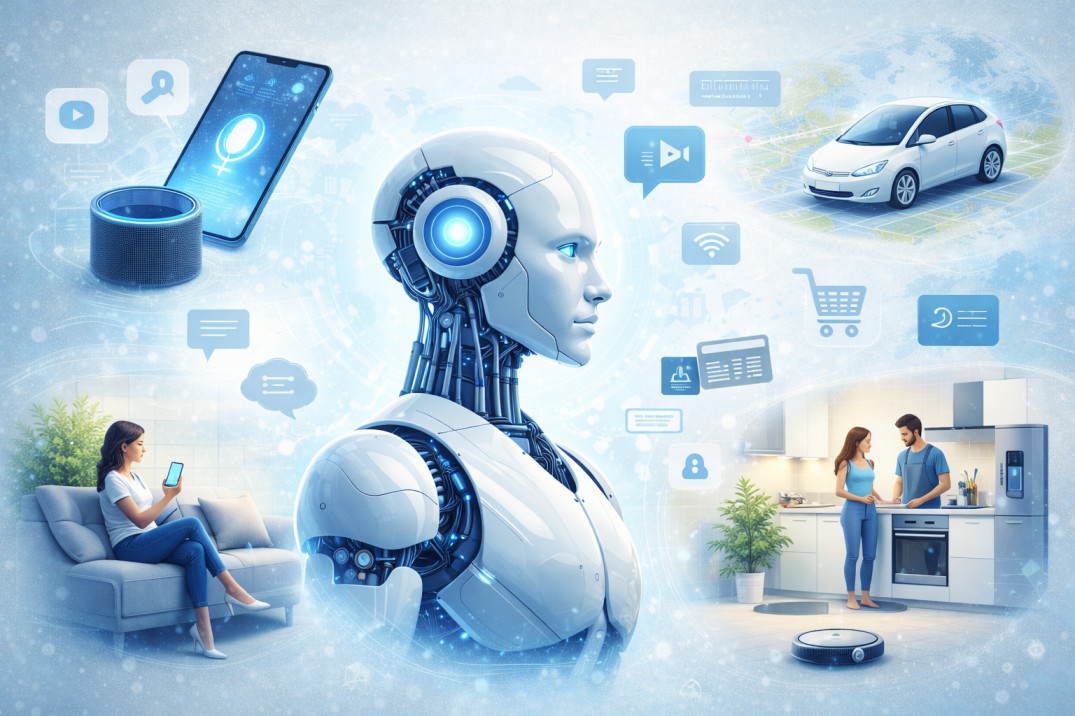
AI in daily life is no longer a future concept—it is already part of how people use smartphones, social media, navigation apps, banking services, and smart home devices every day.
Why AI in Daily Life Matters More Than Ever
AI in daily life is no longer a future concept—it is already part of how people use technology every single day. From smartphones and social media to banking and navigation, artificial intelligence works quietly in the background, helping systems become faster, smarter, and more personalized.
Understanding how AI in daily life functions makes modern technology easier to trust and less intimidating.
1. AI in Daily Life Through Smartphones
One of the most common examples of AI in daily life is the smartphone. Features like face unlock, fingerprint recognition, voice assistants, predictive text, and smart photo enhancement all rely on artificial intelligence.
These systems analyze patterns such as facial structure, typing behavior, or voice commands to improve accuracy over time. Every interaction helps AI learn and adapt.
2. AI in Daily Life on Social Media Platforms
Social media platforms are powered heavily by AI in daily life. Artificial intelligence analyzes likes, shares, comments, and watch time to decide what content appears in a user’s feed.
This personalization helps users see relevant content but also influences how information is consumed, making AI a powerful unseen force behind digital experiences.
3. AI in Daily Life Through Online Search
Search engines use artificial intelligence to understand what users are looking for, even when search queries are incomplete or unclear. AI analyzes search intent, location, and behavior to deliver accurate results.
Voice search and autocomplete suggestions are also everyday examples of how AI in daily life improves convenience.
4. AI in Daily Life in Online Shopping
E-commerce platforms rely on AI in daily life to recommend products, personalize offers, and optimize pricing. Artificial intelligence studies browsing history, past purchases, and user behavior to suggest relevant items.
This helps customers find products faster while helping businesses improve sales efficiency.
AI in daily life continues to expand as more systems learn from data and improve over time. As AI in daily life becomes more accurate and reliable, it plays a bigger role in everyday routines without drawing attention to itself.
5. AI in Daily Life for Navigation and Maps
Navigation apps are a clear example of AI in daily life at work. Artificial intelligence processes real-time traffic data, road conditions, and user movement to suggest the fastest routes.
Ride-hailing apps also use AI to match drivers with passengers and predict arrival times accurately.
6. AI in Daily Life in Banking and Payments
Banks use AI in daily life for fraud detection, transaction monitoring, and customer support. Artificial intelligence identifies unusual spending patterns and alerts banks to possible fraud.
Chatbots and virtual assistants help users check balances, transfer money, and resolve common issues without waiting for human support.
7. AI in Daily Life Through Streaming and Entertainment
Streaming platforms use AI in daily life to recommend movies, shows, and music. Artificial intelligence analyzes viewing history, preferences, and engagement to improve recommendations over time.
These systems learn continuously, making suggestions more accurate with every interaction.
8. AI in Daily Life Inside Smart Homes
Smart home devices are growing examples of AI in daily life. Smart speakers, thermostats, security cameras, and robotic cleaners learn user habits to automate tasks and improve comfort.
These systems adjust settings automatically to save energy, enhance security, and simplify daily routines.
9. AI in Daily Life for Health and Fitness Tracking
Fitness trackers and health apps use AI in daily life to monitor activity, sleep patterns, and heart rate. Artificial intelligence analyzes this data to provide insights, reminders, and health trends.
These tools help users make informed decisions about their well-being without replacing medical professionals.
Why AI in Daily Life Often Goes Unnoticed
AI in daily life works quietly because it is designed to integrate smoothly into existing systems. When artificial intelligence functions correctly, users experience convenience rather than complexity.
This invisibility is one reason many people underestimate how deeply AI is embedded in everyday routines.
Final Thoughts
AI in daily life is already shaping how people communicate, travel, shop, work, and relax. Rather than replacing humans, artificial intelligence supports daily activities by handling repetitive tasks and improving efficiency.
Understanding how AI in daily life works helps people use technology more consciously and prepares them for a future where AI becomes even more integrated into everyday experiences.
IBM – Artificial Intelligence Overview
According to IBM, artificial intelligence systems are designed to learn from data and perform tasks that typically require human intelligence.



Leave a Reply