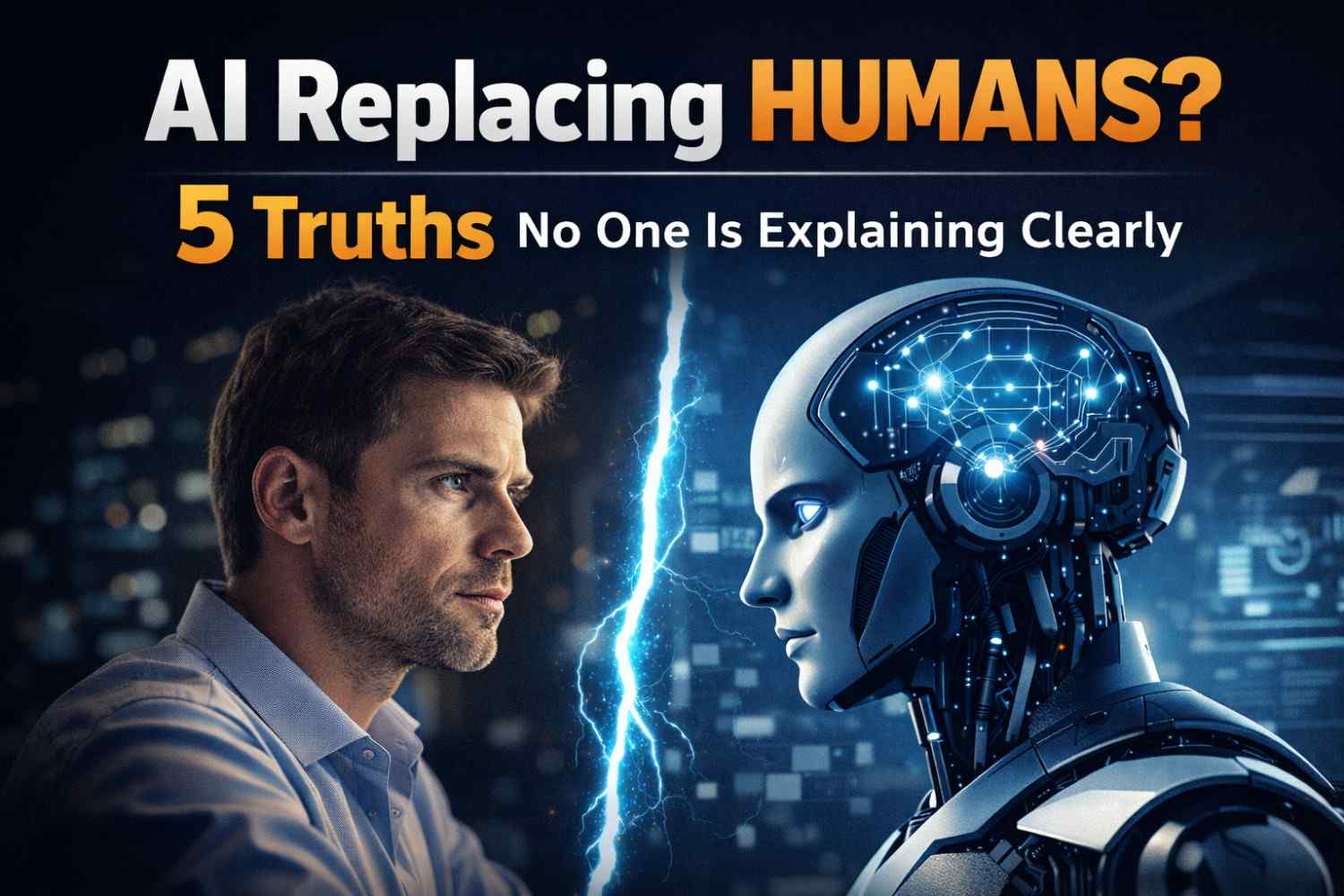
The debate over whether ai replacing humans is imminent has dominated headlines, boardrooms, and kitchen-table conversations alike. This article cuts through hyperbole to explain what ai replacing humans really means in practice, which jobs are most at risk, how society can adapt, and where human skills remain indispensable. By the end you’ll understand the measurable risks, practical responses, and the realistic timeline for significant change.
Table of Contents
Is ai replace humans in the workplace?
When people ask whether ai replacing humans is a threat, they usually mean: will machines take my job, my profession, or even most jobs? The short answer is nuanced. There are clear examples of ai replacing humans for repetitive, rules-based tasks—data entry, simple customer inquiries, and routine assembly-line inspections. But many roles require creativity, leadership, empathy, and complex judgment, areas where ai replacing humans remains a remote possibility for now.
Where ai replace humans is already happening
In manufacturing, logistics, and certain retail functions, ai replacing humans has unfolded through automation and robotics that achieve higher speed and consistency. In customer service, chatbots have taken over triage tasks and frequently asked questions, reducing the number of human agents needed for routine interactions. Even creative industries have seen ai replacing humans for template-based content production, simple design layouts, and automated reporting.
Where ai replacing humans is unlikely soon
Jobs that require deep domain expertise, moral judgment, and complex interpersonal skills are less vulnerable. Healthcare diagnostics supported by ai still rely on human clinicians for interpretation, patient conversations, and ethical decisions. Leadership roles that require inspiring teams, negotiating ambiguous outcomes, and adapting strategy in real time are difficult for AI to fully replicate. Thus, while ai replacing humans will impact tasks within jobs, wholesale replacement of complex occupations is not the immediate reality.
Understanding ai replacing humans: myths and realities
Public perceptions often conflate automation’s effects with existential risk. One myth is that ai replacing humans means everyone will be unemployed. The reality is that ai replacing humans typically redistributes work: some tasks vanish, new tasks appear, and many roles evolve. Historically, technology has shifted employment rather than simply eliminating it. That pattern suggests the transition will be uneven across sectors and geographies.
Economic drivers behind ai replacing humans
Companies pursue ai replacing humans when it lowers costs, improves speed, and reduces errors. Where labor is expensive or tasks are highly repetitive, the business case for ai replacing humans is strongest. However, regulatory, ethical, and customer-preference factors often slow adoption. For example, organizations may avoid full automation for customer-facing roles because many consumers still prefer human interaction in complex or emotionally charged scenarios.
Social and policy responses
To manage the effects of ai replacing humans, governments and institutions must combine upskilling, safety nets, and incentives for job creation. Policymakers can direct investments into education that focuses on transferable skills—critical thinking, problem-solving, communication—and fund programs to help displaced workers transition. Public dialogue about taxes, benefits, and industry responsibilities will influence how smoothly labor markets adapt as ai replacing humans accelerates in some domains.
Practical steps for workers facing ai replace humans
People worried about ai replacing humans can take concrete steps to stay relevant. Upskilling matters, but so does strategic positioning. Focus on areas where human strengths complement AI rather than compete directly with it:
- Develop skills in interpretation, oversight, and ethical judgment that AI cannot easily replicate.
- Learn to work with AI tools so you can leverage them to increase productivity rather than be displaced by them.
- Pursue cross-disciplinary knowledge—combining technical literacy with domain expertise makes you harder to replace.
Understanding how ai replacing humans affects your industry helps you prioritize training. For example, professionals who combine social skills with technical fluency will be in higher demand than those who perform narrowly defined, repetitive tasks.
How employers should respond to risks of ai replace humans
Businesses face both opportunity and responsibility. When implementing systems that could lead to ai replacing humans, companies should invest in redeploying affected workers, create internal mobility programs, and partner with educational providers. Thoughtful adoption reduces reputational risk and can yield better long-term productivity by blending AI strengths with human judgment.
Tools, case studies, and realistic timelines for ai replace humans
Some sectors will see rapid change while others transform over decades. Customer service and back-office processing may continue to see ai replacing humans over the next 5–10 years, especially as conversational AI improves. Healthcare, legal, and creative professions will likely evolve more slowly because they require interpretive work and contextual decision-making.
Examples of transition
A bank replacing human tellers with automated kiosks and AI-powered chat systems exemplifies ai replacing humans at the task level. Yet those same banks often reassign former tellers to advisory roles that require human empathy and product knowledge. In manufacturing, factory floors increasingly feature robots that handle hazardous tasks while humans focus on maintenance, quality oversight, and system optimization.
When assessing timelines and implications, it helps to consult broader research. For context on how work is likely to change globally, see these resources on the future of work insights and analyses of AI policy and employment trends, such as the government-focused perspective on AI impact on employment India.
AI tools and the scope of replacement
Not all tools are designed to replace people. Many enable productivity gains and create new roles. Explore how automation aligns with human roles through practical comparisons like AI automation vs human roles, which examines where AI augments versus replaces labor. Similarly, evaluate how specific solutions affect job design by reviewing analyses of AI tools impacting jobs.
Ethics, governance, and when ai replace
humans becomes a policy issue
As ai replacing humans accelerates in some fields, ethical concerns escalate. Who is accountable when an AI makes a harmful decision? How will bias in training data affect outcomes? Governance frameworks must ensure transparency, fairness, and recourse. Labor policies should consider phased approaches to automation that protect vulnerable workers while encouraging innovation.
Designing fair transitions
Fair transition policies include retraining funds, portable benefits, and wage insurance for displaced workers. They also involve regulating deployment in sensitive areas—such as employment screening or judicial decision support—where the consequences of automated errors are high. By addressing these concerns proactively, society can reduce the worst outcomes of ai replacing humans while capturing positive productivity gains.
What individuals and leaders should remember about ai replace humans
First, ai replace humans is not uniform: it targets tasks more than whole professions, and it creates as well as destroys opportunities. Second, adaptability wins—workers who learn to leverage AI will have an advantage. Third, policy and corporate responsibility shape how dramatic the displacement becomes. Finally, human skills like empathy, creativity, and ethical judgment remain the most resilient against ai replacing humans in meaningful ways.
The future will not be a simple binary of machines versus people. Instead, expect hybrid systems where ai replacing humans occurs for specific tasks, while humans retain oversight, interpretation, and relational work. Preparing for that future requires realistic planning, investment in human capital, and governance that balances innovation with fairness.
In short, ai replacing humans will reshape work, but it will not make humans obsolete. The real question is not whether ai replacing humans will happen, but how we manage the transition so that workers, businesses, and societies benefit.
Conclusion: ai replacing humans is a powerful force in certain sectors and tasks, but with proactive policy, reskilling, and thoughtful adoption, the transition can be managed to preserve human dignity and create new opportunities. Understanding the nuances and preparing now is the best defense against disruption.


Leave a Reply