Introduction: Why AI Is No Longer Optional for US Businesses
Artificial intelligence has moved far beyond being an experimental technology. For many companies across the United States, AI tools for US businesses is now a practical tool used to reduce costs, increase efficiency, and gain a competitive edge. What was once limited to large enterprises is increasingly accessible to startups, small businesses, and mid-sized organizations.
However, the rapid growth of AI has also created confusion. Vendors promise dramatic productivity gains, automation of entire teams, and near-instant returns on investment. At the same time, many US businesses struggle with failed implementations, rising costs, and compliance concerns. The truth lies somewhere in between.
This guide focuses on AI tools for US businesses from a practical, realistic perspective. Instead of hype, it explains how these tools actually work, where they deliver value, and where they often fall short. Whether you are a founder, manager, or decision-maker, understanding these fundamentals is critical before investing time or money.
Table of Contents
What “AI Tools for Business” Really Means in the US Context
When people talk about AI in business, they often mean very different things. In the US market, AI adoption typically falls into three broad categories.
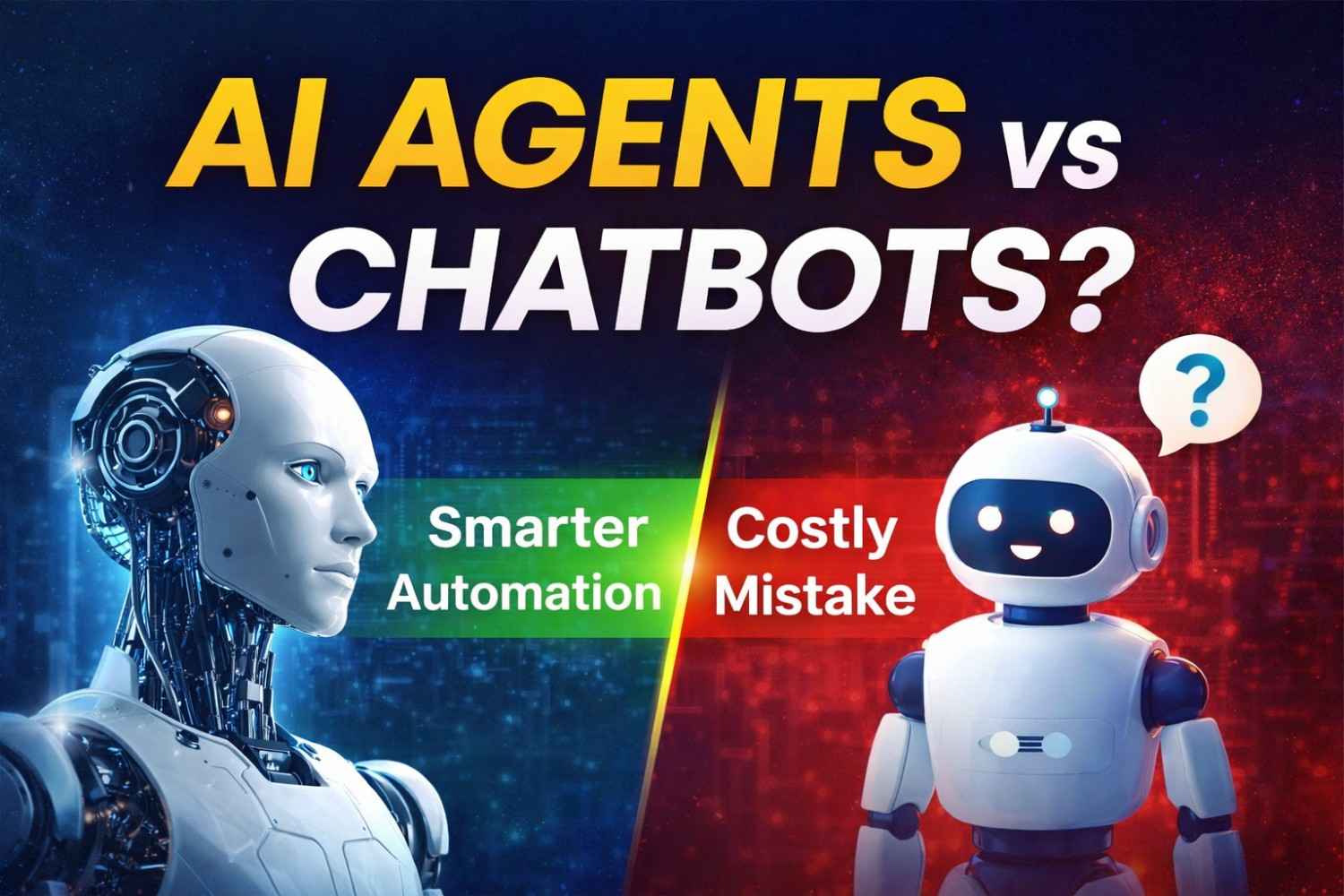
The first category is AI agents. These systems can perform tasks autonomously, make decisions based on data, and operate with minimal human input. Examples include scheduling agents, customer support agents, and workflow orchestration systems.
The second category is AI chatbots. These tools are designed to interact with users, customers, or employees through text or voice. They are widely used in customer service, sales qualification, internal IT support, and onboarding.
The third category is AI automation tools. These focus on automating repetitive or rule-based processes such as data entry, reporting, invoice processing, and system integrations.
Most US companies do not use just one category. Instead, they combine multiple AI solutions depending on their industry, size, and operational maturity. The most successful implementations align AI capabilities with specific business problems rather than adopting technology for its own sake.
Why US Businesses Are Adopting AI Faster Than Ever
Several factors are accelerating AI adoption across the United States.
One major driver is labor cost pressure. Wages, benefits, and employee turnover costs have risen steadily. AI does not replace human creativity or leadership, but it can reduce manual workloads and allow teams to focus on higher-value tasks.
Another factor is customer expectation. US consumers expect fast responses, personalized experiences, and 24/7 availability. AI chat systems and automation tools help businesses meet these expectations without scaling headcount endlessly.
Data availability also plays a role. US businesses generate massive amounts of data through digital operations, e-commerce platforms, CRMs, and analytics systems. AI tools are increasingly used to analyze this data and extract insights that would be impossible to process manually.
Finally, competitive pressure cannot be ignored. When competitors adopt AI successfully, others are forced to follow or risk falling behind.
Core Types of AI Tools Used by US Businesses
AI Agents in Business Operations
AI agents are designed to operate semi-independently. In US companies, they are commonly used for internal operations such as scheduling, workflow routing, and task prioritization.
For example, an AI agent might monitor incoming support tickets, categorize them, assign priority levels, and route them to the appropriate team. In more advanced cases, the agent may resolve common issues automatically without human involvement.
These systems are powerful but require careful configuration. Poorly designed agents can create errors at scale, which is why human oversight remains essential.
AI Chatbots for Customer and Employee Interaction
AI chatbots are among the most widely adopted AI tools for US businesses because they are relatively easy to deploy and offer immediate visibility.
In customer service, chatbots handle FAQs, order tracking, appointment booking, and basic troubleshooting. Internally, they assist employees with HR questions, IT support, and documentation access.
The key advantage of chatbots is availability. They operate continuously and provide instant responses. However, they are not a replacement for human support in complex or emotionally sensitive situations. The most effective US businesses use chatbots as a first layer, not the final solution.
AI Automation Tools for Process Efficiency
Automation tools focus on back-office and operational efficiency. US companies often use them to streamline processes such as payroll processing, inventory management, financial reporting, and compliance tracking.
Unlike chatbots, these tools typically operate behind the scenes. Their value comes from consistency, speed, and reduced error rates.
Automation delivers the highest return when applied to stable, repeatable workflows. Trying to automate poorly defined processes often leads to frustration rather than savings.
Benefits of AI Adoption for US Businesses
The benefits of AI are real, but they vary significantly based on implementation quality and business readiness.
One major advantage is productivity improvement. AI can handle tasks that would otherwise consume hours of human effort. This does not eliminate jobs outright but changes how work is distributed.
Another benefit is scalability. AI systems can handle increased workloads without proportional increases in cost. For growing US businesses, this flexibility is particularly valuable.
AI also enables better decision-making. Predictive analytics, demand forecasting, and customer behavior analysis help leaders make informed choices rather than relying on intuition alone.
Finally, AI can improve consistency and accuracy. Automated systems follow defined rules without fatigue, reducing human error in critical processes.
The Reality Check: Why AI Fails for Many US Companies
Despite these benefits, many AI initiatives fail to deliver expected results.
A common reason is unclear objectives. Companies adopt AI because it sounds innovative, not because it solves a specific problem. Without clear goals, success is impossible to measure.
Another issue is data quality. AI systems rely on accurate, structured data. In many US organizations, data is fragmented across systems or poorly maintained, limiting AI effectiveness.
Cost overruns are also common. Subscription fees, customization, integration, and ongoing maintenance add up quickly. Without careful planning, AI can become more expensive than manual alternatives.
Finally, there is the human factor. Employees may resist AI adoption due to fear of job loss or lack of training. Change management is as important as technology selection.
Transition to Costs and Pricing (What Comes Next)
Understanding how AI works is only the first step. The next critical question for US businesses is cost. Pricing models vary widely, and hidden expenses often surprise first-time adopters.
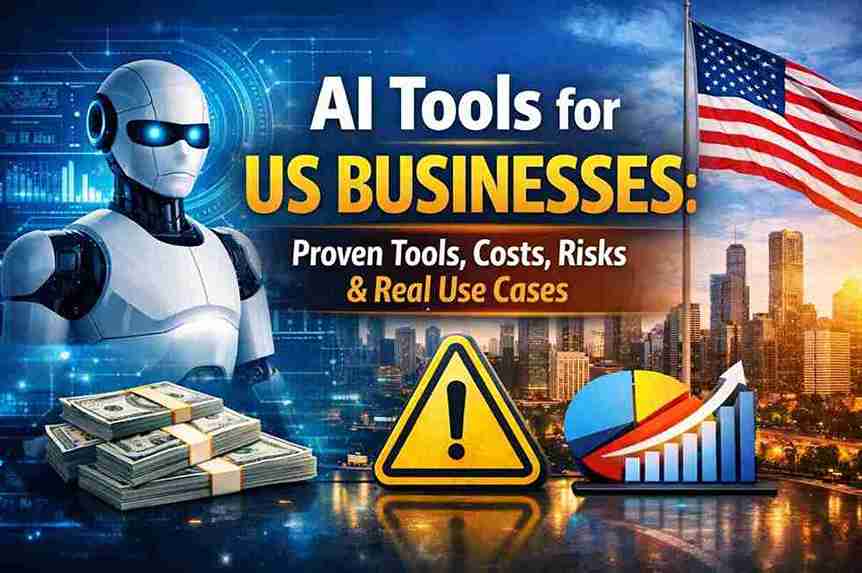
AI for US Businesses: Tools, Costs, Risks & Real Use Cases
Understanding the Real Cost of AI for US Businesses
After understanding what artificial intelligence does and how it is used, the next question most decision-makers ask is simple: How much does it actually cost? This is where many US businesses either gain clarity or make costly mistakes.
The pricing of AI tools for US businesses is rarely straightforward. Vendors often highlight low entry prices, but total ownership costs can increase significantly once implementation, customization, and long-term usage are considered.
To make informed decisions, businesses must understand how AI pricing models work and where hidden expenses usually appear.
Common AI Pricing Models in the US
Subscription-Based Pricing
The most common model used by AI vendors in the US is subscription pricing. Businesses pay a monthly or annual fee to access the platform.
This model is popular because it:
- Offers predictable costs
- Is easy to budget
- Allows scaling up or down
However, subscription plans often limit features, usage volume, or integrations. Businesses frequently need higher-tier plans as usage increases, which raises costs over time.
Usage-Based Pricing
Some AI platforms charge based on usage metrics such as:
- Number of API calls
- Volume of data processed
- Number of conversations handled
This model aligns cost with value but can be unpredictable. As adoption grows, monthly expenses may rise sharply. Many US companies underestimate how quickly usage scales once AI is integrated into daily operations.
Per-User or Per-Seat Pricing
This model is common for AI tools for US businesses used by internal teams. Businesses pay for each employee who accesses the system.
While per-user pricing seems manageable at first, costs grow quickly as teams expand. For larger organizations, this can become a significant expense.
Custom Enterprise Pricing
Large US enterprises often receive custom pricing based on:
- Deployment scale
- Data volume
- Security and compliance requirements
Enterprise contracts offer flexibility but usually involve long-term commitments and higher upfront costs.
Hidden Costs Most US Businesses Overlook
The visible price of AI tools for US businesses software is only part of the equation. Many hidden costs emerge after adoption.
Implementation and Integration
AI tools rarely work in isolation. They must integrate with existing systems such as CRMs, ERPs, customer support platforms, and analytics tools.
Custom integrations often require:
- Developer time
- Third-party connectors
- Ongoing maintenance
These costs are frequently underestimated during planning.
Data Preparation and Cleanup
AI systems depend on clean, structured data. US businesses often discover that their data is fragmented or inconsistent across departments.
Preparing data may involve:
- Data migration
- Cleaning duplicates
- Standardizing formats
This process takes time and resources, even before AI delivers any value.
Compliance and Security Costs
US businesses operate under strict regulatory requirements depending on their industry. Healthcare, finance, and education sectors face particularly high compliance standards.
Ensuring AI tools meet data privacy and security regulations may require:
- Legal consultation
- Security audits
- Additional infrastructure
These costs are rarely included in advertised pricing.
Training and Change Management
Employees need training to use AI effectively. Without proper onboarding, adoption remains low and ROI suffers.
Training costs include:
- Internal workshops
- Documentation
- Ongoing support
Change management is often the difference between success and failure.
ROI Reality: What US Businesses Can Expect
Return on investment is one of the most misunderstood aspects of AI tools for US businesses adoption. Vendors often promote dramatic efficiency gains, but real-world results vary.
Successful US businesses typically see ROI in these areas:
- Reduced manual workload
- Faster response times
- Improved data-driven decisions
- Lower operational error rates
However, ROI is rarely immediate. Many companies require 6–12 months before seeing measurable returns.
Short-term ROI expectations often lead to disappointment. AI should be viewed as a strategic investment, not a quick win.
Industry-Specific Cost Considerations
Small Businesses and Startups
Small US businesses benefit from AI tools for US businesses that offer:
- Low setup costs
- Modular pricing
- Easy deployment
However, they are also the most vulnerable to cost overruns. Choosing overly complex solutions often leads to wasted budgets.
Mid-Sized Companies
Mid-sized organizations typically invest in AI to scale operations efficiently. Their costs often include:
- Advanced automation
- Cross-department integrations
- Custom workflows
These businesses must balance flexibility with budget discipline.
Large Enterprises
Large US enterprises invest heavily in AI but also gain the most from it. Their focus is usually on:
- Process optimization at scale
- Advanced analytics
- Long-term efficiency gains
Enterprise AI budgets are significant, but so are the potential returns.
Risks Associated with AI Adoption in the US
While cost is a major concern, risk management is equally important.
Legal and Regulatory Risk
AI systems can process sensitive data. Mishandling this data may result in legal penalties or reputational damage.
US businesses must ensure:
- Transparent data usage
- Secure data storage
- Compliance with applicable regulations
Operational Risk
Over-reliance on AI without human oversight can lead to errors. Automated decisions must be monitored, especially in customer-facing or financial processes.
Vendor Dependency
Some AI platforms lock businesses into proprietary ecosystems. Migrating away later can be expensive or technically challenging.
Choosing flexible, interoperable solutions reduces this risk.
Smart Cost-Control Strategies for US Businesses
Businesses that succeed with AI take a disciplined approach.
They start small, testing AI tools in limited use cases before scaling. Pilot projects help identify real value and hidden challenges.
They also measure performance continuously, tracking metrics such as:
- Time saved
- Cost reduction
- Error rates
- Customer satisfaction
Most importantly, they align AI initiatives with business goals rather than chasing trends.
Transition to Real-World Use Cases (What Comes Next)
Understanding costs and risks prepares businesses for smarter adoption, but theory alone is not enough. Real-world examples show how AI works in practice across different industries.
AI for US Businesses: Tools, Costs, Risks & Real Use Cases
Real-World AI Use Cases Across US Industries
After understanding how artificial intelligence works and what it costs, the most important question remains: How is AI actually used by real US businesses today? Practical use cases reveal where AI delivers value and where expectations often exceed reality.
Across industries, AI tools for US businesses are most successful when applied to clearly defined problems rather than broad transformation initiatives. Companies that start with focused objectives tend to achieve better outcomes.
AI tools for US businesses in Customer Support and Service Operations
Customer support is one of the earliest and most successful areas of AI adoption in the US.
Many businesses deploy AI chatbots as a first point of contact. These systems handle common queries such as order status, account access, appointment scheduling, and basic troubleshooting. This reduces wait times and frees human agents to focus on complex or sensitive issues.
However, AI chatbots perform best when:
- Questions are predictable
- Responses are structured
- Escalation paths are clearly defined
Failures occur when chatbots are expected to replace human empathy or handle nuanced customer complaints. US companies that treat AI as an assistant rather than a replacement see better customer satisfaction.
AI for Sales, Marketing, and Lead Qualification
In sales and marketing, AI is widely used to analyze customer behavior, score leads, and personalize messaging.
AI-driven tools help US businesses:
- Identify high-intent prospects
- Optimize email campaigns
- Predict customer churn
- Recommend next-best actions
These applications increase efficiency, but they depend heavily on data quality. Poorly maintained CRM systems or incomplete customer records limit AI effectiveness.
The most successful sales teams combine AI insights with human judgment, using automation to support decision-making rather than replace it.
AI in Operations and Supply Chain Management
Operational efficiency is another area where AI delivers measurable value.
US companies use AI automation to:
- Forecast demand
- Optimize inventory levels
- Manage logistics routes
- Detect anomalies in supply chains
In manufacturing and retail, predictive analytics helps reduce waste and improve planning accuracy. These gains translate directly into cost savings.
However, operational AI requires stable processes. Businesses with frequent workflow changes often struggle to maintain accurate models.
AI in Finance and Risk Management
Finance teams increasingly rely on AI for forecasting, fraud detection, and compliance monitoring.
Common applications include:
- Expense categorization
- Revenue prediction
- Risk scoring
- Anomaly detection
For US businesses, these tools improve speed and accuracy, but they also require strict oversight. Financial decisions influenced by AI must remain transparent and auditable.
AI enhances financial operations when it supports professionals rather than replacing accountability.
AI in Human Resources and Workforce Management
HR departments use AI to streamline recruitment, onboarding, and employee engagement.
AI helps US companies:
- Screen resumes
- Match candidates to roles
- Predict attrition risks
- Improve training personalization
While efficiency improves, HR AI raises ethical considerations. Bias in training data can lead to unfair outcomes if not carefully monitored.
Successful organizations combine AI tools for US businesses efficiency with strong governance and inclusive policies.
Where AI Commonly Fails in US Businesses
Despite real success stories, AI adoption also fails frequently.
One major failure point is over-automation. Businesses sometimes automate processes that require judgment, creativity, or emotional intelligence. This leads to poor user experiences and internal frustration.
Another issue is lack of ownership. AI projects often fall between departments, resulting in unclear responsibility. Without strong leadership, AI initiatives lose momentum.
Unrealistic expectations also play a role. AI is not a plug-and-play solution. Companies that expect instant results often abandon projects prematurely.
How to Decide If AI tools for US businesses Is Right for Your Business
Before adopting AI, US businesses should ask a few critical questions.
First, is the problem clearly defined? AI works best when applied to specific, measurable challenges.
Second, is the data ready? Without clean and reliable data, even the best AI tools will fail.
Third, is there internal support? Successful AI adoption requires employee buy-in and ongoing training.
Finally, is there a long-term plan? AI delivers value over time, not overnight.
If these conditions are not met, postponing AI adoption may be the smarter choice.
Practical Adoption Framework for US Businesses
A disciplined approach reduces risk and improves outcomes.
Start with a pilot project that:
- Targets one process
- Has clear success metrics
- Involves a small team
Evaluate results before scaling. Measure performance continuously and adjust based on feedback.
Avoid vendor lock-in by choosing flexible solutions that integrate easily with existing systems.
Most importantly, maintain human oversight. AI tools for US businesses should support decision-making, not replace accountability.
The Future of AI for US Businesses
Looking ahead, AI adoption in the US will continue to grow, but maturity will matter more than novelty.
Businesses that succeed will:
- Focus on value, not hype
- Balance automation with human expertise
- Invest in governance and ethics
- Treat AI as an evolving capability
Regulatory scrutiny is also likely to increase. Companies that build transparency and compliance into their AI strategy today will be better prepared for future changes.
Final Verdict: A Balanced View on AI Adoption
Artificial intelligence is neither a miracle solution nor an existential threat. For US businesses, it is a powerful tool that delivers results when used thoughtfully.
AI tools for US businesses create the most value when aligned with real needs, supported by quality data, and implemented with clear oversight. Companies that approach AI strategically gain efficiency, scalability, and insight. Those that chase trends without preparation often face disappointment.
The smartest path forward is balanced adoption—embracing AI’s strengths while respecting its limits.
Conclusion: The Real Future of AI for US Businesses
The discussion around artificial intelligence often swings between extreme optimism and unnecessary fear, but the real value lies in practical adoption. AI tools for US businesses are no longer experimental technologies reserved for large enterprises; they are increasingly becoming everyday operational assets for companies of all sizes. When implemented with clarity and purpose, AI tools for US businesses can significantly improve productivity, decision-making, and scalability.
That said, success is not automatic. Many organizations fail because they adopt AI tools for US businesses without clear objectives, clean data, or realistic expectations. Technology alone does not create value. Strategy, governance, and human oversight are what transform AI tools for US businesses into sustainable advantages rather than expensive experiments.
Cost is another critical factor. While vendors promote efficiency gains, US companies must evaluate the true total cost of ownership. Subscription fees, integration work, compliance requirements, and training all influence outcomes. Businesses that approach AI tools for US businesses with disciplined budgeting and phased adoption are far more likely to see long-term returns.
Equally important is understanding where AI tools for US businesses should not be used. Automation is powerful, but not every process benefits from it. Tasks that require empathy, creativity, or ethical judgment still depend on human intelligence. The most successful companies treat AI tools for US businesses as assistants that enhance human capability, not replacements that remove accountability.
From customer support and marketing to operations, finance, and HR, real-world examples show that AI tools for US businesses deliver the strongest results when aligned with specific, measurable problems. Organizations that pilot, measure, and refine their approach consistently outperform those that rush into large-scale deployments of AI tools for US businesses without proper planning.
Looking ahead, the role of AI tools for US businesses will continue to expand, but maturity will matter more than novelty. Regulatory scrutiny, data privacy expectations, and ethical considerations will shape how AI tools for US businesses are developed and deployed. Companies that build transparency and responsibility into their AI strategy today will be better positioned for the future.
In the end, AI tools for US businesses are neither a guaranteed shortcut to success nor a threat to stability. They are powerful instruments that require thoughtful use. Businesses that focus on real value, invest in people alongside technology, and respect the limitations of AI tools for US businesses will gain a meaningful competitive edge.
The smartest path forward is balance. By combining human expertise with well-chosen AI tools for US businesses, organizations can grow efficiently, adapt to change, and remain resilient in an increasingly data-driven economy.



Leave a Reply