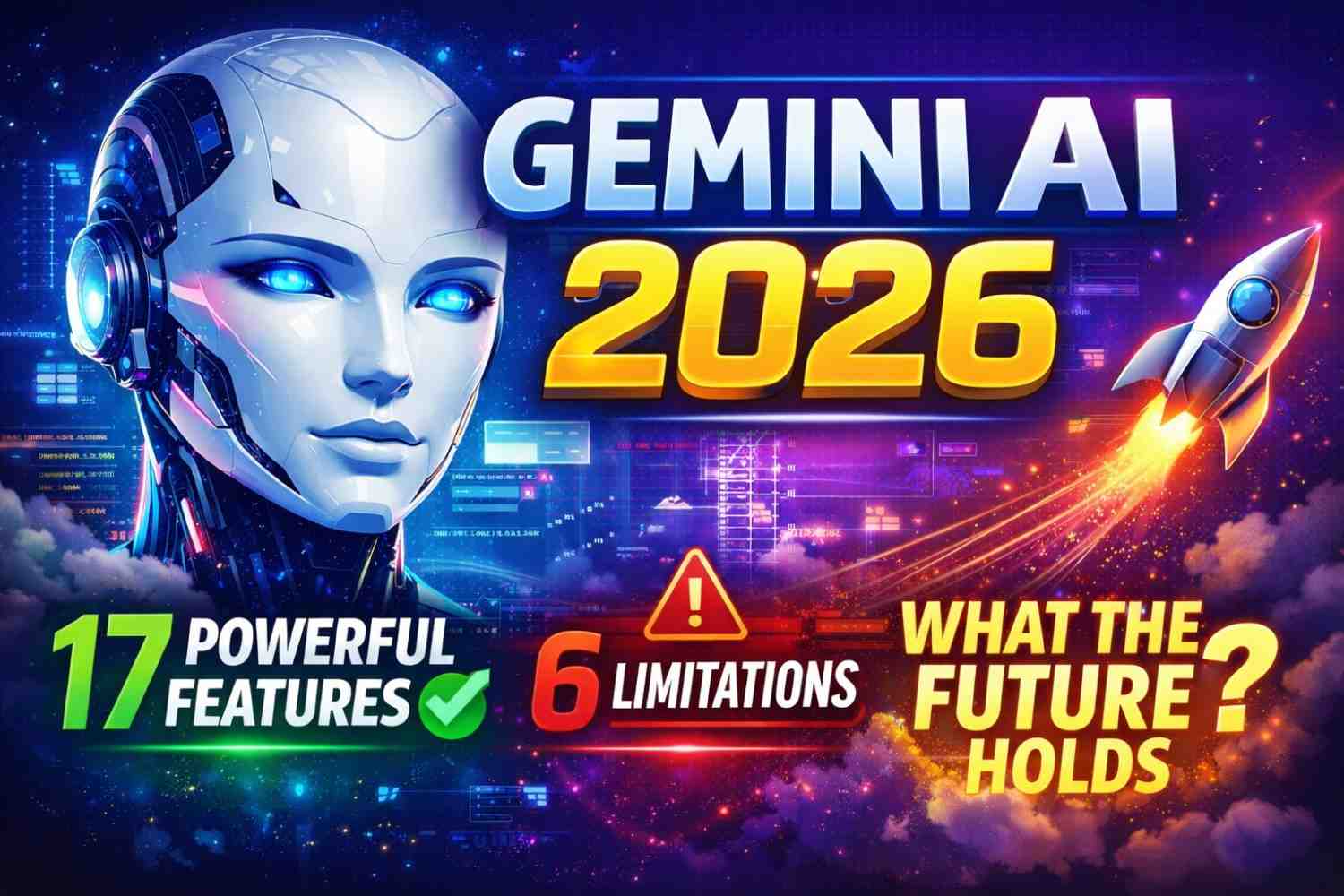
Gemini AI features 2026 mark a significant step in generative intelligence, blending advanced multimodal understanding with real-world application tools. In 2026, Gemini AI features 2026 are powering smarter assistants, creative workflows, and developer platforms that understand text, images, audio, and video more fluidly than before. This post breaks down 17 powerful features, 6 important limitations, and what the near future likely holds for Gemini AI features 2026 so you can see where the technology helps today and where caution is still needed.
Table of Contents
Top 17 Gemini AI features 2026
The following list highlights the most impactful Gemini AI features 2026 users and organizations are adopting. These features combine to make the platform a versatile tool for businesses, creators, and developers.
- Multimodal reasoning: Seamless understanding across text, image, audio, and video, enabling complex cross-modal queries and responses.
- Extended context windows: Context lengths that span millions of tokens enable long-form editing, legal reasoning, and ongoing project memory.
- Tool and API orchestration: First-class tool use lets Gemini call external APIs, run code, query databases, and integrate with enterprise systems safely.
- Real-time video and audio analysis: Live transcription, scene understanding, and sentiment tracking for streams and meetings.
- Personalized memory: Persistent, opt-in memory layers that personalize responses over time while respecting privacy controls.
- Enhanced code generation and synthesis: Multi-language, test-aware code output with automatic debugging suggestions and runtime reasoning.
- Higher factuality modes: Tunable responses that prioritize verifiable sources and cite references when available.
- Adaptive creativity: Styles, tones, and formats can be tuned to match brand voice or creative preferences.
- On-device lite models: Powerful but compact variants that enable offline and latency-critical applications.
- Multilingual fluency: Near-native performance across dozens of languages for translation and cross-cultural tasks.
- Composable pipelines: Modular blocks that let teams assemble custom capabilities for workflows and automation.
- Robust safety layers: Real-time content filters, provenance tracking, and human-in-the-loop review tools.
- Fine-grained permissioning: Enterprise-ready access controls and audit logs for compliance-sensitive deployments.
- Creative media synthesis: High-fidelity image, voice, and video generation with controllable attributes for production work.
- Energy-optimized inference: Better hardware-aware scheduling and model sparsity options reduce compute and cost.
- Improved generalization: Better few-shot and zero-shot performance across niche domains and specialized tasks.
- Developer tooling and SDKs: Richer libraries, playgrounds, and observability tools that simplify integration and monitoring.
How these features change daily workflows
Gemini AI features 2026 enable teams to automate repetitive drafting, accelerate research synthesis, and prototype multimedia experiences without stitching together multiple services. For example, the tool orchestration features let a single prompt trigger a chain: query a knowledge base, run a verification job, draft a report, and produce presentation slides. Developers can reference Gemini AI Developer Documentation for API examples and SDKs that accelerate these integrations.
6 Limitations of Gemini AI features 2026
Despite rapid progress, Gemini AI features 2026 are not without constraints. Understanding limitations helps teams design safer and more effective deployments.
- Residual hallucinations: Even with higher factuality modes, the system can produce plausible but incorrect claims, particularly on narrow, newly emerging topics.
- Bias and fairness gaps: Training data remnants can lead to biased outputs; continuous auditing remains necessary.
- Compute and cost: Large-context, multimodal pipelines still require substantial compute, making some use cases expensive at scale.
- Privacy and data handling: Persistent memory and data-rich integrations introduce privacy risks unless configured with strict controls.
- Interpretability limits: While better explanation tools exist, deep reasoning paths are not always transparent to non-experts.
- Domain-specific accuracy: In highly technical or regulated domains, expert oversight is still essential to validate outputs.
Mitigations and best practices
To reduce risk, teams should combine automated checks with human review, apply domain-specific verification layers, and use the platform’s permissioning and audit tools. For foundational context and background on generative systems that power many Gemini capabilities, see What Is Generative AI and the discussion on differences in learning paradigms at AI vs Machine Learning.
How enterprises are adopting Gemini AI features 2026
Enterprises focus on measurable ROI: automating customer support, accelerating R&D, optimizing content production, and improving decision support. Gemini AI features 2026 make it possible to embed multimodal agents into existing CRMs, to analyze large corpora of technical documents, and to build smart assistants that maintain long-term context for a customer relationship. Integration patterns include hybrid on-prem/off-cloud deployments to balance latency, compliance, and cost.
Examples of production use cases
- Support augmentation: Automated triage with cited references and escalation suggestions.
- Creative studios: Fast prototyping of storyboards, voice casting, and visual concepts using creative synthesis tools.
- R&D assistants: Literature reviews, hypothesis generation, and reproducible experiment tracking with long-context recall.
What the Future Holds for Gemini AI features 2026
Looking ahead, Gemini AI features 2026 will likely evolve along several converging trends: better alignment and safety tooling, more efficient architectures for on-device use, and richer developer ecosystems that make composing capabilities trivial. Expect improvements in multimodal grounding, where models cite sources and provide provenance for claims, reducing uncertainty for decision-critical tasks.
Near-term horizons (1–2 years)
In the immediate future, the focus will be on making Gemini AI features 2026 more accessible: improved SDKs, lower-latency hosted endpoints, and prebuilt connectors for common enterprise systems. Developers will continue using resources like the Google Gemini AI Official Announcement to track capabilities and compliance considerations.
Mid-term horizons (3–5 years)
Over the mid-term, expect deeper personalization that still preserves user privacy, stronger cross-application memories, and improved model explainability. Hardware advances and algorithmic efficiency should reduce the compute tax of large-context multimodal models, making many Gemini AI features 2026 more affordable and sustainable.
Long-term possibilities
In the long run, the most interesting outcomes combine human expertise with AI orchestration: modular AI ecosystems where teams stitch together specialized agents that communicate, verify, and jointly solve complex problems. Responsible governance, transparent auditing, and tight privacy guarantees will determine how widely those powerful Gemini AI features 2026 are trusted and adopted.
Practical tips to get started
If you’re evaluating Gemini AI features 2026 for your projects, start with a pilot on a focused use case, measure outcomes, and iterate. Use the developer documentation and community examples to prototype quickly, and design safety checks into the pipeline from day one. The combination of developer resources and official guides can accelerate learning and safe adoption—refer to the developer portal at Gemini AI Developer Documentation for technical references and sample integrations.
Checklist for pilots
- Define success metrics (accuracy, time saved, cost).
- Limit scope to a single workflow and instrument it for monitoring.
- Apply permissioning, logging, and human review gates.
- Assess data residency and compliance requirements early.
As you experiment, keep in mind that Gemini AI features 2026 provide both the power to automate complex tasks and the responsibility to deploy them thoughtfully. Use the available tools to balance innovation with safety.
In conclusion, Gemini AI features 2026 represent a leap in multimodal capability, developer tooling, and application potential, yet they still require careful governance and expert oversight. By understanding the 17 powerful features and the 6 key limitations described here, organizations can make informed decisions about where and how to integrate Gemini AI features 2026 into their operations while preparing for the technology’s rapid evolution.



Leave a Reply