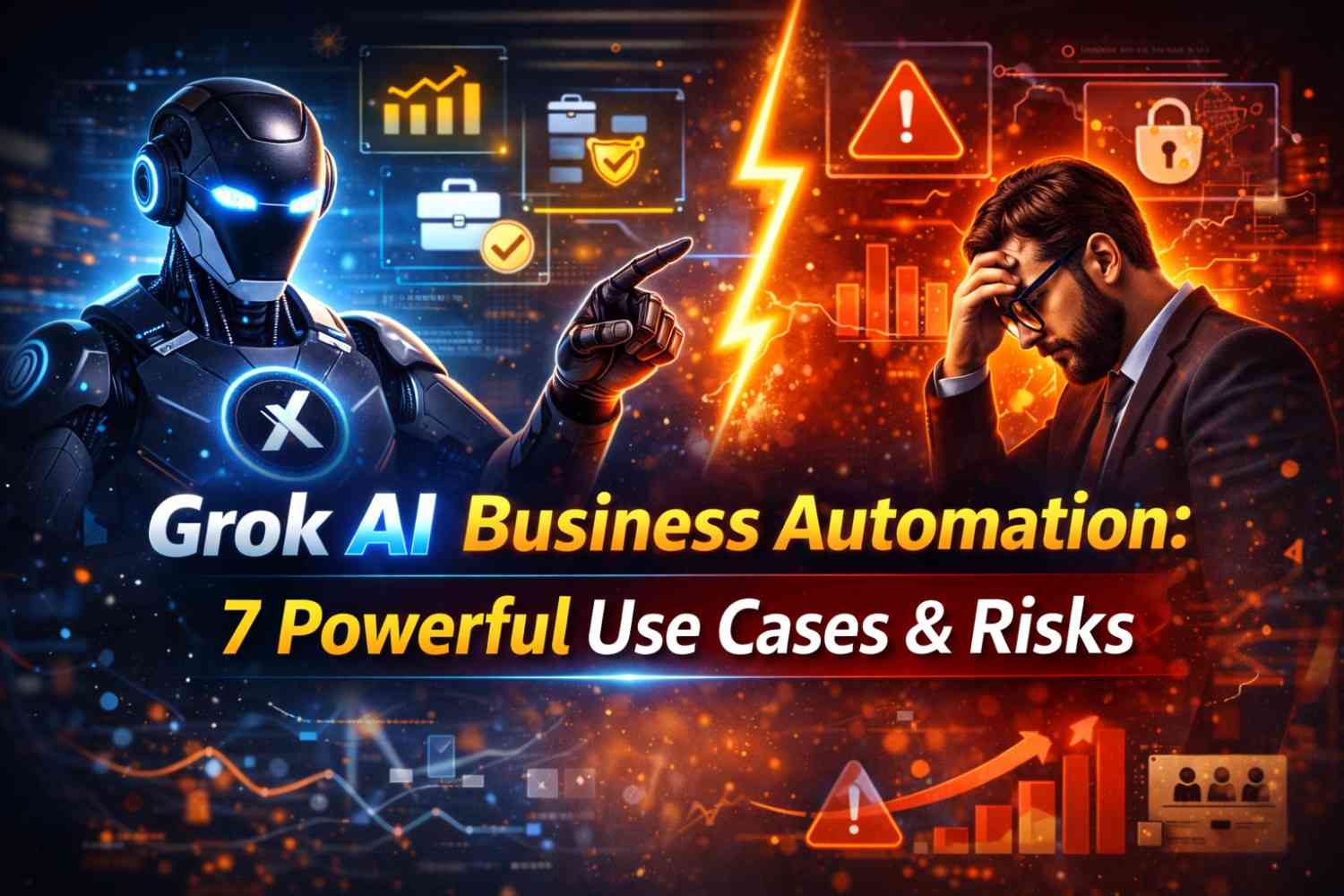
Grok AI business automation is transforming how companies operate by combining advanced language models with workflow orchestration to automate repetitive tasks, surface insights, and accelerate decision-making. In this post I’ll explain how Grok AI business automation works in practical terms, and walk through seven real-world business examples that show measurable time savings and improved customer experiences. Whether you’re evaluating automation pilots or scaling an AI-driven program, these examples will help you envision where Grok AI business automation can create immediate impact.
Table of Contents
Grok AI business automation: What it is and how it works
At its core, Grok AI business automation pairs a conversational AI engine with programmable tasks, triggers, and integrations so that natural language prompts can drive operational workflows. Instead of asking engineers to hard-code every edge case, teams can configure task templates that Grok invokes when certain conditions are met — summarizing documents, extracting structured data, drafting responses, or orchestrating backend services.
Grok’s architecture lets businesses chain actions (for example: read an email, extract customer issue, create a ticket, and draft a reply) while maintaining human review gates where required. For implementation details and API references, consult the Grok AI official documentation. If you want a broader perspective on where automation delivers value across industries, the McKinsey AI automation insights provide useful benchmarks and categories of use cases.
Benefits of Grok AI business automation include:
– Faster turnaround on routine work
– Fewer manual errors in data extraction and routing
– Consistent communication templates that preserve brand voice
– Easier scaling of high-volume processes without proportional headcount increases
For a wider discussion of AI-driven process change and long-term workforce implications, see this overview of AI business automation and the collection of AI automation use cases.
Grok AI business automation: 7 real-world examples
1. Customer support triage and response
One of the fastest ROI scenarios for Grok AI business automation is support ticket triage. When emails, chat messages, or forms arrive, Grok can classify intent, extract key entities (order numbers, product names, error messages), and assign a priority. It can also draft a first-response using the company’s tone guidelines, which agents can edit before sending.
Example outcome: a mid-sized ecommerce company reduced average first-response time from four hours to under 30 minutes while lowering repetitive question volume by 40%. Grok AI business automation handled routine returns and order-status queries so agents focused on escalations.
2. Sales enablement and lead qualification
Sales teams use Grok to analyze inbound inquiry content and automatically enrich leads with firmographic details pulled from internal CRMs or public APIs. Grok AI business automation can then score and route qualified leads to appropriate reps, attach suggested messaging, and create a next-step task in the CRM.
Example outcome: a B2B SaaS company doubled qualified lead throughput without hiring extra SDRs, because Grok automated the initial qualification and scheduling steps.
3. Financial close support and reconciliation
Accounting teams can apply Grok for bank reconciliation, invoice classification, and exception identification. Grok reads statements, matches transactions to invoices or purchase orders, and flags mismatches for human review. It can also produce a summarized checklist for month-end close.
Example outcome: finance teams decreased manual reconciliation time by 60% and cut the close cycle by several days. Using Grok AI business automation reduced routine audit prep effort and improved traceability.
4. HR onboarding and knowledge distribution
HR departments deploy Grok to automate new-hire checklists, generate tailored onboarding plans, and provide an interactive knowledge bot for policy questions. Grok AI business automation can pull a role profile, determine required training modules, and schedule sessions with managers — all while tracking completion and sending nudges.
Example outcome: new hires reached productivity milestones sooner because administrative friction was removed and answers to common policy questions were available instantly.
5. Marketing content generation and localization
Marketing teams leverage Grok to create first-draft copy for emails, landing pages, and social posts based on campaign briefs. Grok AI business automation can also localize content into multiple languages and produce A/B variants for testing. Importantly, this automation is paired with review steps and style checks to maintain quality.
Example outcome: a marketing team scaled content production threefold and improved campaign velocity, enabling more rapid iteration and measurement.
6. Product analytics and incident summaries
When an outage or bug appears, Grok can ingest logs, error reports, and customer complaints to produce an incident summary and suggested mitigation steps. Grok AI business automation helps route the incident to the right engineering queue, create post-incident reports, and surface customer impact details for communications teams.
Example outcome: incident resolution cycles became more organized with clearer handoffs and faster stakeholder updates, reducing downtime and customer frustration.
7. Procurement and contract review
Procurement teams use Grok for initial contract review: extracting dates, renewal clauses, payment terms, and risk flags. Grok AI business automation can populate a contract database with structured fields and recommend negotiation points based on historical outcomes, reducing legal review load for routine agreements.
Example outcome: time-to-execution for standard contracts dropped significantly, and legal teams focused on high-risk agreements rather than repetitive clause checks.
Implementation tips and governance
To get results quickly, start by identifying high-volume, repeatable processes with clear success metrics. Run a small pilot for one use case, measure time saved and error reduction, and iterate on prompts and task templates. Include human-in-the-loop checkpoints for decisions that carry compliance or reputational risk. Maintain logs and versioned prompts so you can audit decisions later.
For teams setting up integrations and automation pipelines, the Grok AI official documentation is a practical resource. Pair vendor docs with industry research like McKinsey AI automation insights to shape your roadmap and estimate potential impact.
Measuring impact and scaling
Track both quantitative and qualitative KPIs. Quantitative measures include time savings, throughput increases, error rates, and cost per transaction. Qualitative feedback from users and customers helps assess adoption and trust in Grok’s outputs. As you scale Grok AI business automation to more processes, maintain a center of excellence that curates best practices for prompt design, integration patterns, and risk controls.
Common scaling steps:
– Standardize templates and prompts that performed best in pilots
– Build connectors to CRMs, ticketing systems, and data stores
– Define escalation paths and SLA thresholds
– Monitor for drift in model behavior and retrain tasks when needed
Integrating Grok into enterprise processes often requires collaboration across IT, legal, and the target functional teams. Plan for change management: training, sample workflows, and early wins that demonstrate value.
Across all these uses, Grok AI business automation is most effective when paired with clear guardrails and measurable goals. The combination of a capable language model and workflow orchestration allows organizations to reduce manual toil while improving consistency and response quality.
Conclusion: Grok AI business automation offers practical, near-term gains across customer support, sales, finance, HR, marketing, product, and procurement. By starting with high-volume, low-risk processes and iterating with human oversight, businesses can unlock efficiency and reinvest time in higher-value work. If you’re mapping a pilot, refer to the implementation guidelines above and the resources linked for further reading on AI business automation and specific automation use cases.



Leave a Reply