
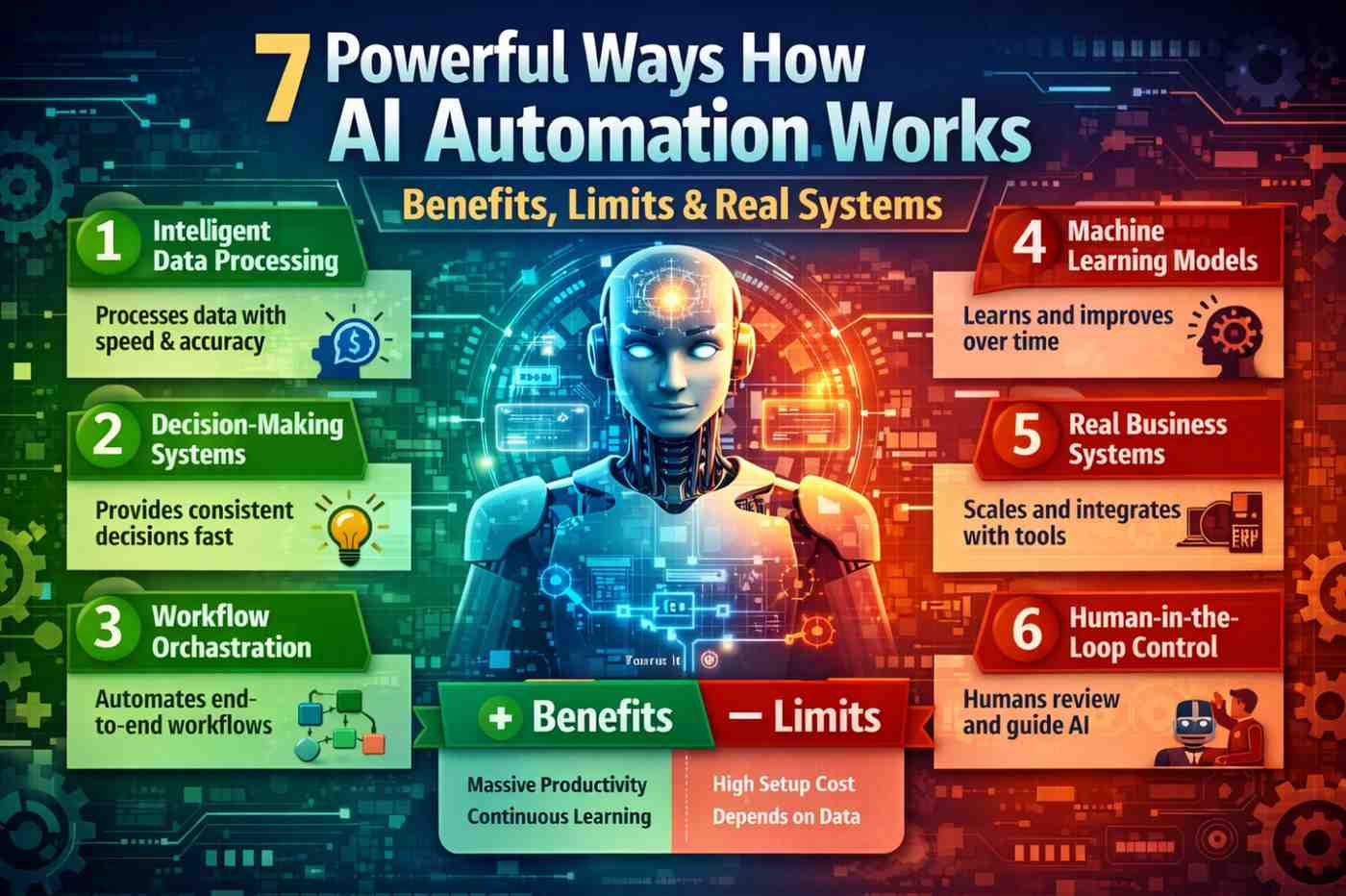
Understanding how AI automation works is essential for organizations looking to streamline processes, reduce errors, and unlock new efficiencies. In this post we’ll explain how AI automation works in practical terms, show seven powerful approaches that are already transforming industries, discuss the benefits and limits, and point to real systems that demonstrate these ideas in action.
Table of Contents
How AI Automation Works: 7 Powerful Ways
1. Intelligent Process Automation (IPA)
One of the clearest demonstrations of how AI automation works is Intelligent Process Automation, which layers machine learning and natural language processing on top of traditional robotic process automation. Instead of executing only rigid, rule-based tasks, systems learn patterns from historical data and adapt when inputs vary. This approach helps firms automate invoice processing, claims handling, and customer onboarding with fewer manual interventions.
2. Conversational AI and Virtual Agents
Conversational AI shows how AI automation works by combining context-aware dialogue management with language models. Virtual agents can handle common queries, escalate complex cases, and even trigger backend workflows. Organizations embed these agents into support channels, reducing hold times and increasing resolution rates while freeing human agents to focus on higher-value tasks.
3. Predictive Maintenance and Anomaly Detection
In industrial settings, predictive models analyze sensor streams to detect patterns that precede failure. That is a concrete example of how AI automation work: the system predicts unwanted outcomes and triggers automated inspections or parts replacement. This reduces downtime, lowers maintenance costs, and increases equipment lifespan.
4. Autonomous Decisioning and Recommendation Engines
Recommendation and decisioning systems illustrate how AI automation work by assessing many variables and returning optimal choices in real time. From credit decisions and dynamic pricing to personalized content, these engines automate decisions that used to require manual analysis, applying business rules, fairness constraints, and feedback loops to continuously improve.
5. Document Understanding and Intelligent Capture
Optical character recognition plus natural language understanding show how AI automation works when documents are messy and varied. These systems extract structured data from invoices, contracts, and forms, validate fields, and feed information into ERPs or CRMs without human keying. The result: speed and accuracy gains across finance, legal, and procurement.
6. Autonomous Data Pipelines and Integration
AI-driven ETL and data orchestration platforms reveal how AI automation work by detecting schema changes, suggesting mappings, and automating transformations. Rather than manual scripting, teams use intelligent pipelines that adapt to new sources, clean data automatically, and maintain lineage, enabling faster analytics and model retraining.
7. Closed-Loop Feedback Systems
Systems that learn from outcomes show how AI automation works by closing the loop between action and result. Models that trigger marketing campaigns, route tickets, or approve loans can ingest outcome signals (clicks, complaints, defaults) to refine future decisions. This self-improving behavior is a hallmark of mature automated AI systems.
Understanding How AI Automation Works: Benefits and Limits
Benefits: speed, scale, and consistency
When firms study how AI automation works, they quickly see benefits: faster processing times, the ability to scale services without linear headcount growth, and consistent application of policies. Examples include automated KYC checks, rapid claims triage, and personalized recommendations that operate 24/7. These gains can materially reduce costs and increase customer satisfaction.
Limits: data quality, bias, and governance
No discussion of how AI automation works is complete without acknowledging limits. Models require good data; poor input quality undermines accuracy. Bias in training sets can produce unfair outcomes, and automated systems may lack transparency, making it hard to audit decisions. Robust governance, explainability tools, and human-in-the-loop checkpoints are necessary to manage these risks.
Operational Challenges
Practical constraints matter when deploying systems that show how AI automation works. Integration with legacy systems, scalability of inference workloads, and monitoring model drift are common hurdles. Teams must design for observability and build rollback mechanisms so automation can be adjusted or paused when errors appear.
Real Systems That Demonstrate How AI Automation Works
Enterprise platforms and intelligent suites
Large vendors provide suites that illustrate how AI automation works in enterprise contexts. For a deep dive into how intelligent automation is being packaged and delivered, see IBM intelligent automation. These platforms integrate process mining, RPA, NLP, and model management to create end-to-end automation capabilities.
Cloud services and serverless automation
Cloud providers make it easier to deploy automated pipelines that show how AI automation works at scale. Services for event-driven workflows, managed ML inference, and integration reduce the operational burden. For a clear primer on automation concepts and cloud patterns, consider What is automation – AWS, which explains basic automation building blocks and how they map to cloud services.
Emerging tools and models
Newer tools combine advanced large language models with automation tooling to showcase how AI automation works in modern workflows. Systems that link language models to code execution, data access, and orchestration can automate more complex, conditional processes. Examples range from automated content generation pipelines to smart assistants that perform multi-step tasks across apps.
Design Patterns and Best Practices for How AI Automation Works
Modular architecture
Designing modular components helps illustrate how AI automation works in maintainable ways. Separate data ingestion, model inference, decision logic, and orchestration layers so teams can update models without rewriting core workflows. Clear APIs and versioning reduce risk when introducing new automated behaviors.
Human-in-the-loop and escalation
One reliable pattern showing how AI automation works is to keep humans in the loop for edge cases. Use confidence thresholds to route ambiguous items for review, and capture reviewer corrections to retrain models. This hybrid approach balances efficiency with safety and keeps oversight where it matters most.
Monitoring, logging, and retraining
Automation systems must be observable to prove how AI automation works over time. Track key metrics like accuracy, latency, and error rates. Log decisions, inputs, and outcomes to support audits and enable periodic retraining when data distributions shift.
Industry Examples and Case Studies of How AI Automation Works
Finance and fintech
In finance, learning how AI automation works often focuses on risk scoring, fraud detection, and compliance automation. Automated models monitor transactions in real time, flag anomalies, and update risk profiles without human lag, enabling faster response to emerging threats.
Healthcare and life sciences
Healthcare organizations demonstrate how AI automation works by accelerating image analysis, triaging patient messages, and automating administrative tasks. While clinical decision automation must be carefully validated, administrative automation frees clinicians to focus on care.
Retail and logistics
Retailers use automated demand forecasting, dynamic replenishment, and personalized offers to show how AI automation works across the customer journey. In logistics, route optimization and predictive fleet maintenance reduce costs and improve delivery reliability.
For readers interested in trends and practical deployments, there are helpful resources that document evolving use cases and toolchains—see AI automation trends for an overview of where investments are going, and explore hands-on examples like Grok & Claude AI automation to see model-enabled scraping and task automation in practice.
Implementation Roadmap: Getting Started with How AI Automation Works
Assess and prioritize
Begin by mapping processes and identifying high-impact, low-risk candidates for automation. Understanding how AI automation works in your context means selecting use cases with clear ROI and measurable outcomes—billing, support triage, or repetitive data entry often fit this profile.
Prototype and validate
Build small pilots to validate assumptions about data availability and model performance. Prototyping helps teams learn how AI automation works without large upfront investments, and it surfaces integration challenges early.
How AI Automation Works Through Intelligent Data Processing
AI automation works by collecting data, cleaning it, and using machine learning models to identify patterns. This enables systems to automate tasks like predictions, classification, and decision support faster than humans.
Benefit: Speed & accuracy
Limit: Depends heavily on data quality
How AI Automation Works in Decision-Making Systems
AI automation works by analyzing multiple variables simultaneously and recommending or executing decisions based on predefined rules or learned behavior.
Benefit: Consistent decisions
Limit: Can fail in edge cases without human oversight
How AI Automation Works Using Workflow Orchestration
AI automation works by connecting tools, APIs, and triggers into workflows that automatically execute tasks end-to-end without manual intervention.
Scale with governance
Once pilots succeed, scale with proper governance: automated testing, ethical reviews, and operational runbooks ensure that how AI automation works in production is reliable, auditable, and aligned with business policies.
Understanding how AI automation works is not a one-time exercise; it’s a continuous journey of measuring outcomes, refining models, and expanding automation to new domains. Well-designed systems balance autonomy and control, combining machine speed with human judgment where needed.
In conclusion, how AI automation works in practice depends on clear objectives, robust data, and disciplined governance. By following proven design patterns, starting small, and learning from real systems, organizations can capture the benefits while managing the limits of automation.




Leave a Reply