
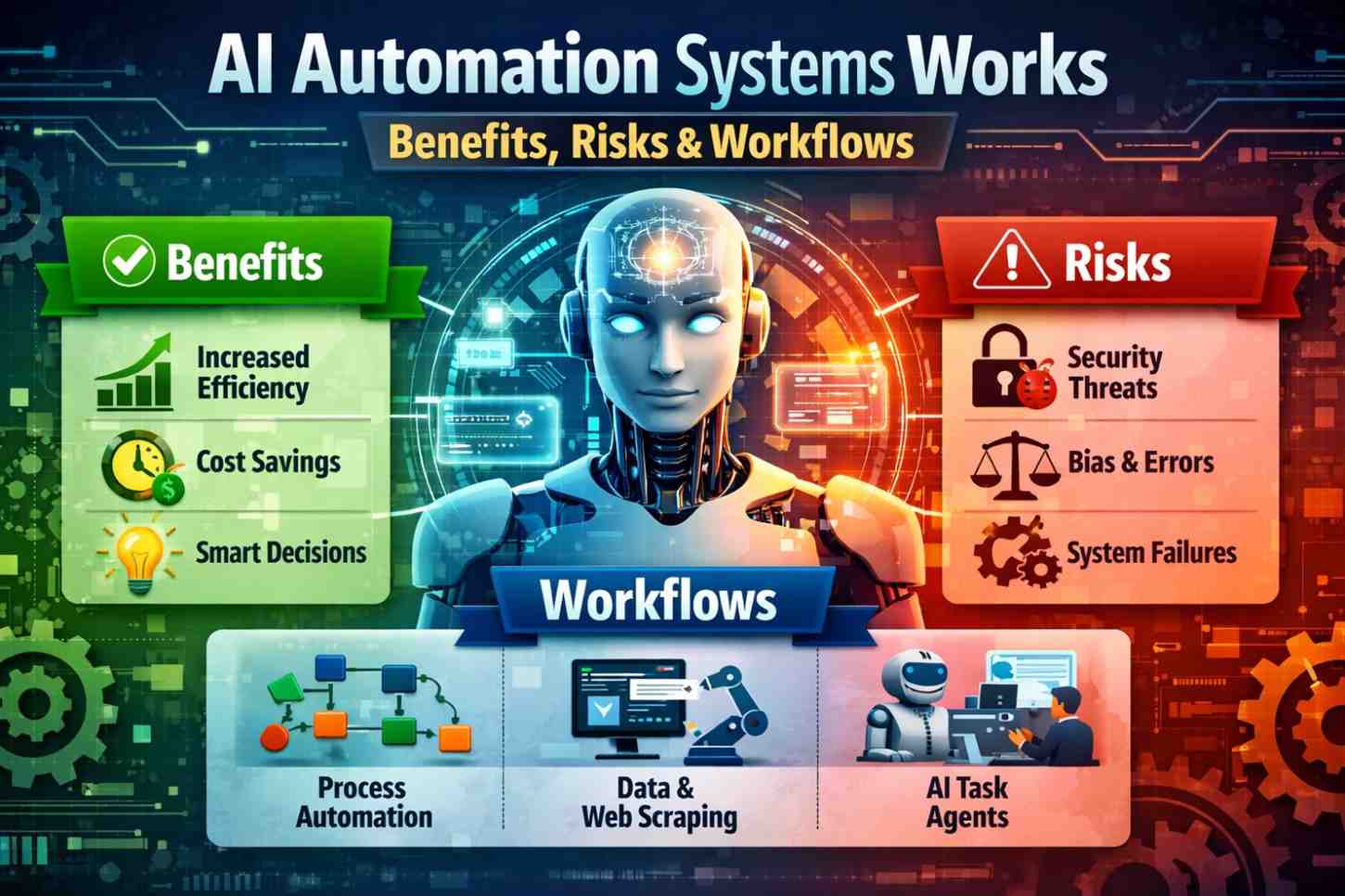
Understanding how AI automation systems work doesn’t require a degree in computer science — it just takes clear explanations about components, decisions, and workflows. In practical terms, AI automation systems combine data, rules, machine learning models, and orchestrated steps to turn inputs into repeatable outcomes. Whether you’re automating customer support triage, invoice processing, or intelligent monitoring, a basic grasp of these systems helps you design, evaluate, and improve automation efforts.
Table of Contents
AI automation system: the basic building blocks
At their core, AI automation systems are assemblies of components that sense, decide, and act. These building blocks work together so that mundane or complex tasks can be executed with minimal human intervention. Typical components include:
- Data sources — databases, sensors, logs, and user inputs that feed the system.
- Preprocessing — cleaning, normalizing, and transforming raw data into usable formats.
- Decision engines — rules, models, or hybrid logic that determine the next step.
- Orchestration — workflow layers that sequence tasks, manage failures, and route outputs.
- Actuators — APIs, messaging systems, or robotic interfaces that carry out actions.
- Monitoring and feedback — telemetry and human-in-the-loop mechanisms that refine behavior.
When these parts are combined, AI automation system transform inputs into repeatable, measurable outcomes. Implementers often layer machine learning models over rule-based logic so systems can handle exceptions while improving over time.
How decisions are made inside AI automation syste
Decision making in AI automation systems typically follows a pipeline that moves from data to action. The pipeline can be simple (if-then rules) or complex (ensembles of models and probabilistic reasoning). Key stages include:
Perception and data interpretation
First, the system must perceive its environment. This could mean parsing an email, extracting fields from a PDF invoice, or reading telemetry from a machine. Preprocessing and feature extraction turn raw inputs into structured signals that the decision logic can consume.
Rule-based versus learned decisions
Rules are explicit: if a condition is met, take a defined action. Learned decisions come from models trained on historical examples. Many AI automation systems combine both: rules handle cases with clear business constraints, and models handle fuzzy or high-dimensional judgments.
Confidence and thresholds
Good systems estimate confidence. A model might predict an outcome with 92% confidence and proceed automatically, or it might fall below a business-defined threshold and escalate to a human reviewer. Confidence thresholds help balance automation speed with accuracy and risk.
Designing workflows for AI automation systems
Workflows are the glue that coordinates sensing, decision-making, and action. Designing workflows for AI automation systems means mapping end-to-end processes that include automation, review, exception handling, and continuous learning. Typical design considerations are:
- Defining clear inputs and outputs for each step
- Specifying where humans intervene
- Handling retries, timeouts, and error conditions
- Logging and audit trails for compliance and improvement
Tools and platforms can help with orchestration. For example, cloud providers and enterprise vendors publish resources that explain automation patterns and best practices; see IBM intelligent automation overview and What is automation – AWS for practical frameworks and examples.
Common patterns in AI automation systems
Certain patterns recur across domains. Recognizing them speeds design and reduces mistakes.
Event-driven automation
Systems respond to events: an incoming email triggers triage, a sensor reading triggers an alert, or a payment triggers reconciliation. Event-driven AI automation systems are reactive and scale well when events are frequent and unpredictable.
Batch processing
Some tasks are bundled and processed periodically. Batch AI automation systems are useful for overnight data enrichment, large-scale model inference, or mass reporting tasks.
Human-in-the-loop
This pattern hands borderline or risky decisions to humans for verification. It’s a practical compromise that lets AI automation systems operate at scale while containing operational risk.
How to evaluate performance of AI automation systems
Evaluating AI automation systems requires metrics for accuracy, speed, reliability, and business impact. Useful measures include:
- Precision and recall for classification tasks
- Throughput and latency for time-sensitive processes
- Rate of exception handling and human escalations
- Cost savings, error reduction, or revenue impact
Monitoring should also capture drift: when inputs or contexts change, models can degrade. A robust feedback loop lets AI automation systems retrain models or adjust rules to maintain performance.
Implementation challenges and practical tips
Building AI automation systems is easier when you anticipate common challenges. Practical tips include:
- Start small with a clear, measurable use case and expand iteratively.
- Use modular design so components (data ingestion, model serving, orchestration) can be updated independently.
- Prioritize observability: rich logs, metrics, and tracing make debugging and tuning faster.
- Balance automation with controls — incorporate human review where needed and track outcomes over time.
To stay current on tooling and business shifts, follow industry resources and trends. For examples of evolving practice and product direction, check resources on AI automation trends and learn how teams map work with AI automation workflows.
Security, compliance, and governance in AI automation systems
Security and governance are essential. AI automation systems often access sensitive data and make process-altering decisions, so controls must include:
- Role-based access and least privilege
- Encrypted data at rest and in transit
- Auditable logs for all automated actions
- Model explainability where decisions affect people or compliance
Developers should collaborate with legal and compliance teams early to ensure data handling and decision logic meet regulatory requirements. Governance also defines who is accountable when an automated decision produces an unexpected outcome.
Scaling and lifecycle management
AI automation systems need lifecycle practices: model versioning, testing, deployment pipelines, and rollback strategies. Scaling also means addressing operational concerns:
- Autoscaling inference infrastructure to meet demand
- Sharding workflows to avoid bottlenecks
- Implementing canary releases to limit exposure of new logic
Operational maturity comes from automating the automation: pipelines that handle data validation, automated retraining triggers, and continuous evaluation allow AI automation systems to remain effective as usage grows.
Future directions for AI automation systems
Looking ahead, AI automation systems will increasingly blend generative models, real-time decisioning, and richer human interfaces. Expect advances in explainability and tighter integration between business process management and model-driven decisioning. These shifts will let organizations automate more nuanced tasks while keeping humans in control when it matters most.
Whether you are mapping a first automated process or architecting enterprise-scale automation, understanding the elements of AI automation systems — data, decisions, workflows, and governance — is the critical first step. Use practical patterns, monitor continuously, and iterate based on measurable outcomes to get the most value from automation.
In conclusion, AI automation systems bring together sensing, decisioning, and orchestration to deliver reliable, scalable outcomes; starting with clear design and governance will keep you on track as your automation initiatives grow.




Leave a Reply