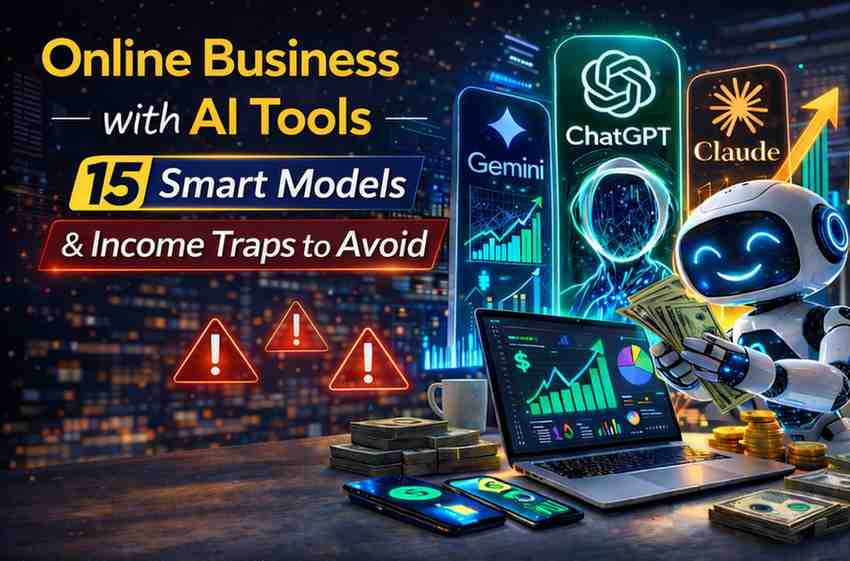
Starting an Online Business with AI Tools can transform a small idea into a scalable income stream faster than ever, but it also brings unique choices and pitfalls. This guide lays out 15 smart models you can adopt, practical ways to implement them, and the income traps to avoid so your Online Business with AI Tools grows reliably and ethically from day one.
Table of Contents
15 Smart Business Models Using Online Business with AI Tools
Below are 15 tested models that leverage automation, generative AI, and intelligent workflows. Each model can be launched with modest upfront investment and scaled using the right mix of tools and processes to build an Online Business with AI Tools.
- Content-as-a-Service: Offer blog posts, newsletters, or video scripts generated and edited with AI to busy entrepreneurs.
- Micro-SaaS Products: Build small subscription tools that use AI for niche tasks (e.g., invoice summarization, email triage).
- Automated Consulting Packages: Use AI to create diagnostic reports, growth plans, and automation blueprints for clients.
- AI-Powered Course Creation: Quickly outline, script, and produce online courses with AI-assisted lesson plans.
- Low-Content Publishing: Design journals, planners, and workbooks using AI layouts and publish via platforms like Amazon KDP.
- Chatbot Monetization: Deploy specialized chatbots for customer service, lead qualification, or membership experiences.
- Marketing Automation Agencies: Provide end-to-end campaign creation using AI copy, targeting, and performance optimization.
- AI-Enhanced E-commerce: Use AI for product descriptions, image generation, and personalized recommendations.
- Creative Services Marketplace: Match clients with AI-assisted designers, video editors, and voice artists.
- Data Labeling & Fine-Tuning Services: Prepare datasets and fine-tune models for small businesses without ML teams.
- Voice & Conversational Products: Build audio guides, narration, or voice apps using synthetic voice models.
- Research-as-a-Service: Provide competitive analysis, summarization, and trend reports powered by large language models.
- Subscription Intelligence Dashboards: Aggregate business KPIs with AI-driven insights and automated alerts.
- Localized Content Production: Create multilingual marketing and product content with AI translation and cultural adaption.
- White-Label Automation Kits: Package automations and templates that other consultants can resell under their brand.
Each of these models benefits from careful selection of AI capabilities — from text generation to image creation, and from workflow automation to custom fine-tuning — enabling a variety of revenue streams for an Online Business with AI Tools.
How to Choose and Evaluate Tools for Your Online Business with AI Tools
Choosing the right AI stack is essential. Not every tool fits every model, and the best choices minimize manual overhead while maximizing reliability. Consider these evaluation criteria when assembling your Online Business with AI Tools:
- Accuracy and output quality for your use case (content, code, voice, images).
- Integration options: APIs, webhooks, and automation platforms.
- Cost per call and predictable scaling to avoid surprise bills.
- Data privacy and ownership — who owns the outputs and how data is stored.
- Community and documentation to accelerate implementation.
Pairing models with best-in-class AI
Leverage specialty models where appropriate. For example, advanced multimodal platforms like Gemini AI Technology can be useful for complex reasoning or multimodal content, while simpler text-only APIs are efficient for high-volume copy tasks.
Testing and MVPs
Start with a minimum viable product: a simple workflow that proves value and cash flow. Use it to validate pricing, demand, and performance before investing in custom models or expensive infrastructure.
Income Traps to Avoid When Building Online Business with AI Tools
While an Online Business with AI Tools can be lucrative, several common traps can derail growth or erode profitability. Awareness and practical countermeasures will protect your time and reputation.
Trap 1 — Over-Reliance on a Single Tool
Relying solely on one AI provider or tool creates concentration risk. If pricing changes or the tool’s performance degrades, your entire operation can suffer. Mitigate this by designing interchangeable components and testing fallback providers.
Trap 2 — Monetizing Outputs Without Quality Control
Delivering raw AI outputs to paying customers without human editing leads to errors, bias, or irrelevance. Establish robust review workflows and quality gates so your Online Business with AI Tools consistently delivers reliable results.
Trap 3 — Mispriced Subscriptions and One-Offs
Many founders underprice their services because AI lowers marginal production cost. Price for value — not just cost — and model your pricing around retention and outcome-based tiers rather than purely per-output fees.
Trap 4 — Ignoring Data Privacy and Compliance
Client data handled by AI systems can trigger legal and trust issues. Be transparent about data usage, implement opt-outs, and use secure processing environments when required.
Trap 5 — Failing to Showcase Differentiation
An Online Business with AI Tools that looks like every other provider will compete only on price. Highlight unique processes, curated data, human oversight, or vertical expertise to create defensible differentiation.
Trap 6 — Scaling Too Fast Without Systems
Automation can create rapid demand, but without customer support, billing, and fulfillment systems, growth becomes chaos. Build support playbooks and escalation paths early to protect reputation.
Operational Tips to Scale an Online Business with AI Tools
Operations determine whether your Online Business with AI Tools becomes a dependable income generator or an unpredictable side project. Implement these practical tips.
Automations that Reduce Rework
Automate repetitive steps like formatting, metadata tagging, or delivery notifications. This reduces cost per sale and improves margins as volume grows.
Measure Unit Economics
Track acquisition cost, fulfillment time, and lifetime value. Knowing these allows you to scale profitably and identify where AI can reduce costs without harming quality.
Build Reusable Templates and Prompts
Invest time in prompt engineering and reusable templates; these become intellectual property that speeds new client onboarding and keeps output consistent across the business.
Marketing and Growth Without Overpromising
Marketing an Online Business with AI Tools should emphasize outcomes and transparency. Avoid overhyping capabilities — instead, use case studies, documented processes, and measurable results to build trust and referrals.
For an implementation playbook and monetization pathways, see this resource: Make Money with AI Tools Blueprint. For automation frameworks specifically designed for small operations, consult this guide: AI Automation for Small Businesses.
Legal, Ethical, and Long-Term Considerations for Your Online Business with AI Tools
As you grow an Online Business with AI Tools, address legal and ethical concerns proactively. Clear terms of service, transparent disclosure of AI use, and mechanisms for disputing or correcting outputs will protect you and your customers.
Intellectual Property and Licensing
Clarify who owns derivative works, especially for creative outputs. Structure contracts so clients understand reuse rights and any limitations tied to the underlying AI provider.
Bias, Fairness, and Accessibility
Audit your outputs for bias and ensure accessibility standards are met. These practices reduce reputational risk and expand your addressable market.
Final Checklist Before You Launch an Online Business with AI Tools
- Validate demand with a paid pilot or MVP.
- Document workflows and build templates/prompts.
- Set pricing that reflects delivered value and recurring benefit.
- Implement monitoring and error-correction processes.
- Ensure compliance with relevant data and IP rules.
Starting with a clear checklist helps you convert experimentation into repeatable revenue for your Online Business with AI Tools.
Whether you aim to publish low-content books on platforms such as Amazon KDP, offer white-label automations, or create subscription intelligence dashboards, the combination of smart model choice and disciplined operations is what turns AI capabilities into dependable income. Keep learning about new models and underlying technologies, stay transparent with customers, and avoid common income traps to sustain growth.
Conclusion: An Online Business with AI Tools offers powerful opportunities, but success depends on careful model selection, quality control, and ethical practices. Use the 15 models and the traps-to-avoid outlined here to build a resilient, scalable business that serves real customer needs.




Leave a Reply