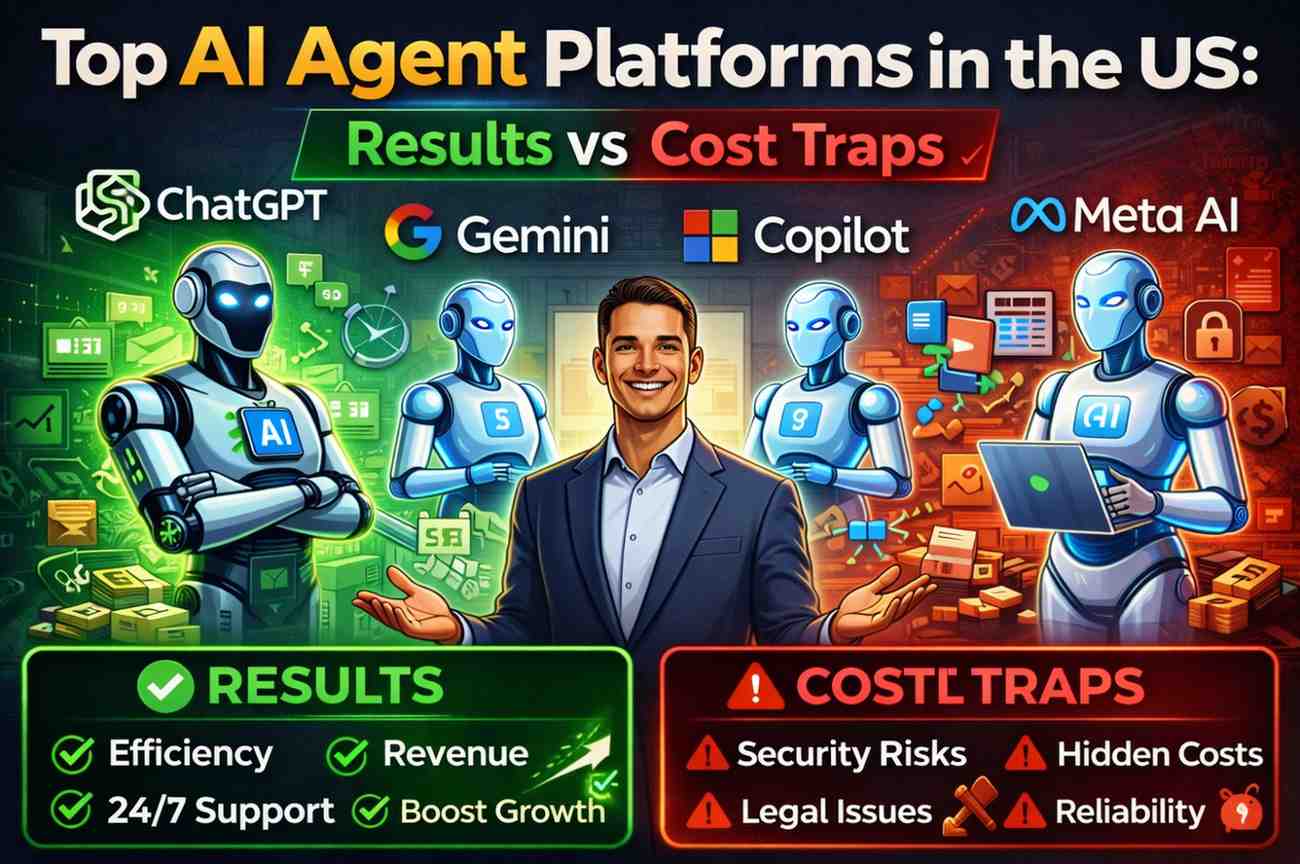
The landscape of AI agent platforms USA is rapidly changing — promising autonomous workflows, conversational agents, and automated decision-making that can dramatically boost productivity. For US businesses evaluating options, the key questions are straightforward: which platforms deliver measurable results, and where do cost traps hide? This post compares leading AI agent platforms USA, highlights practical performance benchmarks, exposes common billing surprises, and gives an action plan for choosing systems that deliver value without breaking the budget.
Table of Contents
Top AI agent platforms USA: Results vs cost — what to expect
When assessing AI agent platforms USA, it helps to separate raw capability from total cost of ownership. On capability, several US-based and US-serviced offerings lead in natural language, API maturity, and enterprise controls. On cost, platform pricing often understates the true expense: compute, storage, integration, and professional services can double or triple initial estimates.
Performance and real-world results
For many teams the primary metric is outcome: did the agent reduce manual work, raise revenue, or improve customer satisfaction? Top-performing AI agent platforms USA typically show improvements in these areas when paired with disciplined design and monitoring. Examples of measurable wins include:
- Automated triage for customer support that reduces first-response time by 40–60%.
- Sales assistant agents that surface qualified leads and increase conversion rates by 10–25%.
- Knowledge agents that retrieve accurate answers from internal docs, speeding employee onboarding.
Sources to research platform reviews and category comparisons are helpful during vendor selection; look at independent marketplaces such as G2 AI Platforms and Capterra AI for user feedback and feature breakdowns that reflect real deployments.
Common cost traps and billing surprises
Even when an AI agent platform USA advertises a reasonable monthly fee, hidden costs often appear after launch. Watch for these pitfalls:
- Per-inference or per-agent usage fees that rise quickly as you scale.
- Data egress, storage, and retention charges tied to compliance or logging needs.
- Integration and customization services billed by the hour or as fixed packages.
- Higher model tiers for production-quality latency and reliability.
To avoid surprises, get a sample billing scenario from vendors using your expected query volumes and retention windows before signing a long-term contract.
How to benchmark AI agent platforms USA for your use case
Benchmarking AI agent platforms USA requires a mix of technical tests and business-oriented pilots. A short pilot that mirrors production workloads gives the clearest picture of both results and costs.
Define success metrics and test data
Start with a small, measurable pilot: define KPIs (time saved, task completion rate, customer NPS change, revenue uplift), prepare representative data, and run the agent for a defined period. Make sure your test covers peak usage patterns so you measure cost under realistic load.
Technical checks that matter
Key technical criteria to validate during a pilot include:
- Latency and throughput under load.
- Accuracy rates on your domain-specific prompts and documents.
- Robustness of API and webhooks.
- Security features like role-based access, encryption, and audit logs.
Pair these checks with cost modeling — translate API calls, storage, and compute into a monthly spend projection so you can compare apples to apples between vendors.
Choosing AI agent platforms USA: balancing capability, cost, and culture
Choosing between AI agent platforms USA isn’t purely technical. Organizational adoption, vendor support, and data governance are decisive. A platform that integrates well with existing workflows and teams will deliver better results even if its sticker price is higher.
Shortlist criteria: functionality and fit
When building a shortlist, evaluate platforms on these dimensions:
- Out-of-the-box templates for common agent tasks (support, sales, research).
- Extensibility via custom code, connectors, and plugins.
- Compliance certifications and data residency controls relevant to US businesses.
- Quality of vendor documentation and community resources for faster onboarding.
For companies expanding automation beyond prototypes, consider ecosystems that connect to widely used tools; explore options that pair agent capabilities with enterprise automation suites or AI assistants. If your objective includes workflow automation, review vendors listed under AI automation tools to see integrations and automation patterns common among US adopters.
Implementation tips to avoid expensive rework
Avoid customizing too early. Begin with a minimal viable agent that addresses a small set of high-value tasks. Use iterative improvement based on metrics and user feedback to guide further investment. Document decision points and instrument each agent with usage and error monitoring so you can identify inefficiency before it becomes costly.
Managing total cost of ownership for AI agent platforms USA
After selection, deliberate cost management makes the difference between a sustainable program and runaway spend. An explicit cost governance plan should be part of your deployment playbook.
Practical cost control strategies
Effective tactics include:
- Rate limiting and query batching to lower per-call expenses.
- Tiered routing where non-critical requests use smaller (cheaper) models.
- Monitoring dashboards for cost per user and cost per completed task.
- Contract negotiations that account for burst usage and predictable growth.
Another practical step is to pair agents with human-in-the-loop workflows for high-cost decisions, ensuring the platform is used where it generates the most value. When training or fine-tuning models, consider the long-term savings of domain-adapted models that reduce repeated expensive API calls.
Vendor ecosystem and reviews for AI agent platforms USA
Because vendor maturity ranges widely, leverage third-party reviews and comparisons to understand real-world adoption patterns. Consult marketplaces like G2 AI Platforms and Capterra AI to read verified user feedback. Those platforms often surface themes like ease of integration, hidden costs, and support responsiveness — all important inputs for assessing AI agent platforms USA.
When to engage vendors vs build in-house
Decide based on core competency and speed to value. Choose a vendor if you need rapid deployment, support, and a maintained stack. Build in-house when you require full control over data, customized models, or expect to optimize costs through sophisticated on-prem or cloud architectures. Many organizations adopt a hybrid approach: vendor-hosted agent cores with in-house connectors and governance.
Final checklist before committing to an AI agent platforms USA
Before signing, run through this checklist to reduce risk:
- Document expected KPIs and get a vendor-provided cost simulation for your usage profile.
- Verify compliance, encryption, and data handling practices align with company policy.
- Confirm SLAs for uptime, support response, and escalation paths.
- Plan a staged rollout with measurable milestones and a kill-switch if costs or quality degrade.
- Evaluate vendor ecosystems (connectors, community, training) and look at related solutions like AI chatbots for business to see how agents can complement chatbot and automation investments.
AI agent platforms USA can deliver impressive outcomes — from automating routine tasks to augmenting decision-making — but only when selections are guided by measured pilots, transparent cost modeling, and close operational governance. Use the frameworks above to test vendors, reveal cost traps early, and plan for scalable adoption that aligns with business goals.
In conclusion, AI agent platforms USA offer powerful capabilities but require disciplined evaluation to ensure results justify costs. Run pilots, model expenses, and use vendor reviews to choose platforms that meet both technical needs and financial constraints.




Leave a Reply