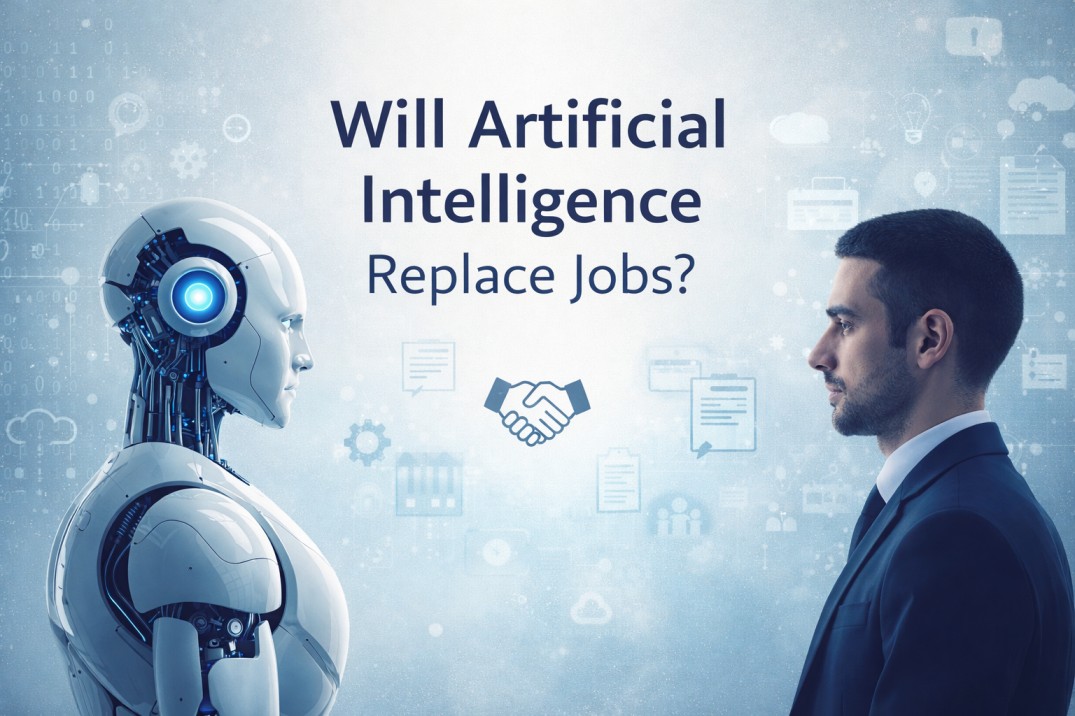
Artificial intelligence has become a regular topic of discussion, and one question keeps coming up repeatedly: will AI replace jobs? News headlines often present extreme views, either claiming that AI will take over most human work or that it will have no real impact at all. The truth is more balanced and far more practical.
This article explains how artificial intelligence is actually affecting jobs today, what it can realistically do, and how work is likely to change in the coming years.
Why People Are Worried About AI and Jobs
Fear around job loss is not new. Every major technological shift has created uncertainty. When computers entered offices, many people feared clerical roles would disappear. When automation entered factories, manufacturing jobs changed significantly.
AI feels more threatening because it appears to perform tasks that involve thinking, such as writing, analyzing data, or making predictions. When people do not fully understand how AI works, this uncertainty often turns into fear.
What Artificial Intelligence Is Good At
AI systems perform best when tasks are clearly defined and data-driven. They are especially effective at handling repetitive work and identifying patterns that humans may take longer to notice.
Examples include processing large datasets, classifying information, automating routine tasks, and making predictions based on historical data. In these areas, AI can improve speed and efficiency.
What Artificial Intelligence Cannot Replace
Despite rapid advancements, AI has clear limitations. It does not understand emotions in the human sense, cannot make ethical decisions independently, and struggles in unpredictable or highly creative situations.
Jobs that depend on empathy, leadership, judgment, and human responsibility are difficult to automate completely. In most real-world scenarios, AI works best when supporting humans rather than replacing them.
How Jobs Are Actually Changing
In practice, AI is not replacing entire jobs. Instead, it is changing how work is done. Many roles are being reshaped so that repetitive tasks are handled by software while humans focus on decision-making, communication, and problem-solving.
This shift often increases productivity and allows people to spend more time on meaningful aspects of their work. In many industries, AI acts as an assistant rather than a replacement.
Jobs Most Likely to Be Affected by AI
AI has the biggest impact on roles that involve structured, repetitive tasks. Jobs that rely heavily on routine data processing or predictable workflows are more likely to change.
However, even in these areas, AI usually augments human work instead of eliminating it entirely. Human oversight remains essential.
New Opportunities Created by AI
As some tasks become automated, new roles continue to emerge. These include managing AI systems, interpreting AI-generated insights, ensuring ethical use of technology, and applying AI tools within specific industries.
History shows that technology often removes certain tasks while creating entirely new kinds of work.
How Individuals Can Prepare for an AI-Driven Future
Rather than fearing AI, individuals can focus on developing skills that remain valuable across industries. Critical thinking, communication, creativity, adaptability, and domain knowledge will continue to matter.
Learning how to work alongside AI tools is becoming an important part of modern professional life.
Final Thoughts
Artificial intelligence is not replacing humans. It is reshaping how work is organized and performed. Understanding this shift helps reduce fear and encourages thoughtful preparation.
The future of work is not about humans versus machines, but about how humans and technology can work together more effectively.


Leave a Reply