
AI automation case studies is becoming one of the fastest growing opportunities in the AI economy. Many entrepreneurs are exploring AI automation case studies to build scalable online income streams.
Table of Contents
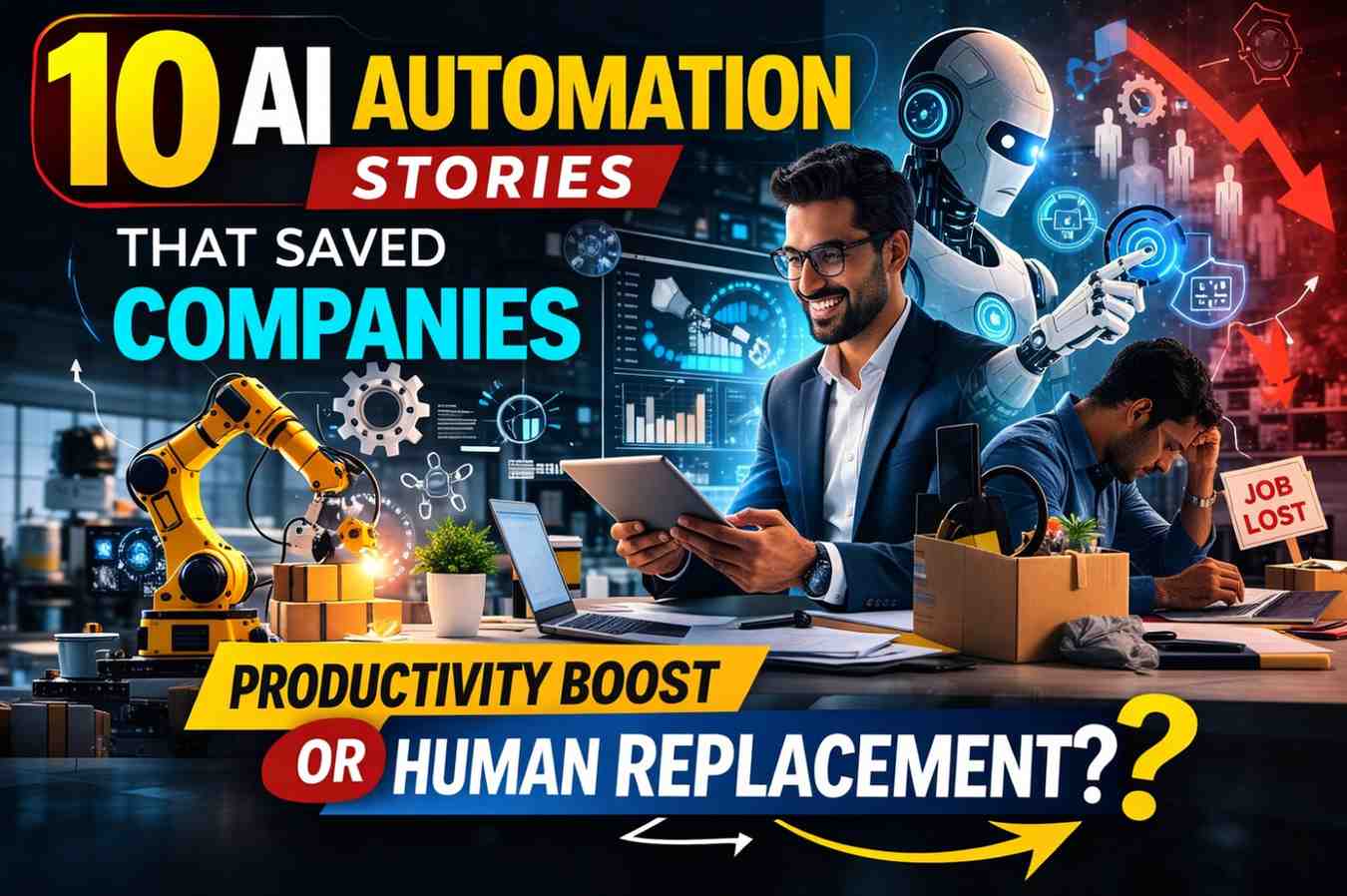
10 AI Automation Stories That Saved Companies — Productivity Boost or Human Replacement?
In today’s fast-paced business world, companies are continuously looking for ways to improve efficiency and reduce costs. One solution that has gained traction is AI automation. Our focus on AI automation case studies reveals how various organizations have successfully integrated this technology to streamline operations and enhance productivity. However, this wave of innovation also raises questions about the impact of automation on human jobs. In this article, we will explore ten compelling AI automation case studies that illustrate both the benefits of business automation AI and concerns regarding human replacement.
Understanding AI Automation
AI automation refers to the use of artificial intelligence technologies to automate tasks that typically require human intelligence. This includes processes such as data analysis, customer service, logistics management, and even decision-making. When executed effectively, business automation AI can significantly enhance productivity, accuracy, and speed. However, it also poses challenges, particularly related to workforce displacement.
1. IBM Watson in Healthcare: Revolutionizing Patient Care
One of the most notable AI automation case studies is IBM Watson’s integration in the healthcare industry. By using natural language processing, Watson can analyze vast datasets and provide insights to healthcare professionals. This system has been instrumental in diagnosing diseases more accurately and recommending personalized treatment options.
Productivity Boost: Hospitals utilizing Watson have reported a 30% improvement in diagnostic accuracy, which allows doctors to focus more on patient care rather than extensive research.
Human Replacement Perspective: While AI aids in diagnosis, it has sparked concerns over the potential reduction of medical professionals in certain roles. The challenge lies in finding a balance where AI enhances human capability rather than replacing it.
2. Automation Anywhere: Streamlining Business Processes
Automation Anywhere focuses on robotic process automation (RPA) to automate repetitive tasks in various industries. Companies leveraging this platform have seen significant improvements in productivity by allowing AI to handle mundane tasks.
Productivity Boost: Companies using Automation Anywhere reported up to 90% faster task completion times. Employees are freed to focus on higher-value activities that require creativity and critical thinking.
Human Replacement Perspective: Despite these enhancements, many employees expressed fears about job security, believing that their roles could be completely superseded by automation.
3. Starbucks and AI for Customer Personalization
Starbucks employs AI-driven analytics to enhance the customer experience. By analyzing purchase data, the company personalizes marketing messages and recommendations for individual customers.
Productivity Boost: This personalization has led to a significant increase in customer satisfaction and repeat purchases, effectively boosting overall sales by approximately 20% in the targeted demographics.
Human Replacement Perspective: While AI improves marketing efficiency, the human touch in customer service remains invaluable. Starbucks has opted to enhance, not replace, their baristas, demonstrating a combined approach of AI and human interaction.
4. Amazon: Inventory Management and Supply Chain Efficiency
Amazon’s use of AI in inventory management is among the best-known AI productivity stories. The company employs sophisticated algorithms to predict demand and optimize supply chain operations.
Productivity Boost: This has resulted in a 25% reduction in storage costs and improved order fulfillment speed.
Human Replacement Perspective: The surge in automation has raised concerns regarding job loss within warehouses. However, Amazon has emphasized the creation of new jobs in tech and management as a counterbalance.
5. Sephora: AI Chatbots Enhancing Customer Experience
Sephora has embraced AI chatbots to assist customers with their shopping decisions. This technology provides personalized product recommendations based on user input and browsing history.
Productivity Boost: By implementing AI chatbots, Sephora has increased online sales by over 10%, as customers receive immediate assistance and personalized service.
Human Replacement Perspective: While chatbots can handle basic inquiries, Sephora has maintained human beauty consultants to provide in-depth advice, showcasing a collaborative strategy between AI and human agents.
6. H&M: Trend Prediction Through AI Analytics
Fashion retailer H&M employs AI to analyze market trends and predict customer preferences. Using AI, they can optimize inventory and improve design decisions, ensuring they stay ahead in the fashion game.
Productivity Boost: This approach has reduced unsold stock by 15% and improved design cycles, meaning that H&M is responding to market demands more swiftly than ever.
Human Replacement Perspective: While AI analytics assists in decision-making, creative roles within fashion design remain untouched, highlighting the importance of human creativity in the industry.
7. ChatGPT and Virtual Assistants in Business Communication
Virtual assistants powered by AI, such as ChatGPT, have revolutionized internal and external communication for businesses. Companies use these tools to streamline communication, manage scheduling, and provide customer support.
Productivity Boost: Organizations using AI assistants report up to 40% time savings in communication-related tasks.
Human Replacement Perspective: The rise of virtual assistants does spark concerns about the future of administrative roles. However, these assistants often serve to augment human workers rather than completely replace them, contributing to a more efficient workflow.
8. Zomato: AI in Food Delivery and Customer Feedback
Zomato uses AI to recommend restaurants based on individual preferences, analyze customer reviews, and optimize food delivery routes. This application of AI has transformed their service model.
Productivity Boost: The result has been a reduction in delivery times by up to 30%, significantly enhancing customer satisfaction.
Human Replacement Perspective: While AI optimizes logistics, Zomato focuses on maintaining a diverse workforce in customer service and delivery, balancing automation with human input.
9. Salesforce: AI-Driven Insights for Sales Teams
Salesforce leverages AI through its Einstein platform to provide sales representatives with meaningful insights from customer data. This empowers sales teams to make informed decisions rapidly.
Productivity Boost: Companies using Salesforce have seen a 25% increase in sales productivity, as AI assists in identifying leads and predicting customer behavior.
Human Replacement Perspective: While AI may reduce the need for repetitive data entry, the insights generated enhance the strategic abilities of sales teams rather than outright replacing them.
10. Boeing: AI in Aircraft Manufacturing
Boeing employs AI for predictive maintenance and quality control in their manufacturing processes. By analyzing patterns and anomalies in production data, they can enhance quality assurance and minimize defects.
Productivity Boost: This integration of AI has led to a 20% reduction in manufacturing errors, enhancing overall productivity.
Human Replacement Perspective: Although AI manages quality control, the complexity of aircraft manufacturing ensures that skilled human workers remain essential to the process, further emphasizing collaboration over replacement.
The Future of AI Automation: Collaboration Over Replacement
As illustrated by these ten compelling AI automation case studies, the introduction of AI and automation into businesses significantly boosts productivity. However, the specter of human job loss looms large over this transformative technology. The challenge for organizations lies in leveraging AI to enhance human back-end processes rather than completely replace them.
The balanced approach observed in many companies emphasizes the partnership of AI and human capabilities, fostering creativity, empathy, and the nuanced judgment only humans can provide. As businesses continue to evolve, ongoing discussions and strategies will be essential to navigate the landscape of automation, ensuring that AI becomes a tool for empowerment rather than displacement.
AI automation case studies are becoming powerful examples of how companies improve efficiency, reduce costs, and increase productivity. Many AI automation case studies show that businesses using business automation AI can automate repetitive tasks like data entry, customer support, marketing campaigns, and reporting.
Through AI automation case studies, organizations demonstrate how AI productivity stories highlight real transformations where teams save hours of manual work and focus on strategy and innovation. These AI automation case studies clearly prove that business automation AI helps companies scale operations faster while improving accuracy and reducing human error. As more AI automation case studies emerge, businesses are discovering that AI productivity stories are not just theoretical ideas but real-world results that improve performance across industries.
Many successful AI automation case studies reveal how companies integrated business automation AI into daily workflows to boost operational speed and productivity. These AI automation case studies often highlight AI productivity stories where businesses automated email marketing, lead generation, inventory tracking, and customer support systems.
With business automation AI, organizations can analyze large amounts of data quickly and make smarter decisions. Several AI automation case studies also demonstrate how AI productivity stories show dramatic improvements in workflow efficiency, saving both time and resources. As technology evolves, more AI automation case studies continue to appear, proving that business automation AI is becoming essential for modern companies. These AI productivity stories inspire other businesses to adopt automation and unlock new levels of growth and innovation.
Conclusion
Overall, these AI productivity stories demonstrate the significant benefits that AI automation can bring to organizations. However, it is crucial for companies to consider the potential societal implications of their automation strategies and to prioritize a collaborative approach that maximizes both technology and human talent. As we look to the future, the integration of AI into the workforce presents an opportunity to revolutionize industries while enhancing the value of human contributions.
Related Articles
- AI marketing tricks
- AI Summit 2026
- AI Summit 2026
- AI Summit 2026
- artificial intelligence today
- artificial intelligence ai
- ai replacing humans
- ai future of work
- AI tools for government exam preparation
- best AI tools for government exam study
- AI tools for government exam success
- AI tools for easy government exam study
- Grok and Claude AI web scraping
- Grok AI automation
- Grok AI business automation
- Grok AI automation workflows
- AI automation systems
- how AI automation works
- AI automation vs traditional automation
- AI agents explained


Leave a Reply