
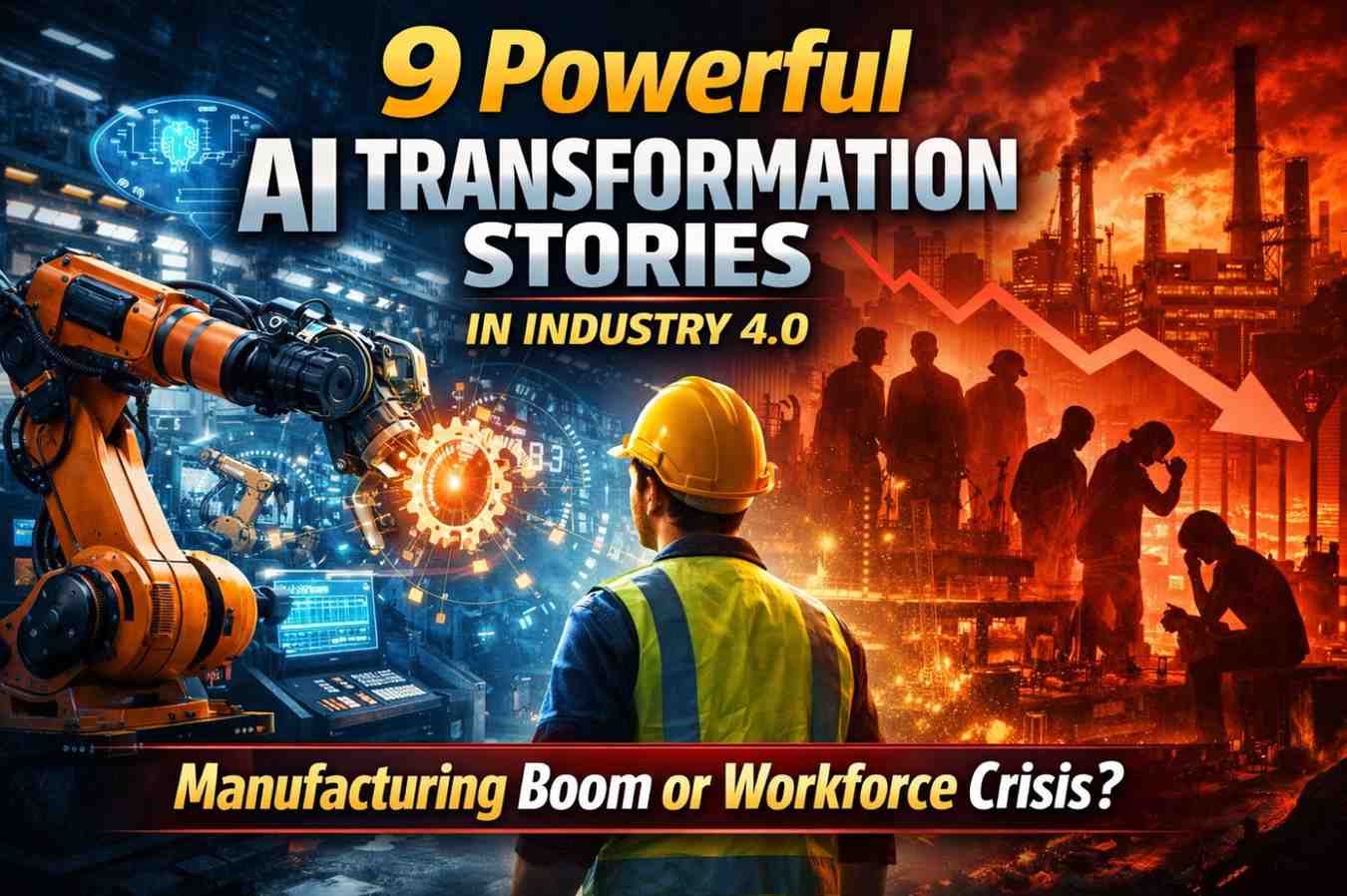
9 Powerful AI Transformation Stories in Industry 4.0 — Manufacturing Boom or Workforce Crisis?
The advent of AI in Industry 4.0 is reshaping the manufacturing landscape, promising unprecedented advancements in efficiency and productivity. As more businesses adopt AI, questions arise around whether this transformation leads to a manufacturing boom or triggers a workforce crisis. This article will explore nine powerful AI transformation stories that exemplify the impact of AI on manufacturing, delving into both the opportunities and challenges presented by AI manufacturing automation and robotics in Industry 4.0.
Table of Contents
1. General Electric: Predictive Maintenance Revolution
General Electric (GE) is at the forefront of integrating AI in Industry 4.0 with its Predix platform, designed for the Industrial Internet. By utilizing AI manufacturing automation, GE has transformed its maintenance strategies. Predictive maintenance powered by AI algorithms helps anticipate equipment failures before they happen. This proactive approach not only reduces downtime but significantly cuts maintenance costs. For GE, these advanced practices have resulted in millions saved and an increase in production efficiency.
Impact on Workforce
The implementation of AI for predictive maintenance does not necessarily eliminate jobs but instead shifts the skill requirements of the workforce. Employees are now encouraged to upskill themselves to work alongside AI technologies, focusing on data analysis and machine learning rather than traditional maintenance tasks.
2. Tesla: Smart Manufacturing at Scale
Tesla exemplifies the synergy between AI and advanced manufacturing techniques. The company utilizes AI in Industry 4.0 to enhance their assembly lines through the integration of robotics. Automated robots work hand in hand with human workers, accelerating the production process of electric vehicles. Tesla’s use of AI allows for real-time monitoring and adjustments, leading to improved quality control and faster production times.
The Dual Role of Robots
In this robotics industry 4.0 environment, the dual role of robots is critical; they not only take on repetitive tasks but also provide support to human workers. This partnership innovation facilitates higher output while alleviating workers from monotonous activities.
3. Siemens: Data-Driven Manufacturing
Siemens is another industry leader that has embraced AI in Industry 4.0. Their MindSphere IoT platform enables facilities to harness vast amounts of data generated by machines. AI algorithms analyze this data to derive actionable insights, leading to optimized manufacturing processes. The application of AI manufacturing automation in Siemens’ operations has resulted in enhanced productivity and reduced waste, which is crucial in an environmentally conscious market.
Reskilling Initiatives
Siemens recognizes the potential disruption to the workforce and has implemented reskilling programs to help employees transition into data-centric roles. By doing so, they are investing in human capital alongside technological advancements.
4. Amazon: Supply Chain Optimization
Amazon’s use of AI in Industry 4.0 extends beyond its online retail space into its powerful logistics and fulfillment systems. With AI-powered predictive analytics, Amazon efficiently manages its inventory and optimizes delivery routes. AI manufacturing automation has streamlined operations, ensuring that goods are delivered faster to customers while maintaining high service quality.
Workforce Strategy
While some fear that automation could lead to job losses, Amazon has created new job opportunities within its tech and logistics divisions. The challenge remains for existing employees to adapt to a more automated environment, necessitating ongoing training and development.
5. Bosch: Enhancing Efficiency with AI
Bosch is leveraging AI in Industry 4.0 to optimize manufacturing processes. Through their AIoT (Artificial Intelligence of Things) platform, Bosch integrates AI algorithms to improve decision-making in production lines. By enhancing operational efficiency, Bosch experiences notable savings in costs and resources.
AI and Human Collaboration
In the Bosch factories, human workers collaborate with AI systems, receiving real-time feedback that enhances their productivity. This collaborative approach promotes a ‘human-in-the-loop’ model where AI supports the workforce rather than replacing them.
6. Ford: Embracing Change with Smart Factories
Ford’s commitment to AI in Industry 4.0 involves the establishment of smart factories that utilize AI manufacturing automation to transform the design and production of vehicles. In one of their facilities, AI is used for quality control, where computer vision and deep learning algorithms identify defects in real time.
Opportunities for Workers
As Ford embraces digitization, training programs for their workers ensure that they are well-versed in operating AI technologies. By fostering a culture of learning, Ford successfully mitigates fears around job displacement.
7. Honeywell: Automation in the Sky
Honeywell has significantly advanced its AI in Industry 4.0 applications through the development of autonomous aircraft. Their AI systems enhance manufacturing efficiency while ensuring safety in aviation—a sector where precision and reliability are paramount. Implementing AI manufacturing automation has streamlined fabrication processes, resulting in quicker turnaround times for aircraft parts.
Rethinking Workforce Roles
The introduction of advanced AI-driven systems has required Honeywell to rethink workforce roles. Emphasizing data analytics and IT skills has become crucial as the aviation industry evolves with AI.
8. ABB: Collaborative Robotics
ABB is a leader in robotics industry 4.0, developing collaborative robots (cobots) designed to work beside humans safely. These robots utilize AI to optimize production without replacing workers. The co-working environment allows for increased efficiency and reduced injury risks, showcasing how AI in Industry 4.0 can create safer workplaces.
Investing in People
ABB invests heavily in workforce development, focusing on training employees to work alongside robots. By facilitating this transition, ABB fosters an environment that upskills rather than downsizes.
9. Boeing: Engineering Excellence through AI
Boeing applies AI in Industry 4.0 to streamline aircraft design and manufacturing processes. By employing machine learning algorithms, Boeing enhances predictive analytics for maintenance and fuel efficiency in aircraft. AI-driven simulations allow for optimized engineering, giving Boeing a competitive edge in a challenging market.
Workforce Training Programs
Recognizing the potential shift in workforce demands, Boeing invests significantly in training its personnel, ensuring engineers and technicians are equipped with the necessary skills to adapt to this technologically advanced environment.
Conclusion: Balancing Innovation with Workforce Needs
The stories of these nine companies vividly illustrate the transformative potential of AI in Industry 4.0. While AI manufacturing automation and robotics industry 4.0 have opened doors to unparalleled efficiencies, they also pose significant challenges regarding workforce displacement and the need for upskilling.
Ultimately, the path forward lies in collaboration between technology and human talent. Companies must prioritize investment in their workforce, ensuring that workers are not merely left behind but are integral to the digital transformation. The real challenge for businesses will be to strike a balance that enhances productivity while addressing workforce concerns, leading to a sustainable manufacturing boom in the age of AI.
“`
Related Articles
- AI marketing tricks
- AI Summit 2026
- AI Summit 2026
- AI Summit 2026
- artificial intelligence today
- artificial intelligence ai
- ai replacing humans
- ai future of work
- AI tools for government exam preparation
- best AI tools for government exam study
- AI tools for government exam success
- AI tools for easy government exam study
- Grok and Claude AI web scraping
- Grok AI automation
- Grok AI business automation
- Grok AI automation workflows
- AI automation systems
- how AI automation works
- AI automation vs traditional automation
- AI agents explained


Leave a Reply