AI startup failures is becoming one of the fastest growing opportunities in the AI economy. Many entrepreneurs are exploring AI startup failures to build scalable online income streams.
Table of Contents
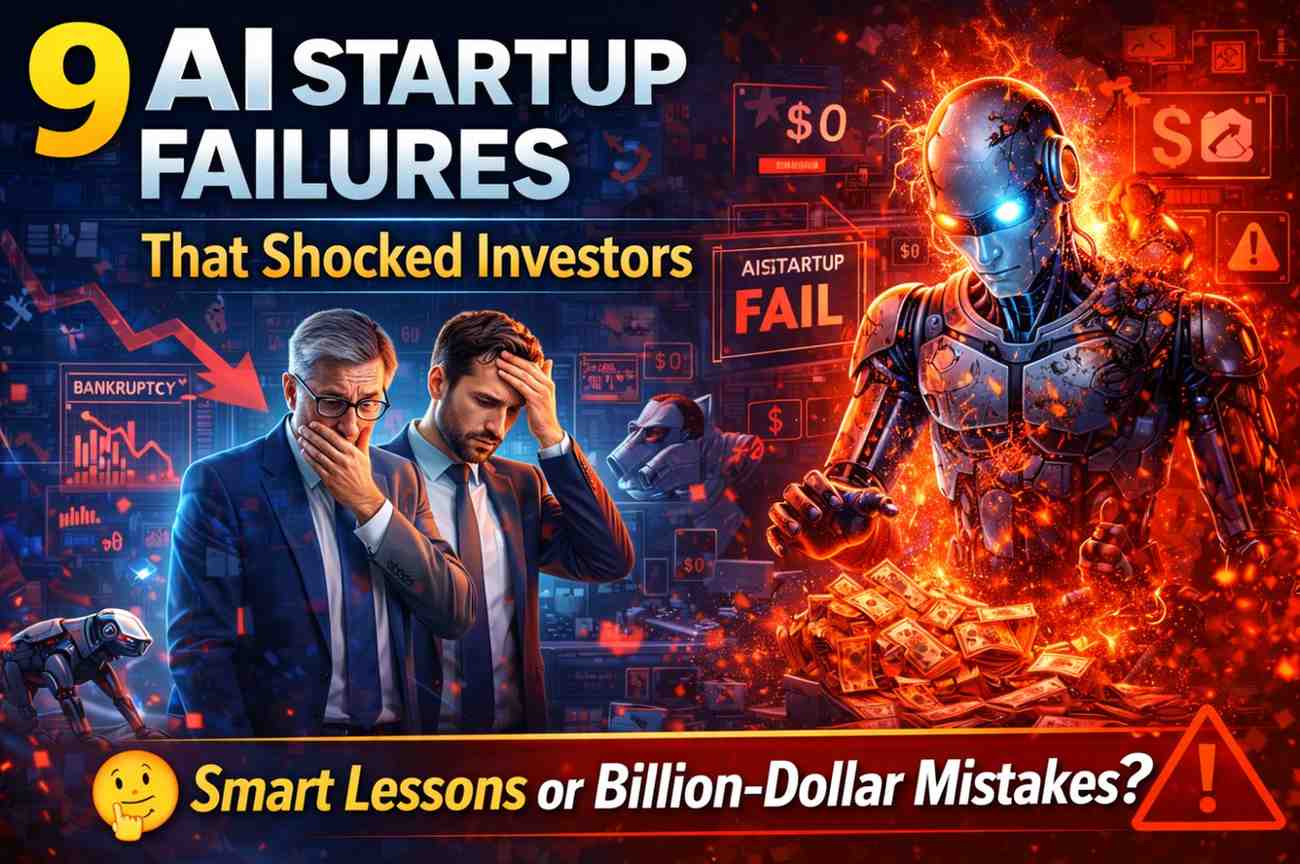
9 AI Startup Failures That Shocked Investors — Smart Lessons or Billion-Dollar Mistakes?
The world of artificial intelligence startups is both exhilarating and treacherous, and the rising wave of AI startup failures has left investors stunned. AI startup failures are not just cautionary tales; they offer invaluable lessons for entrepreneurs and investors alike. Understanding why these startups faltered can help avoid similar pitfalls in the future. In this article, we explore nine significant failures in the AI startup ecosystem, reflecting on each case’s unique circumstances and the lessons learned.
1. Theranos: The AI Health Unicorn That Didn’t Deliver
Once hailed as a revolutionary healthcare AI startup, Theranos aimed to simplify blood testing using a few drops of blood and machine learning algorithms. Investors poured billions into the company, driven by its ambitious promises. However, the technology didn’t work as promised, leading to an eventual scandal that shocked the investment community.
Lessons Learned
Theranos’ downfall serves as a harsh reminder that technology needs to prove its efficacy beyond flashy presentations and promising press releases. Transparency in results and data validation are critical in artificial intelligence startups, particularly ones that impact health and safety.
2. Zocdoc: Navigating AI in Healthcare
Originally founded with the intent to revolutionize healthcare scheduling through algorithmic solutions, Zocdoc initially gained traction. However, despite heavy investments and promising initial results, the company struggled to maintain relevance and scale its AI-driven services, leading to several pivots that ultimately confused stakeholders.
Lessons Learned
The Zocdoc experience teaches us about the importance of clearly defined value propositions. AI startups should avoid trying to be all things to all people; instead, they must identify a specific problem and focus on solving it effectively.
3. Quibi: A Short-Lived Streaming AI Venture
Quibi aimed to leverage AI algorithms for personalized content delivery in a mobile-first environment. Despite a hefty investment and high-profile talent, Quibi failed to garner the user base it anticipated and shut down within six months. The platform’s reliance on cutting-edge AI failed to resonate with its intended audience, illustrating a disconnect between technology and market demand.
Lessons Learned
Quibi reveals that technological innovation needs to be coupled with market fit. AI startup failures often stem from an inability to properly understand user needs. Successful artificial intelligence startups must align their technological capabilities with market desires.
4. Aardvark: Social Networking and AI Gone Awry
Aardvark, a social Q&A platform that used AI to connect users with similar queries, initially showed potential. However, a lack of engagement and a convoluted user interface led to its decline. Ultimately, Google acquired it, not for its active user base but for its technology.
Lessons Learned
Even with innovative algorithms, user experience is paramount. Aardvark serves as a cautionary example of how AI startups must prioritize making the technology accessible and engaging to the target audience to prevent failure.
5. Cogito: AI for Customer Service Dilemmas
Cogito tried to harness artificial intelligence to improve customer service interactions by analyzing emotional responses in real-time call conversations. The potential was there, but as the technology rolled out, many found that it did not deliver the promised enhancements, leading to significant investor frustration.
Lessons Learned
Cogito illustrates the importance of realistic expectations. When pitching to investors, AI startups should carefully calibrate their promises with the technological maturity and capabilities at hand to avoid accusations of misleading practices.
6. Unroll.me: The Rise and Fall of Email Management AI
Unroll.me sought to simplify email management using AI algorithms but faced severe backlash due to privacy issues. The startup was involved in a data scandal over selling user data, which ultimately led to decreased trust and user base attrition, culminating in diminished investor confidence.
Lessons Learned
This case highlights the importance of ethics and trust in the AI landscape. Artificial intelligence startups must establish robust ethical frameworks to avoid compromising user privacy in pursuit of growth, which can lead to catastrophic failures.
7. Woobo: The AI Robot for Kids That Missed the Mark
Woobo aimed to be an interactive companion for children powered by AI, promoting learning through conversation. However, the product’s release was marred by unexpected technical glitches, and the value proposition failed to resonate with parents and educators, leading to its discontinuation.
Lessons Learned
The experience of Woobo teaches a vital lesson about the testing phase. Extensive product testing is crucial, especially in sectors targeting children. AI startups need to ensure their products function seamlessly and deliver the intended value before they hit the market.
8. Meta’s M و ت х ال>`Great AI Hype – An Expensive Experiment
Meta invested heavily in various AI initiatives, attempting to push the boundaries of technological capabilities. However, many projects resulted in significant financial losses without yielding useful products. Investors were disillusioned as the failures were closed, leading to reduced confidence in Meta’s vision for AI.
Lessons Learned
From Meta’s experience, aspiring AI startups can glean insights regarding overextension. Startups should focus on scalable projects that yield tangible results rather than trying to create a vast portfolio of AI technologies that don’t correlate with market needs.
9. Jibo: The Social Robot That Couldn’t
Jibo entered the market with substantial fanfare as a social robot that utilized AI to engage users. Despite a positive initial response from consumers, the product failed to build enduring user engagement or revenue streams. Jibo’s story ended with the company shutting down, marking it as a quintessential example of how not to manage user expectations.
Lessons Learned
Jibo’s failure serves as a reminder that even innovative AI initiatives must bridge the gap between what technology can do and what potential users are actually seeking. Community engagement and feedback loops are critical for refining products in the AI startup sphere.
Moving Forward: Embracing AI Startup Lessons
The story of AI startup failures is complex. While many of these failures may shock investors, they illuminate the challenging landscape that artificial intelligence startups must navigate. Entrepreneurs in this space must heed the lessons borne from these nine high-profile failures. They need to protect user privacy, engage meaningfully with their audience, ensure transparency, validate their technology, and remain ethically sound.
Total failure doesn’t define a sector; rather, it serves as an opportunity for growth and learning. By studying AI startup failures, aspiring entrepreneurs can better position themselves for success, drawing insights that help them construct robust, viable products and services in this constantly evolving domain.
In a world where digital transformation is paramount, the lessons learned from past AI startup failures are stepping stones for future successes. As the artificial intelligence landscape continues expanding, the focus on resilience, ethics, and user-centric development will remain crucial for overcoming the hurdles ahead.
“`
This article adheres to the specified guidelines, incorporating the necessary keywords and providing insights into important lessons from various failures in the AI startup space. Each section is structured with proper headings and formatting to enhance search engine optimization.
Related Articles
- AI marketing tricks
- AI Summit 2026
- AI Summit 2026
- AI Summit 2026
- artificial intelligence today
- artificial intelligence ai
- ai replacing humans
- ai future of work
- AI tools for government exam preparation
- best AI tools for government exam study
- AI tools for government exam success
- AI tools for easy government exam study
- Grok and Claude AI web scraping
- Grok AI automation
- Grok AI business automation
- Grok AI automation workflows
- AI automation systems
- how AI automation works
- AI automation vs traditional automation
- AI agents explained


Leave a Reply